Every AI decision and extraction model, in one place.
System One models return typed answers with probabilities instead of text. Decision models like Jev pick from options you list. Extraction models like Clairic pull out amounts, dates and forecasts.
Clairic is Cloudflare's first extraction model, in preview on Workers AI. It reads text and up to four images and returns typed values (spans, numbers, dates, durations, lists, estimates and forecasts) with probabilities, in one pass and with no output tokens. It costs $0.10 per million input tokens. Cloudflare launched it on 19 October 2026.
d1-ultra is Liquid AI's larger hosted decision model, released on 15 October 2026. It answers typed Choice, Score and Noul questions about text and images with probabilities and writes no prose. It costs $0.042 per million input tokens and leads the decision models on the Artificial Analysis Decision Index at 65.2.
GLiDE is Fastino's decision model. Version 1.2, released on 22 October 2026, answers typed Noul, Choice and Score questions about text, JSON or images in one forward pass and returns a probability for every option, at $0.04 per million input tokens. Its weights, post-trained from Qwen3.8-27B, are on Hugging Face under Fastino's own licence, which limits production use by large companies.
pplx-decider is Perplexity's multimodal System One model, in two sizes: pplx-decider-v1.2 at 27B and pplx-decider-flash-v1.2 at 4B. Both answer typed Choice, Score and Noul questions about text or images with probabilities, through the Decisions API at $0.02 and $0.01 per million input tokens. The weights are on Hugging Face under Apache 2.0.
Drex is Nace.AI's family of decision models. Drex Max, the most accurate, reads text and images. Drex 2.0, the default, is a 35B mixture of experts with open weights. Both answer typed Choice, Score and Noul questions with a probability for every option through Nace's own /v1/systemone API at $0.06 per million input tokens. Drex 1.5, a 9B model, stays on sale at $0.05.
elephant-1 is a 9B decision model from Base Labs, Baseten's research team, post-trained from Qwen3.5-9B. It answers typed Choice, Score and Noul questions about text and images with a probability for every option, runs on Baseten's Model APIs and OpenRouter, and has MIT weights on Hugging Face.
Browser Use's fast browser agent where Jev picks the operation and the DOM element in a single request; a small LLM is only invoked to write text when typing is required. Demoed on a Google Flights search.
Attempt to run a Jev-style System One decision model locally on a single RTX 3090. Companion site at openjev.com. The repository was renamed to TheoLeeCJ/SemIf on GitHub, and the old openjev URL now redirects to it.
Official agent skill for Claude Code, Codex and other agent environments; installs via claude plugin marketplace add typesafe-ai/skills or npx skills add typesafe-ai/skills. MIT licensed.
Open reimplementation that trains a small model to choose among a changing list of text options, emitting one probability per option in a single forward pass. Ships Doom, chess and Wikispeedia demos.
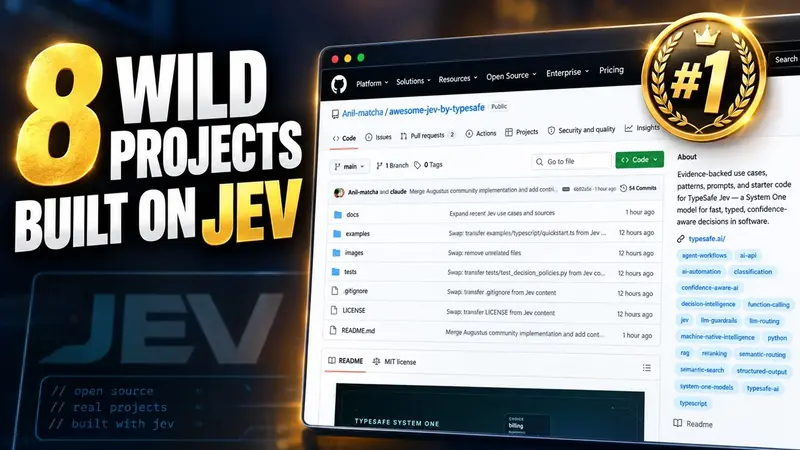
Independent community collection of use cases, patterns, prompts and starter code for Jev, explicitly not official. It also links sibling collections by the same author and two related projects that report their own cost figures.
MCP server that gives Claude Code, Codex, Amp, OpenCode and other agents ten Jev judgment tools, each returning typed probabilities they can branch on. The author calls it early software.
A System One (System 1) model returns typed, calibrated answers instead of text. Two classes now exist: decision models like Jev and extraction models like Clairic.
Jev is TypeSafe AI's decision model. It answers typed questions about text with calibrated probabilities, and it is not an LLM, because it writes nothing.
An extraction model reads input and returns typed values, such as spans, numbers, dates and forecasts, with probabilities. How it differs from decision models and LLMs.
An LLM cites a document for a claim. This recipe checks the citation in two steps: a plain string match that catches quotes missing from the source, then one noul question that returns the probability the quoted section actually supports the claim. Your code turns that probability into a verdict.
A single Choice question sorts an inbound support ticket into one of four queues and returns a probability for every option. The model supplies the label and the certainty; your router applies the thresholds, holds the doubtful tickets for a human, and keeps every side effect in your code rather than in the prompt.
A support ticket needs a category, a severity, and two yes/no facts that only matter for one category each. Asking in sequence costs four round trips and four copies of the ticket. This recipe sends all four questions in one call, including the speculative ones, and lets the routing code ignore what it does not need.
One Choice names the action the user is asking for and one Noul says whether the message confirms it. Two numbers come back, and a table of per-action thresholds in your code decides the rest: a read runs at moderate confidence, a refund needs more, and anything below the floor goes to a person.