Specifications side by side
Read from each model's page, so a change there updates this table. A blank field is dated to the day that model's page was last checked.
| Specification | Jev | Laya |
|---|---|---|
| Vendor | TypeSafe AI | Convai Innovations |
| Status | Generally available | Generally available |
| Access | Hosted API | Open weights, self-hosted |
| Question types | Choice, Score, Noul | Choice, Score, Noul |
| Input price | $0.042 per 1M tokens | No hosted API |
| Output price | Free | No hosted API |
| Total context | 64,000 tokens | 512 tokens |
| State budget | 32,000 tokens | 320 tokens |
| Latency | 70 to 500 ms1 | 32.8 to 39.5 ms2 |
| Max Choice options | 255 | Not published as of 12 Oct 2026 |
| Score levels | Up to 10 | Not published as of 12 Oct 2026 |
| Rate limit | 100,000 tokens/sec and 40 requests/sec as of 2026-09-30, adjusting dynamically | None. It runs on your own hardware. |
| SDKs | Python, TypeScript | Python |
| Licence | Not published as of 15 Oct 2026 | Apache-2.0 |
| Jev Decision Index, Full score | 60.11 scorev0.3.1, 10 Oct 2026 | 4.43 scorev0.3.1, 10 Oct 2026 |
| Jev Decision Index, Public score | 57.96 scorev0.3.1, 10 Oct 2026 | 6.19 scorev0.3.1, 10 Oct 2026 |
| Jev Decision Index, Expected calibration error | 0.074 ECEv0.3.1, 10 Oct 2026 | 0.1402 ECEv0.3.1, 10 Oct 2026 |
| JevBench, Capability Score | 77.1 scorev1.7.46, 12 Oct 2026 | 32.5 scorev1.7.46, 12 Oct 2026 |
| Microsoft 36-benchmark comparison, Average accuracy | 82.3 %vendor-run9 Oct 2026 | Not published as of 12 Oct 2026 |
| Microsoft 36-benchmark comparison, Calibration score | 93.7 scorevendor-run9 Oct 2026 | Not published as of 12 Oct 2026 |
| Artificial Analysis Decision Index, Index score | 57.5 scorev1.0, 13 Oct 2026 | Not published as of 12 Oct 2026 |
| Artificial Analysis Decision Index, Expected calibration error | 0.1174 ECEv1.0, 13 Oct 2026 | Not published as of 12 Oct 2026 |
| Artificial Analysis Decision Index, Cost per 1M tasks | 42 USDv1.0, 13 Oct 2026 | Not published as of 12 Oct 2026 |
| Artificial Analysis Decision Index, Time per task | 127 msv1.0, 13 Oct 2026 | Not published as of 12 Oct 2026 |
| Convai README benchmarks, ECE after temperature fitting | Not published as of 15 Oct 2026 | 0.081 ECEvendor-run18 Sep 2026 |
| Docs and console | docs.typesafe.ai, Console | github.com, Console |
- 1 Jev: 70ms to 500ms end-to-end is TypeSafe's own figure from the launch post, as is the 3 to 329 seconds it compares frontier LLMs against and the resulting 40x to 200x multiple.
- 2 Laya: Convai's own measurements on one Tesla T4 GPU for a single question: 32.8ms on laya-multilingual and 39.5ms on the English checkpoint.
Examples in the directory
637 Jev examples
The top 3 by stars and views. All Jev examples.

Jev Ultrafast (Browser Use)
Browser Use's fast browser agent where Jev picks the operation and the DOM element in a single request; a small LLM is only invoked to write text when typing is required. Demoed on a Google Flights search.

19k starsFlight search 7.1 s

openjev
Attempt to run a Jev-style System One decision model locally on a single RTX 3090. Companion site at openjev.com. The repository was renamed to TheoLeeCJ/SemIf on GitHub, and the old openjev URL now redirects to it.
 TheoLeeCJOpenopenjev on github.com
4.1k starsJSON vs direct 5.21x slowerPeak throughput 20.03 dec/s
jev-trader
Makes one AI trade decision every Monad block on the Kuru MON-USDC market using Jev. The public deployment runs in dry-run mode with a mock model.
 jarrodwattsOpenjev-trader on github.com
2.2k starsLoop, mock model p50 100 msDecision window ~300 ms/block
106 Laya examples
The top 3 by stars and views. All Laya examples.

Introducing Clef: our open-source decision models, and new RL fine-tuning platform
Cloudflare's launch post for Clef and Clef-flash, two decision models on Workers AI that accept the Jev request format and open weights under Apache 2.0. It covers the architecture, Cloudflare's own benchmark tables against Jev, Kev and Laya, and a new reinforcement learning service.
 Michelle Chen (@michellechen)140k viewsOpenIntroducing Clef: our open-source decision models, and new RL fine-tuning platform on blog.cloudflare.com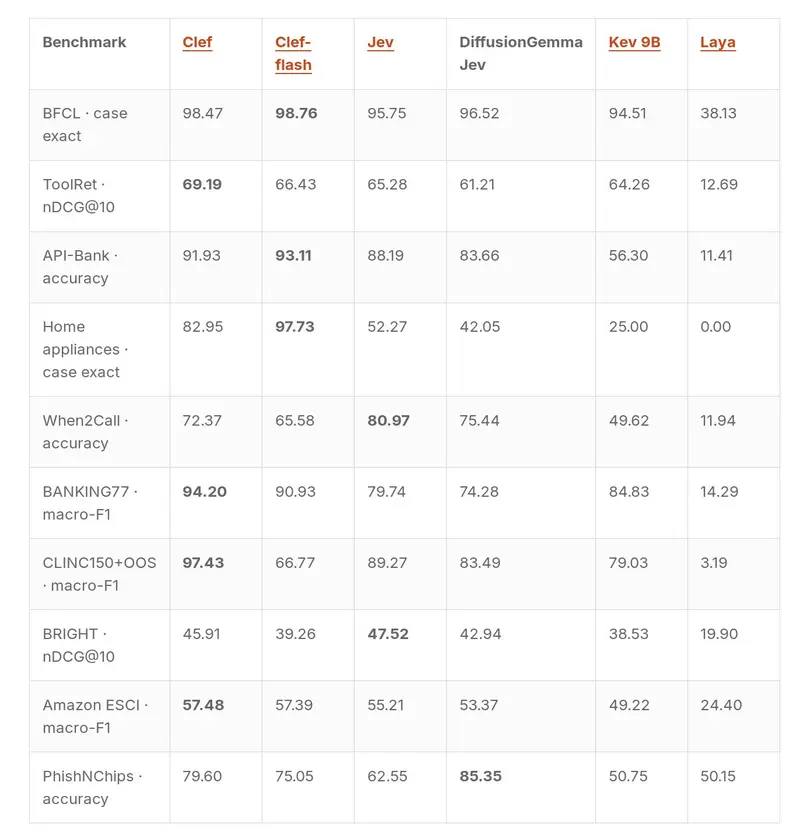
Decision Model Leaderboard
Cloudflare's live leaderboard for decision models on the Jev Decision Index suite, with Clef, Clef-flash, Jev, Kev-9B and Laya plotted by score and latency. Cloudflare built and ran it, so treat the ranking as vendor-run.
 Cloudflare (@ritakozlov)41k viewsOpenDecision Model Leaderboard on clef-evals.workers-ai-mle.workers.dev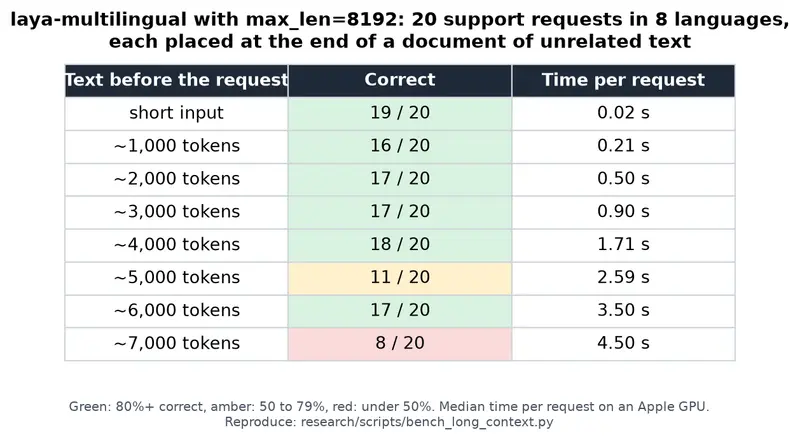
NandhaKishorM/laya
Decision model from Convai Innovations that fully fine-tunes an encoder and adds a typed-decision head: a 421M English checkpoint on ModernBERT-large and a 322M multilingual one on mmBERT-base, with a router picking between them by detected language. Returns choice, score and noul answers, and reports expected calibration error of 0.081 after temperature fitting, down from 0.466 as shipped.

Shared use cases
Patterns both Jev and Laya list on their pages.
Short answer
Jev is a hosted decision model you pay for by the token. Laya is a set of open weights you download and run. Both take a state and typed Choice, Score and Noul questions and return probabilities instead of prose. Zero-shot, on the independent Jev Decision Index 0.3.1 (multimodalart’s community board on Hugging Face), Jev scores 60.11 and Laya 4.43, close to random guessing. Fine-tuned on one task, Laya got within 0.6 points of Jev in a third-party test.
Pick Jev if
- You want good answers without training anything. Jev’s Full score on the Jev Decision Index 0.3.1 is 60.11, third of 117 rows and a shared second under the board’s tie rule. Laya is 108th at 4.43. Convai’s own README calls Laya “a fast base to specialise, not a zero-shot decision engine.”
- Your states are long. A Jev request holds 64,000 tokens, with the state plus the longest question capped at 32,000. Laya’s English checkpoint defaults to 512 tokens, about 320 of them for the state.
- You have dozens of labels. Jev takes up to 255 options per Choice. Laya’s options share one token budget: with Banking77’s 77 labels the README reports 0.425 accuracy, and SOTAAZ measured 37.0%.
- You do not want to run GPUs. Jev is a POST to
/v1/systemonewith Python and TypeScript SDKs, at $0.042 per million input tokens and free output. - You need probabilities you can threshold on day one. TypeSafe says Jev’s are calibrated and the Index measures its calibration error at 0.074. Laya ships at 0.466 by Convai’s own measurement, until you fit a temperature on your data.
Pick Laya if
- Latency has to be local. Convai measures 32.8ms to 39.5ms for one question on a Tesla T4. Two builders timed Laya on Apple laptops at 19ms and 15.3ms medians against roughly 300ms for Jev over the cloud. Jev’s own figure is 70ms to 500ms end to end; OpenRouter measured a 154ms median and JevBench 239ms.
- The data cannot leave your machine. Laya runs on your hardware with no API key and no rate limit. Jev is hosted only. TypeSafe says it does not train on customer requests and offers zero data retention to enterprise customers under a data processing agreement.
- You have labelled examples and a narrow task. Alexander Ollman fine-tuned Laya on 1,001 Banking77 examples and got 79.4% against Jev’s 80.0% on all 3,080 test questions, and it beat Jev on four of five other workflows.
- You want to read the training recipe. Convai publishes it: a strictly proper scoring rule as the reward, REINFORCE with a group-mean baseline. TypeSafe has not published Jev’s.
- Volume makes $0.042 per million tokens add up. Laya’s only cost is the hardware.
What the numbers don’t tell you
The Jev Decision Index measures a job Laya was not built for. Jev is tuned for broad zero-shot use. Laya is a 421M-parameter encoder that Convai tells you to specialise, so a 4.43 on a broad suite says nothing about Laya after fine-tuning, where the only head-to-head figure is Ollman’s. Label count matters as much as the model: on SOTAAZ’s six-label TREC test, base Laya scored 86.6% in 23ms.
The latency figures come from different people on different hardware. Convai’s T4 numbers are the vendor’s own, the laptop medians are two builders’ machines, and Jev’s medians come from OpenRouter and Benchmark Heaven. A local model skips the network, so most of the gap is the round trip. Batch ten questions and Convai’s own T4 figure rises to 72.3ms to 158.6ms. Switching language reloads a checkpoint, which costs 7 to 10 seconds unless you preload.
Laya is three checkpoints, not one model. convaiinnovations/laya is the English model: a fully fine-tuned ModernBERT-large encoder (395M parameters) with a decision head, 421M in all, 512-token context. laya-typed-decisions is the same model fine-tuned on the typed-decisions benchmark’s training split, with a 1,024-token window. laya-multilingual swaps in mmBERT-base, 322M parameters and 1,024 tokens, and the encoder underneath accepts up to 8,192 if you raise max_len. A Router picks between them by script. The English model fails silently on other scripts: on Khmer it scored 0.000 at 0.952 confidence.
Laya is not a Jev clone. Jev’s architecture is not published, which how Jev is built covers. Laya is an encoder with two transformer layers and a per-option scorer on top, trained with Convai’s own version of RLCD, and its author says he built decision models of this kind before TypeSafe launched. Only the question types match.
Calibration is a step on Laya and a claim on Jev. Convai’s 0.466 expected calibration error falls to 0.081 after fitting one temperature per question type on held-out data. TypeSafe says RLCD makes Jev calibrated and publishes no recipe; the Index’s 0.074 is the only outside figure. Convai’s README compares Laya with Jev figures that third parties published, not a same-run test. The same-run tests are the directory entries above.
FAQ
Is it Laya or Layla?
Laya, spelled L-A-Y-A, from Convai Innovations. Searches for Layla, Lara and Leya usually mean the same model, but none of those is its name. The Hugging Face repos are convaiinnovations/laya, laya-typed-decisions and laya-multilingual, the Python package is laya on PyPI, and the code lives at NandhaKishorM/laya on GitHub.
Is Laya faster than Jev?
On a local machine, yes, by the builders’ own numbers: 19ms and 15.3ms medians on Apple laptops against about 300ms for Jev over the cloud, and 32.8ms to 39.5ms on a T4 by Convai’s measurement. Most of that gap is the network round trip. On CPU, Convai gives 193ms to 464ms, which overlaps with Jev’s independent medians of 154ms and 239ms.
Is Laya as accurate as Jev?
Not zero-shot. On the Jev Decision Index 0.3.1, Jev scores 60.11 and Laya 4.43, where 0 is random guessing. Laya does well on small label sets, 86.6% on TREC’s six classes, and badly on large ones, 37.0% on Banking77’s 77. After fine-tuning on 1,001 examples it reached 79.4% on Banking77 against Jev’s 80.0% in Ollman’s test.
Can I run Jev locally instead?
No. TypeSafe has not released Jev’s weights, architecture or training method, so there is no self-hosted build and nothing open reproduces Jev. It runs only through TypeSafe’s API, OpenRouter and Cloudflare Workers AI. If you need a decision model on your own hardware, Laya is one option; Jev alternatives lists the others, including larger open models that score closer to Jev.
Examples
Jev vs fine-tuned Laya
Compares Jev with Laya before and after task-specific fine-tuning across Banking77 and five other public workflows, plus a chat-moderation study. Fine-tuning raised Laya's Banking77 accuracy from 51.3 to 79.4 percent, close to Jev's 80.0 percent.
 Alexander-OllmanOpenJev vs fine-tuned Laya on github.com
Jev Decision Index: Jev against 50+ open decision models
A leaderboard that runs Jev and 54 open System One models and clones through the same 120,000-question suite on one RTX PRO 6000, scoring accuracy and calibration. Jev leads the 0.2 edition at 51.67 on a chance-corrected scale, with AutoJev-27B close behind at 50.94.
 apolinario (poli) (@multimodalart)43k viewsOpenJev Decision Index: Jev against 50+ open decision models on huggingface.co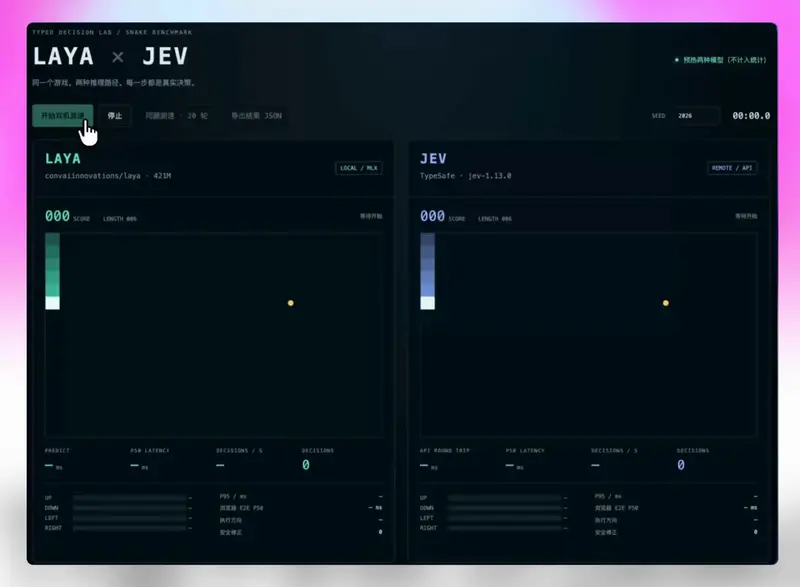
Local Laya vs Cloud Jev on the Same Snake Game
30-second Snake benchmark: a local 421M Laya checkpoint scores 46 at 86.5 decisions per second, while Jev 1.13.0 over the cloud API scores 1 at 3.2 decisions per second.
 Simplifying AI (@simplifyinAI)OpenLocal Laya vs Cloud Jev on the Same Snake Game on x.com
24k viewsLaya speed 86.5/sJev speed 3.2/s
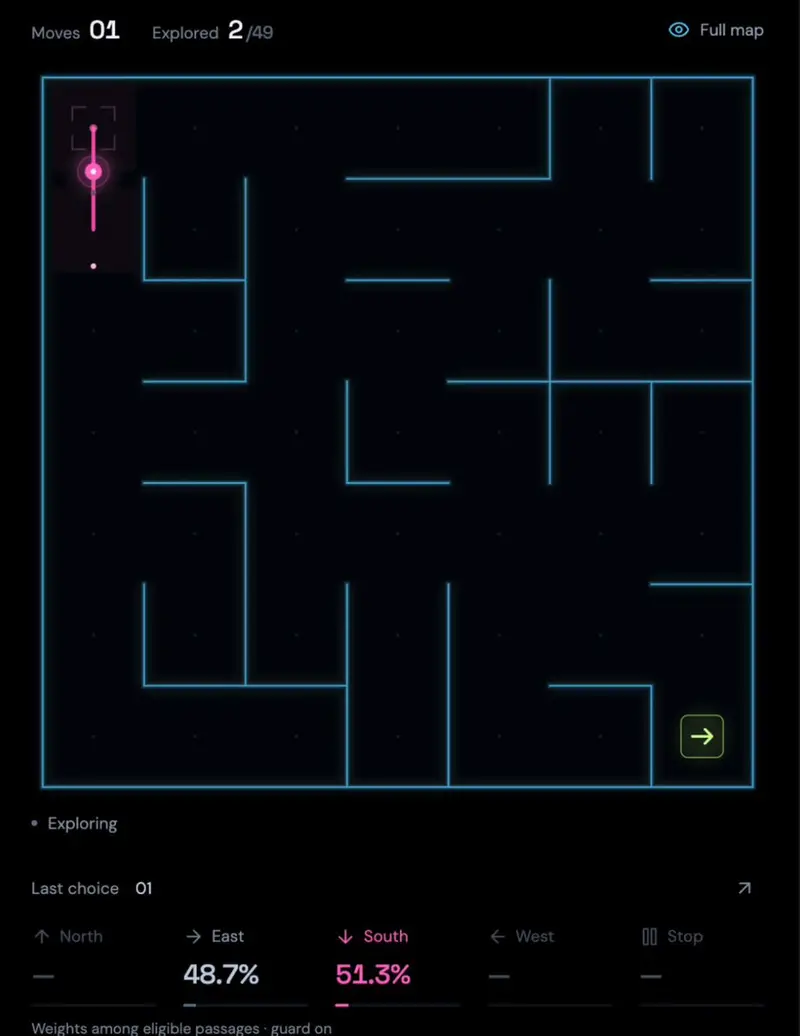
Laya vs Jev Latency Demo
A maze demo comparing decision latency: local Laya on a base M5 responds at a 19ms median, versus roughly 300ms from Jev's cloud API for the same task.

Jev vs Laya on English and Thai support tickets
Tested Jev against a local MLX build of Laya in zero-shot mode on 40 English and Thai support tickets. Jev scored 90 to 100 percent accuracy, Laya scored 30 to 80 percent, though Laya ran faster.

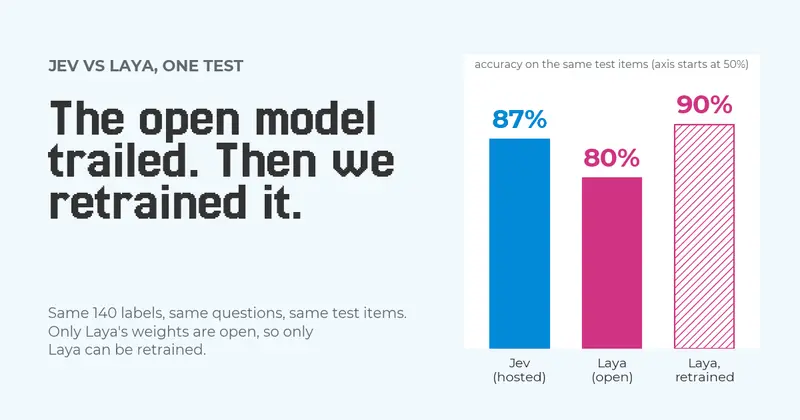
Jev vs Laya: Same Labels, Same Questions, One Variable
An independent benchmark testing Jev against Laya on the same 140 labels, checking whether each engine's own feedback loop finds a hidden labeling factor, and fine-tuning Laya on the same data to compare results.