jkudish/jev-mcp
MCP server that gives Claude Code, Codex, Amp, OpenCode and other agents ten Jev judgment tools, each returning typed probabilities they can branch on. The author calls it early software.

320 starsPer call 150-500 ms
Before a decision model can sit in your code, something has to call it. This hub collects the glue: client libraries, MCP servers, command-line tools, wrappers and framework plug-ins. A client library turns a question into a request and returns a typed answer. An MCP server lets an agent such as Claude Code call the model as a tool. The entries here run on Jev and other decision models. They cover many languages, including Rust with AbdelStark/s1-rs, Swift with ainame/swift-typesafe and PHP with binnash/typesafe-sdk. The Vercel AI SDK has an official provider, and blakestone-x/jev-mcp exposes Jev as classify, score and check tools. Several others are unofficial community builds written by one person. Before you copy one, check which API version it follows, whether it returns the confidence value with each answer, how it handles retries and errors, and when it was last updated. Each entry names its language and what it wraps, so you can narrow to the stack you already use.
132 entries
Showing 1 to 48 of 132
MCP server that gives Claude Code, Codex, Amp, OpenCode and other agents ten Jev judgment tools, each returning typed probabilities they can branch on. The author calls it early software.
320 starsPer call 150-500 ms
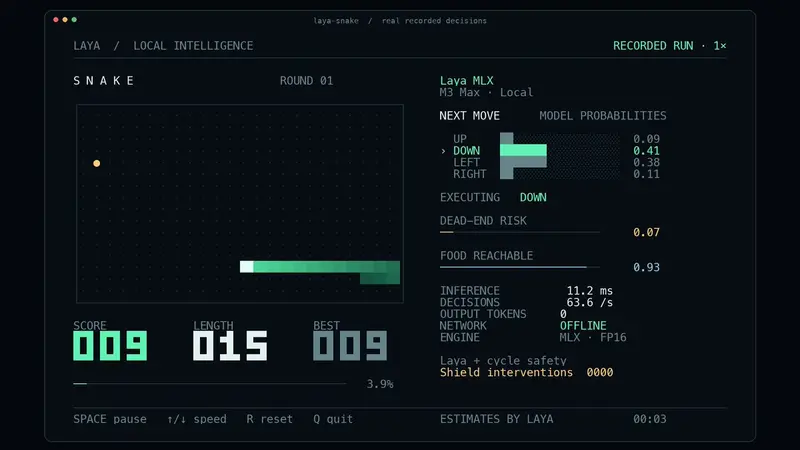
An independent MLX port of Laya for Apple Silicon, 13.4ms median for a short English decision and 7.4ms on the multilingual checkpoint, with a Snake demo that plays at up to 75 moves per second under 1GB of memory.
 mizorewwwOpenLaya-MLX on github.com
6.1k starsShort decision 13.4 ms P50Snake demo 75.4 moves/s

Core ML ports of all three Laya checkpoints for Apple Silicon, reaching 4.98ms P50 on the Neural Engine for a short multilingual decision, with a Snake demo sustaining about 50 decisions per second.
 mizorewwwOpenLaya-CoreML on github.com
1.4k starsShort decision 4.98 ms P50Snake demo 49-50 dec/s
Vercel Labs CLI for generating from the terminal. Its evaluate command takes a state plus typed questions and defaults its evaluation model to typesafe-ai/jev on the AI Gateway, with -m jev as the shorthand and an --input flag for text or JSON state.
Node.js and TypeScript package that runs the Laya decision model through ONNX Runtime, so JavaScript projects can call it without Python.
 receptronOpen@receptron/laya on github.com
374 stars3-question call ~140 msModel size ~1.7 GB
PostgreSQL extension that lets you filter, rank and classify rows with plain-language conditions, such as WHERE jev(tickets, 'the customer is angry'). Adds jev_prob, jev_choice and jev_score functions that compose with joins, GROUP BY and ORDER BY, with no index or embeddings. Published on PGXN.
 realZachiOpenpg-jev on github.com
329 stars2k rows, cold ~3.5s, $0.0122k rows, cached ~50ms
MCP server for TypeSafe shipped as a single static Go binary with no Node or Python runtime. Sends usage guidance to the client so the agent writes better questions.
Official drop-in replacement for TypeSafeClient that sends the same typed questions to ordinary LLM APIs, so developers can compare Jev against an LLM on cost, speed and answers.
A CLI from Sutro for building AI functions with Jev: it finds uncertain examples, has you label them, and uses GEPA to improve the function.
Browser-use tool driving a real headless browser through an MCP server, CLI or library, with Jev choosing the actions. Returns text, markdown, HTML or accessibility-tree output plus traces and screenshots.
256 starsWikipedia nav ~4s, $0.0016
Self-hosted, versioned skills library for AI agents. Serves skills over MCP with scoped clients, and adds optional Jev recommendations for which skill to reach for.
Official TypeScript/JavaScript client published to npm as @typesafe-ai/sdk (v0.6.0), requiring Node.js 20+ and shipping ESM, CommonJS and type declarations.
Official Python client for the TypeSafe System One API, published to PyPI as typesafe-sdk with sync (TypeSafeClient) and async (AsyncTypeSafeClient) clients.
Local-first MCP plugin giving Claude Code, Codex, Cursor and OpenCode structured code-quality scores (correctness, complexity, modularity, security) while they work. Sends focused diffs to Jev and keeps keys and code local.
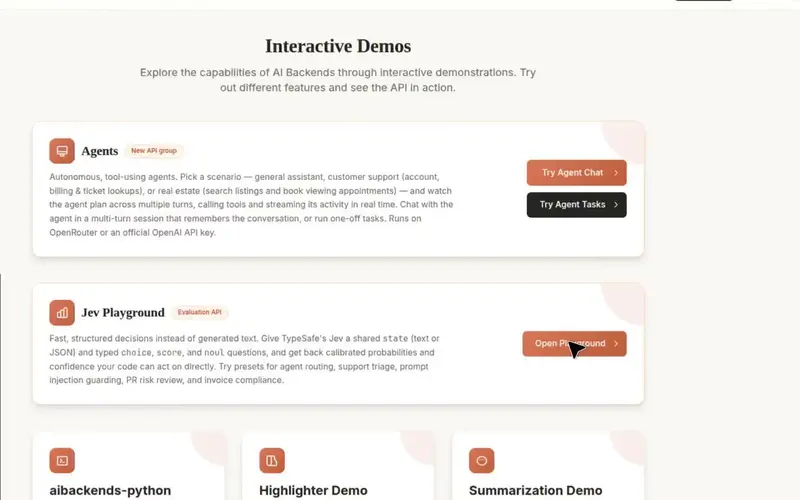
An AI API server that abstracts multiple models and providers behind one layer, for local use with Ollama or LM Studio or in the cloud via OpenRouter, OpenAI, Anthropic or Google. It now supports Jev.
Small type-safe client for asking questions about your data, powered by Jev. Returns probabilities, choices and scores in a single request, and ships an agent skill that teaches coding agents how to design the questions.
Standalone C++ inference for Laya's typed decisions using ggml, with CUDA and Vulkan backends, a Jev-compatible /v1/systemone HTTP server, and automatic request batching.
 lkarlslundOpenlaya.cpp on github.com
85 starsCUDA BF16 speedup 1.11-2.71x
Pre-alpha PostgreSQL extension that calls TypeSafe Jev from SQL for Choice, Noul and Score, including a batched function that classifies many distinct rows in one request.
 giuliosmallOpengiuliosmall/pg_typesafe on github.com
82 starsOne-by-one time 23sBatched time 0.86s
A Python evals and guardrails library for agent traces that uses Jev-style decision models instead of an LLM judge, running Jev through TypeSafe or Vercel, or Kev or Laya locally on a Mac. All checks for a trace go out as one request in a few hundred milliseconds.
 openlayer-aiOpenjevals on github.com
81 starsVariance vs LLM 92-913x
Swift 6 bridge that maps Apple Foundation Models @Generable types onto Jev: Bool to noul, enum to choice, and @Guide range to score.
A Python CLI that turns Jev calls into Unix-pipeline predicates, routing, scoring and JSONL filtering with stable exit codes, plus an agent-safety guard recipe for authorization and destructiveness checks.
Experimental Hono router where you describe a request in plain words and Jev decides which description fits the incoming request. The author warns it is not an authorization boundary, and the values of Authorization, Cookie and API key headers are redacted before anything is sent.
An agent plugin and MCP tool that sends a query plus a batch of file paths, URLs or text straight to Jev and returns relevance probabilities, so the calling agent only opens what is worth a closer look.
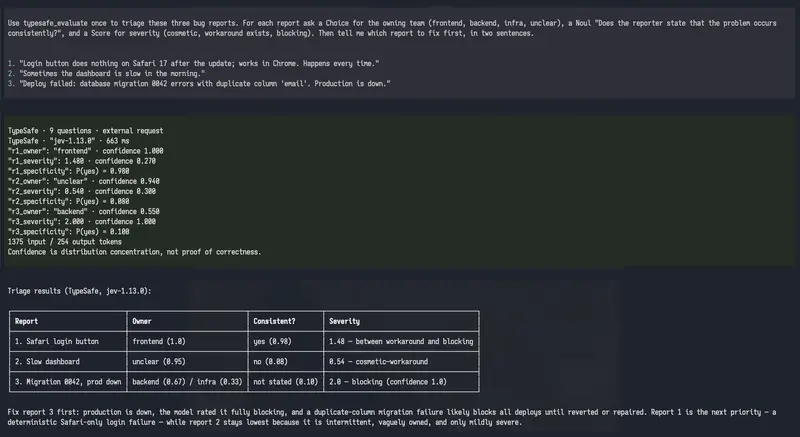
Pi extension that gives the agent and other extensions one key-managed TypeSafe client. A batched typesafe_evaluate tool hands classify, triage, compare and score judgments to Jev in a single call, and a terminal playground runs requests without touching the model's context.
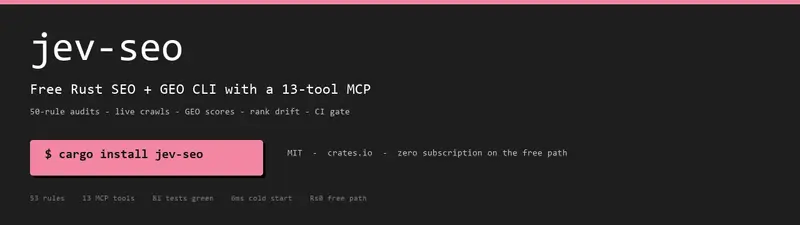
An agent-first SEO and GEO CLI and MCP server written in Rust, combining DuckDuckGo search with Jev for the judgment calls.
ACP and MCP adapter that bridges Jev with any LLM, putting computer use and typed decisions alongside Codex, Claude, Grok and OpenCode.
Hermes skill that lets an agent call jev-latest as a typed tiebreaker, getting Choice, Score and Noul answers with probabilities so it can act or escalate. Documents when to call Jev, confidence gates and pitfalls, and ships a live reliability suite.
A Spring Boot 4 starter for calling Jev using Spring MVC and RestClient.
Jev for OTP, published on Hex as jev. The model is a peer process: you reply to it from a GenServer and its answer arrives as a message you pattern match on, so clause order becomes the routing and thresholds become guards.
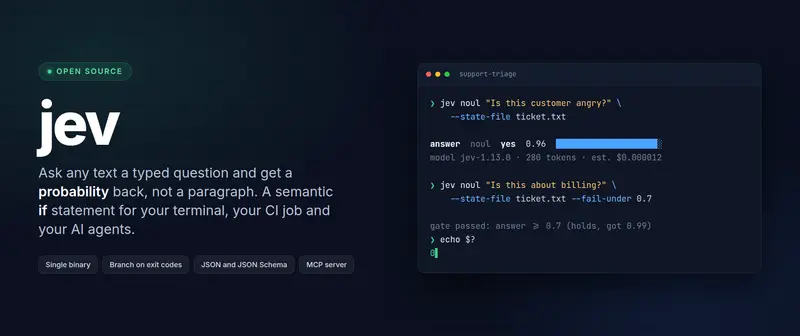
A command-line tool for Jev: ask yes/no, multiple-choice or rubric questions about any text and get calibrated probabilities back as shell exit codes, JSON, or MCP tools.
A DuckDB extension that returns Jev's typed answers as native SQL types, so a query can call Jev directly.
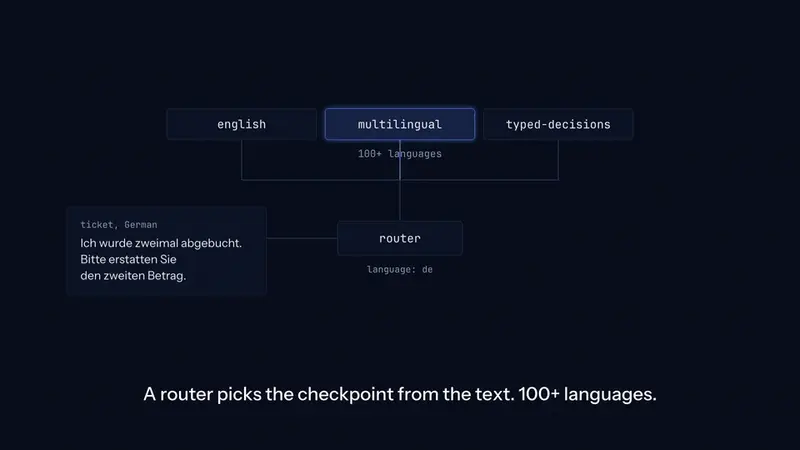
Serves typed-decision models, including Laya or your own, behind a Jev-compatible API on NVIDIA GPUs or Apple Silicon, with coding-agent integrations.
Python MCP server exposing Jev as classify, score, check, match and screen tools, with a confidence value on every answer. Ships registration steps for Claude Code, Codex and Cursor that keep the API key out of tool arguments.

Agent-ergonomic CLI for Jev with pick, rate, check, rank, triage and guard subcommands, meant for agents offloading snap judgments from the shell.
A Rails-native wrapper around TypeSafe's Jev API that puts typed, calibrated decisions directly in a Rails app's control flow.
TypeSafe structured-output provider for RubyLLM 2, wiring Jev into the RubyLLM provider interface.
A Jev decision layer for agents, shipped as an MCP server, an embeddable DecisionModel library, and an escalate-only Claude Code plugin.
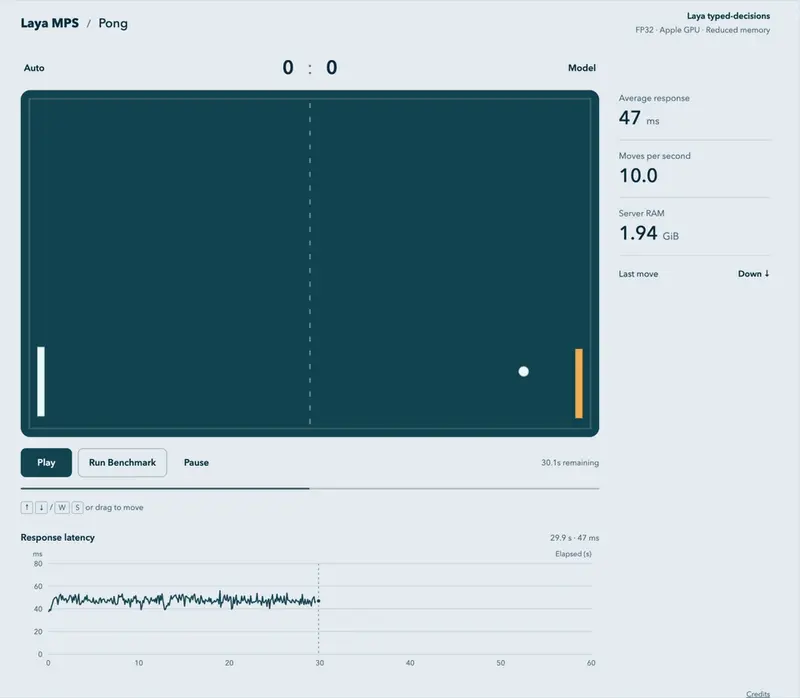
A local server running Laya's typed-decisions checkpoint on a Mac's GPU through PyTorch MPS, with a Pong demo and a memory-versus-latency tradeoff reaching about 32ms median decisions at 2.1GiB RAM on an M5 Pro.
A native Elixir runtime for Laya built on Nx and Bumblebee, downloading the official checkpoint on first load and answering typed choice and noul questions in-process.
Unofficial Swift 6.4 SDK for TypeSafe that follows the Python SDK's 0.6.0 API, with macro-based question sets for Choice, Noul and Score. Supports macOS 26+, iOS 26+, tvOS, watchOS, visionOS and Linux, and tracks the upstream version it mirrors.
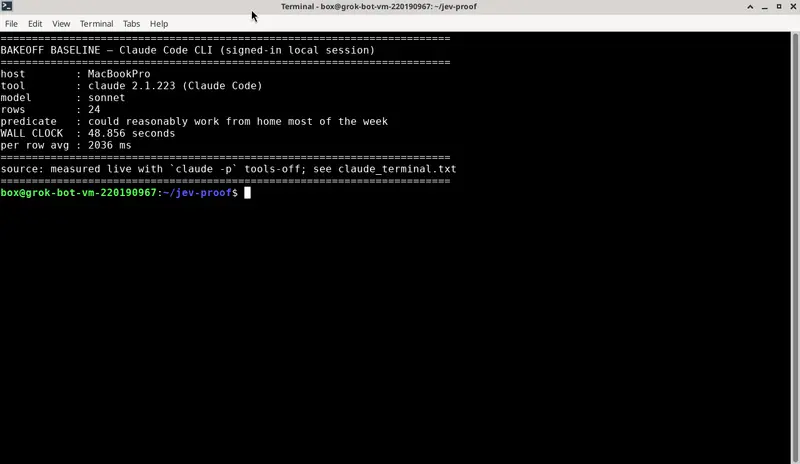
TypeScript library that wraps Jev choice, score and noul answers in the parts production needs: a policy, a confidence gate, shadow mode, reusable recipes and an offline eval CLI. On the same row-filter job it measured 1.3 s against 48.9 s for the Claude Code CLI.
Dependency-free Python CLI that sends text, JSON, files or stdin to Jev and returns machine-readable noul, choice or score answers. Several questions go in one request, and output can be reduced to the primary value for shell scripts.
Rust client for the System One evaluation API with async and blocking backends, Noul, Choice and Score responses deserialised into typed enums, and several judgments batched over one shared state. Retries can be observed step by step and errors stay inspectable.
Open-source LLM router that uses Jev to pick a model, built on LiteLLM. Clients send a single model ID and Jev routes each request; it falls through without a TypeSafe API key.
An experimental language for composing Jev questions into methods, with a standalone Rust runtime and an earlier Python reference implementation kept for comparison.
An MCP server and Chrome/Brave extension that lets Claude drive a real browser in plain English, with Jev deciding each click, tab switch, or form fill and a guard freezing irreversible actions.
Community .NET SDK for the System One API with typed noul, choice and score questions returning confidence-scored answers. States it is not affiliated with TypeSafe AI.
Pure-Rust inference for Laya built on candle, with CPU, Metal and CUDA backends, no Python, torch or ONNX export step, and weights pulled straight from the Apache-2.0 checkpoint.
Nothing matches those filters
Clear a filter to widen the search, or send us the thing you were looking for.
Most projects here wrap the HTTP API in a typed client, expose the model to an agent as an MCP server, or add a layer on top. AbdelStark/s1-rs derives questions from ordinary Rust enums and structs, so the compiler checks the answer type. AntonioCoppe/jev-harness adds a policy, a confidence gate and a shadow mode, where the model runs beside your existing logic while you compare its answers.
Each answer kind maps to a type. Choice is an enum, score is an ordered level, and noul is a yes or no with a probability. SDKs that keep this mapping, like codeitlikemiley/typesafe-sdk-rust with accessors that fail loudly on the wrong kind, catch mistakes at the first call instead of deep in your code. Pick a client that matches the answer type you plan to use.
The limit is drift. Many of these are unofficial and track the official Python SDK by version, so an API change can break them. Pin versions and read a project's issues before you build on it. A choice question also accepts at most 255 options, which is why reachjalil/jev-tree walks a large taxonomy one level at a time. Check the date of the last commit.
There is an official Vercel AI SDK provider, and the community SDKs here follow the official Python SDK's API. Entries list community builds for Rust, Swift, PHP and other languages. Check which version each one targets.
Yes. Several entries expose Jev as an MCP server or a plugin, such as blakestone-x/jev-mcp and Brainwires/jevwire. The agent calls it as a tool and gets a typed answer back.
Yes. Entries such as colliber/duckdb-jev and the DuckDB extension from Hamilton Ulmer let a query run Jev on rows of a table, so classification happens inside the database.


