Specifications side by side
Read from each model's page, so a change there updates this table. A blank field is dated to the day that model's page was last checked.
| Specification | Jev | OpenAI Decisions API |
|---|---|---|
| Vendor | TypeSafe AI | OpenAI |
| Status | Generally available | Early access |
| Access | Hosted API | Hosted API |
| Question types | Choice, Score, Noul | Choice, Score, Noul |
| Input price | $0.042 per 1M tokens | $0.1 per 1M tokens |
| Output price | Free | Free |
| Total context | 64,000 tokens | Not published as of 14 Oct 2026 |
| State budget | 32,000 tokens | Not published as of 14 Oct 2026 |
| Latency | 70 to 500 ms1 | Not published as of 14 Oct 2026 |
| Max Choice options | 255 | Not published as of 14 Oct 2026 |
| Score levels | Up to 10 | Not published as of 14 Oct 2026 |
| Rate limit | 100,000 tokens/sec and 40 requests/sec as of 2026-09-30, adjusting dynamically | Not published as of 14 Oct 2026 |
| SDKs | Python, TypeScript | Python, JavaScript |
| Licence | Not published as of 15 Oct 2026 | Not published as of 14 Oct 2026 |
| Jev Decision Index, Full score | 60.11 scorev0.3.1, 10 Oct 2026 | Not published as of 14 Oct 2026 |
| Jev Decision Index, Public score | 57.96 scorev0.3.1, 10 Oct 2026 | Not published as of 14 Oct 2026 |
| Jev Decision Index, Expected calibration error | 0.074 ECEv0.3.1, 10 Oct 2026 | Not published as of 14 Oct 2026 |
| JevBench, Capability Score | 77.1 scorev1.7.46, 12 Oct 2026 | Not published as of 14 Oct 2026 |
| Microsoft 36-benchmark comparison, Average accuracy | 82.3 %vendor-run9 Oct 2026 | Not published as of 14 Oct 2026 |
| Microsoft 36-benchmark comparison, Calibration score | 93.7 scorevendor-run9 Oct 2026 | Not published as of 14 Oct 2026 |
| Artificial Analysis Decision Index, Index score | 57.5 scorev1.0, 13 Oct 2026 | 48.5 scorev1.0, 13 Oct 2026 |
| Artificial Analysis Decision Index, Expected calibration error | 0.1174 ECEv1.0, 13 Oct 2026 | 0.1547 ECEv1.0, 13 Oct 2026 |
| Artificial Analysis Decision Index, Cost per 1M tasks | 42 USDv1.0, 13 Oct 2026 | 79 USDv1.0, 13 Oct 2026 |
| Artificial Analysis Decision Index, Time per task | 127 msv1.0, 13 Oct 2026 | 168 msv1.0, 13 Oct 2026 |
| Docs and console | docs.typesafe.ai, Console | developers.openai.com |
- 1 Jev: 70ms to 500ms end-to-end is TypeSafe's own figure from the launch post, as is the 3 to 329 seconds it compares frontier LLMs against and the resulting 40x to 200x multiple.
Examples in the directory
637 Jev examples
The top 3 by stars and views. All Jev examples.

Jev Ultrafast (Browser Use)
Browser Use's fast browser agent where Jev picks the operation and the DOM element in a single request; a small LLM is only invoked to write text when typing is required. Demoed on a Google Flights search.

19k starsFlight search 7.1 s

openjev
Attempt to run a Jev-style System One decision model locally on a single RTX 3090. Companion site at openjev.com. The repository was renamed to TheoLeeCJ/SemIf on GitHub, and the old openjev URL now redirects to it.
 TheoLeeCJOpenopenjev on github.com
4.1k starsJSON vs direct 5.21x slowerPeak throughput 20.03 dec/s
jev-trader
Makes one AI trade decision every Monad block on the Kuru MON-USDC market using Jev. The public deployment runs in dry-run mode with a mock model.
 jarrodwattsOpenjev-trader on github.com
2.2k starsLoop, mock model p50 100 msDecision window ~300 ms/block
2 OpenAI Decisions API examples
The top 2 by stars and views. All OpenAI Decisions API examples.
Microsoft-Decision-1: Our model for fast decision-making
Microsoft's launch post for Microsoft-Decision-1, a Qwen3.5-9B decision model on Foundry at $0.042 per million input tokens. Its vendor-run charts, run on an undisclosed 36-benchmark suite, now include Jev: 82.3% accuracy and 93.7 calibration against 83.5% and 92.2 for Microsoft-Decision-1.
 Satya Nadella (@satyanadella)454k viewsOpenMicrosoft-Decision-1: Our model for fast decision-making on commandline.microsoft.com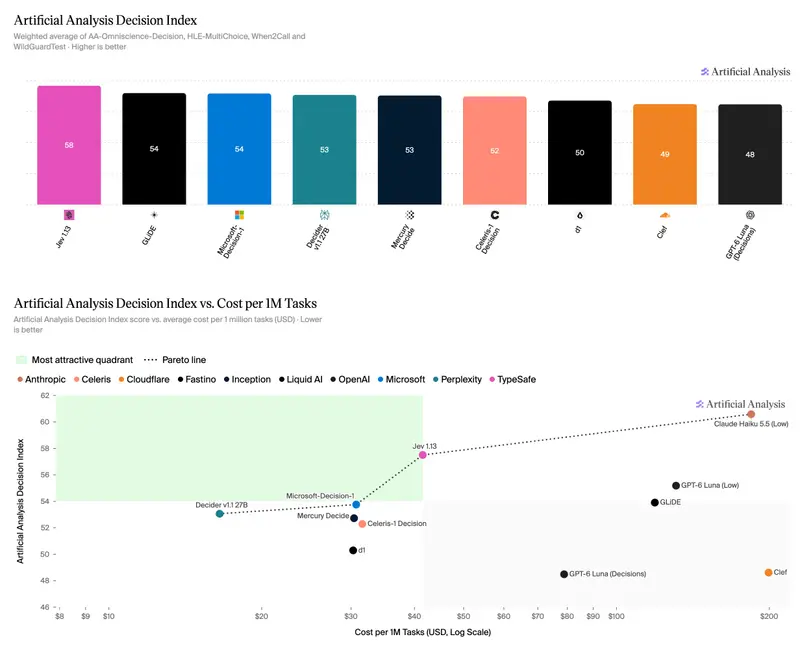
Artificial Analysis Decision Index: 11 hosted decision models against language models
Artificial Analysis scores 11 hosted decision models on knowledge, reasoning, tool-calling and safety tests, with cost and time per task, and runs language models on the same tests. Jev 1.13 leads the decision models at 58; Claude Haiku 5.5 (Low) scores 61 but takes 1.4 seconds per task against 0.13.
 Artificial Analysis (@ArtificialAnlys)45k viewsOpenArtificial Analysis Decision Index: 11 hosted decision models against language models on artificialanalysis.ai
Shared use cases
Patterns both Jev and OpenAI Decisions API list on their pages.
Short answer
Jev and the OpenAI Decisions API do the same job: you send text and typed questions with fixed answers, and each returns a probability per answer instead of writing a reply. Jev costs $0.042 per million input tokens, has been generally available since 15 September 2026, and has scores on three independent boards. OpenAI’s API costs $0.10, reads images as well as text, and has been in public beta since 6 October 2026. OpenAI has published no benchmark, latency figure or calibration data for it as of 12 October 2026, so the outside evidence is a few small tests by early users and one latency row on JevBench.
Pick Jev if
- Price per decision matters. Jev is $0.042 per million input tokens against $0.10, with free output on both. OpenAI adds that regional processing premiums and long-context multipliers still apply.
- You want independent evidence before you commit. Jev scores 60.11 on the Jev Decision Index 0.3.1 (multimodalart’s community board on Hugging Face), third of 117 rows and a shared second under the board’s tie rule, with a calibration error of 0.074. The Decisions API has no row in the 10 October file. On the Artificial Analysis Decision Index it scores 48.5 against Jev’s 57.5.
- You need calibrated probabilities. TypeSafe says Jev’s probabilities are calibrated and ties that to its training method. OpenAI makes no calibration claim and tells you to set thresholds from labelled examples of your own.
- You need published limits to design against. Jev documents 255 options per Choice, 10 levels per Score, a 64,000-token request and a rate limit of 40 requests and 100,000 tokens per second. OpenAI documents none of those for the Decisions API.
Pick the Decisions API if
- Your state includes images. The Decisions API takes user messages with text and inline base64 images. Jev reads text only.
- Your inputs are far longer than 64,000 tokens. OpenRouter lists
openai/gpt-6-luna-decisionswith a 1,050,000-token context, the same window as GPT-6 Luna. OpenAI’s own docs state no separate figure for the Decisions API, so test that ceiling rather than design to it. - You already run on OpenAI. It takes an OpenAI API key, ships in the official SDKs from Python 3.26.0 and JavaScript 7.30.0 plus Go, Ruby and Java, and sits in the Playground.
- You need OpenAI’s compliance terms. OpenAI offers Zero Data Retention and HIPAA use for eligible customers, with data residency in the United States and Europe. TypeSafe offers zero data retention to enterprise customers under a data processing agreement.
What the numbers don’t tell you
One independent board has scored both. The Artificial Analysis Decision Index, launched on 13 October 2026, ranks Jev first of 11 decision models at 57.5 and the Decisions API, listed as GPT-6 Luna (Decisions), ninth at 48.5. TypeSafe publishes workflow evals for Jev, and the Jev Decision Index and JevBench score it. OpenAI has published no benchmark for the Decisions API. Every, which had preview access, ran its own head-to-head tests: the Decisions API picked the right control in 76 of 78 steps of a text replay of computer tasks against 73 for Jev, tied on thread classification where Jev was faster, and trailed on Every’s wider suite. Microsoft’s launch charts score “GPT-6 Luna Decisions” at 79.4% average accuracy and give Jev none, and Microsoft ran those tests itself.
The latency figures come from four harnesses. OpenAI’s guide says the API answers about 10 times faster than its Responses API, which the press relayed as roughly 150ms against 1.6 seconds, a vendor figure with no test setup. JevBench measured a 298ms median and 399ms 95th percentile over 598 requests on 6 October, against 239ms for Jev on the same board. Every saw 230ms typical against 500ms for Jev on one text task and a 309ms median against 161ms on another. TypeSafe’s own claim is 70ms to 500ms end to end.
TypeSafe claims calibration and OpenAI makes no claim. TypeSafe says RLCD trains Jev to give probabilities that match real outcome rates, and the Jev Decision Index measures its expected calibration error at 0.074. OpenAI says nothing about whether its probabilities are calibrated, and no outside board has measured them.
Beta means the spec can change. OpenAI lists the Decisions API as released in beta on 6 October with gpt-6-luna as its only model and names no version beyond that; OpenRouter lists a dated snapshot, openai/gpt-6-luna-decisions-20261006. Jev has a pinned jev-1.13.0 with a per-version page of documented weak spots. OpenAI has also not said, as of 12 October 2026, whether developers can tune the Decisions API on their own data, how many questions a request can hold, or how many options a choice can take.
The request formats differ in ways that matter for porting. OpenAI uses input where Jev uses state, a questions array with a name on each item where Jev uses a keyed map, and predicate where Jev says noul. Answers come back in an answers array, and a question can come back as a refusal. On OpenRouter both models sit behind one Decisions endpoint, but this site has not tested the OpenAI model through it.
FAQ
Is the OpenAI Decisions API cheaper than Jev?
No. OpenAI charges $0.10 per million input tokens and Jev $0.042, both with free output and no cache charges on OpenAI’s side. OpenAI says regional processing premiums and long-context multipliers still apply. OpenRouter lists both models at their makers’ prices, so the gap is the same there.
Is the OpenAI Decisions API faster than Jev?
Not on the evidence so far. JevBench measured a 298ms median for the Decisions API against 239ms for Jev on 6 October 2026. Every saw it slower on one task and faster on another. OpenAI’s own claim is about 10 times faster than its Responses API, with no millisecond figure. Time both from your region before deciding on speed.
Can I use TypeSafe’s SDKs with the OpenAI Decisions API?
No. The Decisions API has its own request format at POST https://api.openai.com/v1/decisions: input instead of state, a questions array with a name per item, and predicate instead of noul. It ships in OpenAI’s official SDKs from Python 3.26.0 and JavaScript 7.30.0. A client written for /v1/systemone needs changes to call it.
Is the OpenAI Decisions API generally available?
Not as of 12 October 2026. OpenAI opened a public beta on 6 October 2026 with gpt-6-luna as the only model, after a week of limited preview, and its guide says it expects general availability in the coming weeks. Jev has been generally available with open sign-up since 20 September 2026, when TypeSafe removed its waitlist.
Examples
Microsoft-Decision-1: Our model for fast decision-making
Microsoft's launch post for Microsoft-Decision-1, a Qwen3.5-9B decision model on Foundry at $0.042 per million input tokens. Its vendor-run charts, run on an undisclosed 36-benchmark suite, now include Jev: 82.3% accuracy and 93.7 calibration against 83.5% and 92.2 for Microsoft-Decision-1.
Satya Nadella (@satyanadella)454k viewsOpenMicrosoft-Decision-1: Our model for fast decision-making on commandline.microsoft.com
Jev Decision Index: Jev against 50+ open decision models
A leaderboard that runs Jev and 54 open System One models and clones through the same 120,000-question suite on one RTX PRO 6000, scoring accuracy and calibration. Jev leads the 0.2 edition at 51.67 on a chance-corrected scale, with AutoJev-27B close behind at 50.94.
 apolinario (poli) (@multimodalart)43k viewsOpenJev Decision Index: Jev against 50+ open decision models on huggingface.co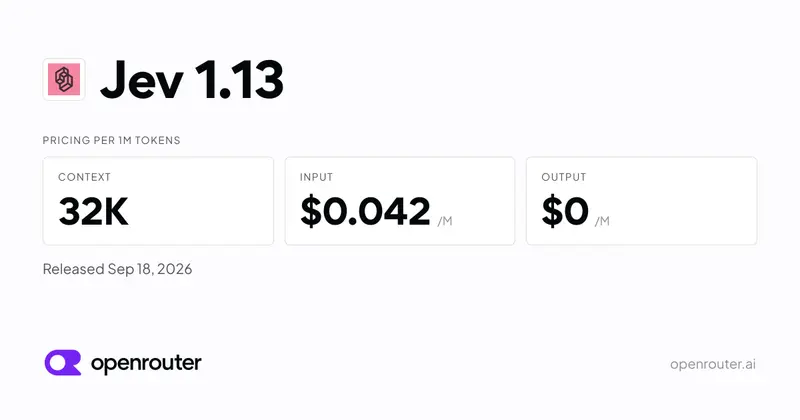
Jev 1.13 on OpenRouter
OpenRouter's model page for Jev 1.13, which runs on OpenRouter's Decisions API rather than its OpenAI-compatible chat endpoint. Listed at $0.042/M input and $0/M output with a 64,000-token context on 10 October 2026, up from 32,000 when added in September.
JevBench by Benchmark Heaven: Jev-class decision model leaderboard
Benchmark Heaven's own leaderboard for Jev-class decision models, unrelated to the dhruvmehra/jevbench repo, ranking 106 of 112 systems on 1,624 choice, score and noul decisions each in release v1.5.4. Jev 1.13.0 leads on capability at 80.0, while on the four-axis composite that adds speed and cost, Cygnet and Winnow-12B Q8 tie first and Jev is third.