Project203
Projects
Things people built, from weekend demos to products already running.
743 public things people have built, written or argued about since Jev shipped: code, tools, official cookbooks, videos, articles, threads, lists, and the open-source alternatives that cover the same ground. If something is missing, use the submission form.
743 entries
Things people built, from weekend demos to products already running.
SDKs, wrappers, MCP servers and integrations that call the API for you.
Official worked examples and patterns, straight from the vendor docs.
Walkthroughs, launch coverage and explainers, in several languages.
Write-ups, reviews and analysis, mostly from outside the vendor.
Threads and posts where people argue about what this actually is.
Awesome lists and roundups that collect everything else.
Open-source models and libraries that cover similar ground.
Every entry with a screen recording or GIF, across all kinds, most viewed first.
Featured entries first, then by stars and views. Filter or search to look across every page.
Showing 1 to 48 of 743

Browser Use's fast browser agent where Jev picks the operation and the DOM element in a single request; a small LLM is only invoked to write text when typing is required. Demoed on a Google Flights search.
19k starsFlight search 7.1 s

Attempt to run a Jev-style System One decision model locally on a single RTX 3090. Companion site at openjev.com. The repository was renamed to TheoLeeCJ/SemIf on GitHub, and the old openjev URL now redirects to it.
 TheoLeeCJOpenopenjev on github.com
4.1k starsJSON vs direct 5.21x slowerPeak throughput 20.03 dec/s
Makes one AI trade decision every Monad block on the Kuru MON-USDC market using Jev. The public deployment runs in dry-run mode with a mock model.
 jarrodwattsOpenjev-trader on github.com
2.2k starsLoop, mock model p50 100 msDecision window ~300 ms/block
Official agent skill for Claude Code, Codex and other agent environments; installs via claude plugin marketplace add typesafe-ai/skills or npx skills add typesafe-ai/skills. MIT licensed.
Open reimplementation that trains a small model to choose among a changing list of text options, emitting one probability per option in a single forward pass. Ships Doom, chess and Wikispeedia demos.

Independent community collection of use cases, patterns, prompts and starter code for Jev, explicitly not official. It also links sibling collections by the same author and two related projects that report their own cost figures.
MCP server that gives Claude Code, Codex, Amp, OpenCode and other agents ten Jev judgment tools, each returning typed probabilities they can branch on. The author calls it early software.
320 starsPer call 150-500 ms

Walks through the Choice, Score and Noul primitives live in the TypeSafe playground, with speed and cost numbers and their caveats.
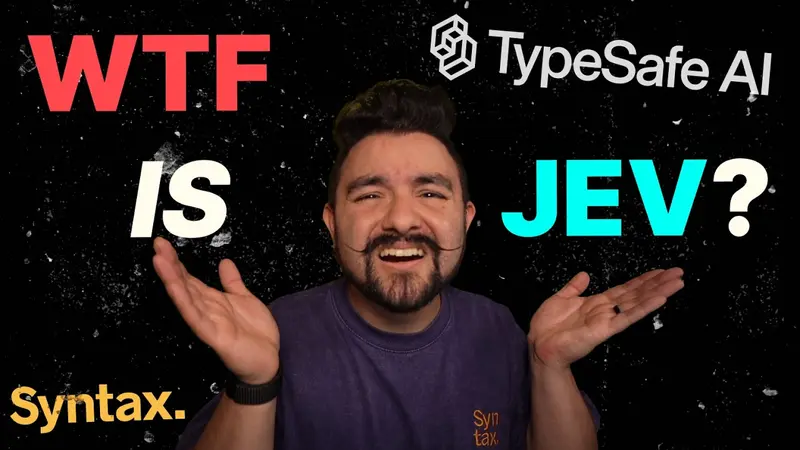
CJ from Syntax explains what Jev is, how it works, and walks through several use cases and demos. 17 minutes.
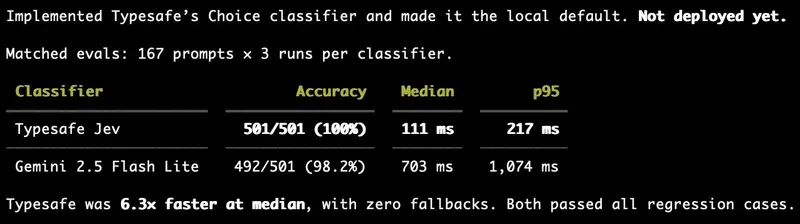
Vercel CTO reports Jev saturated an existing classifier eval that had used Gemini 2.5 Flash Lite and ran about 6x faster. Original post; TypeSafe's quote-tweet is a separate item.
 Malte Ubl (@cramforce)OpenRan Jev against an existing classifier eval that previously used Gemini 2.5 Flash Lite on x.com
220k viewsSpeed vs Gemini 6x faster

Cloudflare's launch post for Clef and Clef-flash, two decision models on Workers AI that accept the Jev request format and open weights under Apache 2.0. It covers the architecture, Cloudflare's own benchmark tables against Jev, Kev and Laya, and a new reinforcement learning service.
 Michelle Chen (@michellechen)140k viewsOpenIntroducing Clef: our open-source decision models, and new RL fine-tuning platform on blog.cloudflare.com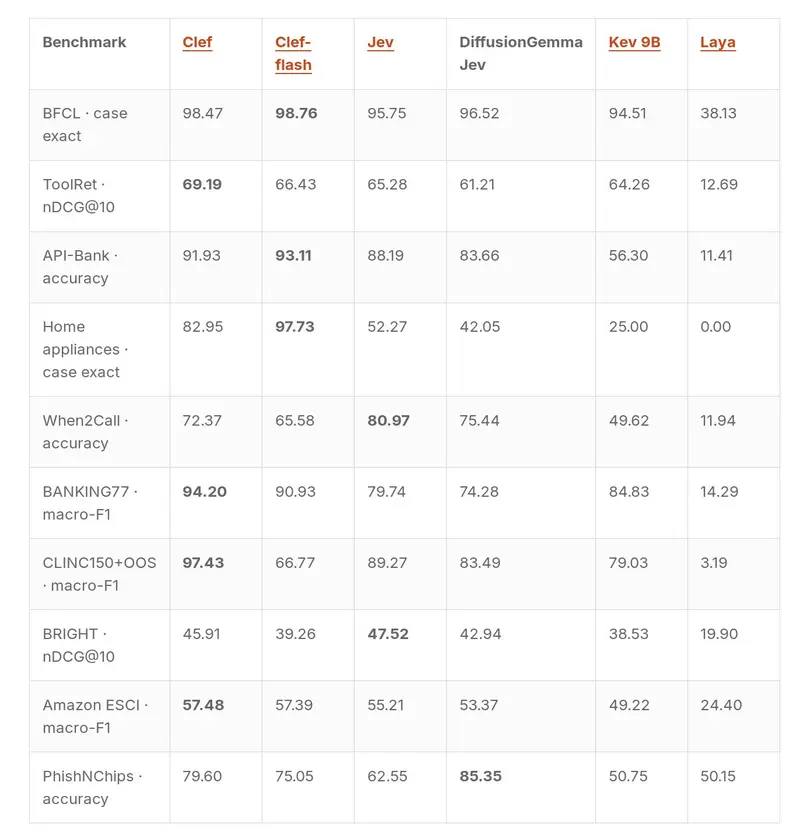
Cloudflare's live leaderboard for decision models on the Jev Decision Index suite, with Clef, Clef-flash, Jev, Kev-9B and Laya plotted by score and latency. Cloudflare built and ran it, so treat the ranking as vendor-run.
 Cloudflare (@ritakozlov)41k viewsOpenDecision Model Leaderboard on clef-evals.workers-ai-mle.workers.dev
Apache 2.0 weights for Cloudflare's 27B Clef decision model, post-trained from Qwen3.8-27B, that reads text and images. The smaller 9B Clef-flash is published next to it as Cloudflare/clef-flash.
AI News daily roundup leading with the Jev launch, summarising RLCD and TypeSafe's 20-200x speed and 40-400x cost claims. Its recap of reactions notes posters using Jev as a structured classifier, judge and routing policy where text generation is unnecessary.
Argues Jev's speed comes mainly from constrained single-token generation and aggressive prefill, techniques reproducible with existing LLMs, rather than a new architecture. Still treats very fast structured output as a new primitive, while doubting Jev matches frontier models on raw intelligence.
The 1,978-point, 513-comment launch thread. The top comment calls the speed comparison misleading, since Jev only returns structured output, and disputes the cannot-hallucinate claim because a valid type can still hold a wrong value. Others note ordinary LLMs can already be forced into structured output.
Declares typed input/output Signatures for LLM modules and optimizes the underlying prompts and weights against a metric. Its Signature abstraction is the closest widely-used open equivalent of Jev's typed-question interface. Star count is GitHub's rounded display figure.

Cua's own family of small System 1 models for computer-use decisions, separate from TypeSafe's Jev. CUA-S1-FORMS is the first release, with weights and a dataset on Hugging Face.
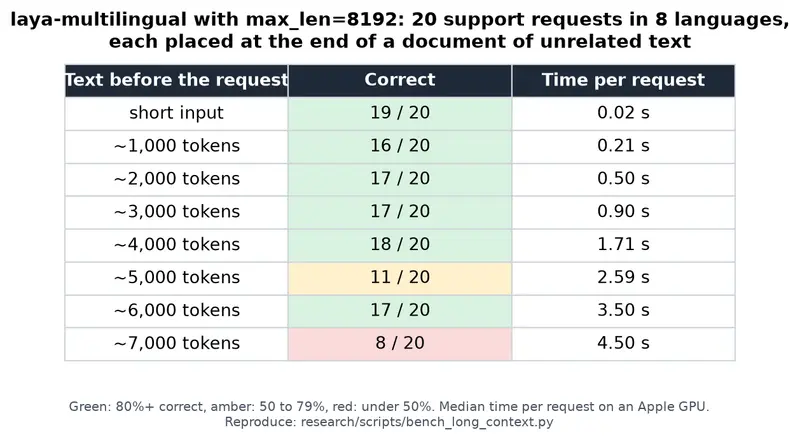
Decision model from Convai Innovations that fully fine-tunes an encoder and adds a typed-decision head: a 421M English checkpoint on ModernBERT-large and a 322M multilingual one on mmBERT-base, with a router picking between them by detected language. Returns choice, score and noul answers, and reports expected calibration error of 0.081 after temperature fitting, down from 0.466 as shipped.
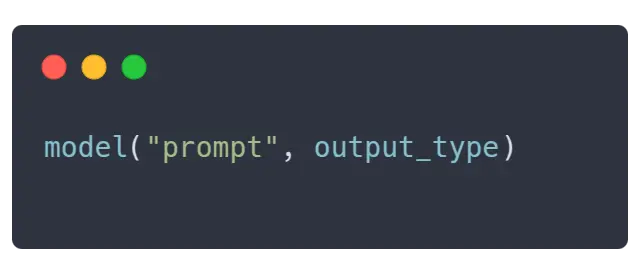
Guarantees valid structured output during generation by constraining decoding to a grammar or schema. The mechanism HN commenters repeatedly cited as already covering Jev's cannot-produce-a-type-error guarantee on ordinary LLMs. Star count is GitHub's rounded display figure.
Pydantic-based library that extracts typed, validated structured data from LLMs across providers with automatic retries. The established way teams get Jev-style typed answers today, at LLM latency and cost. Star count is GitHub's rounded display figure.
Claude Code plugin that replaces the compaction summary with Jev decisions. Every tool call and result is scored in one request against the whole conversation, stale ones are dropped or truncated, and everything kept stays verbatim. Also usable as an npm library.
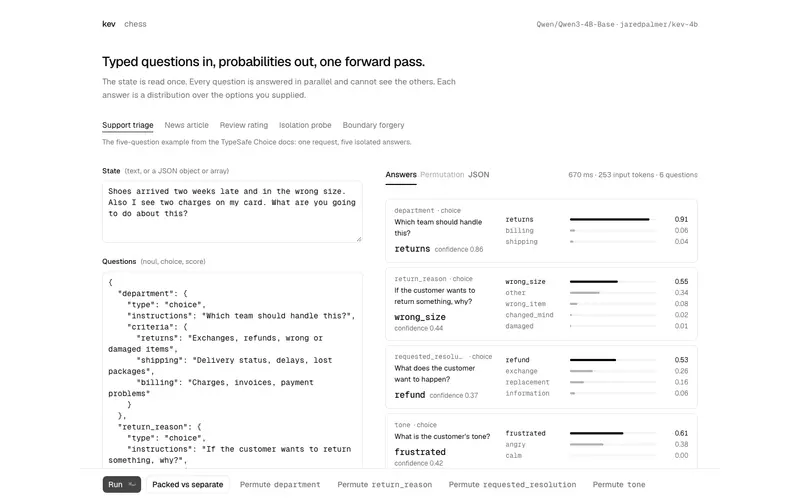
A family of small, self-hosted decision models built on Qwen3.5 at 0.8B, 4B and 9B, with training code and an API that matches TypeSafe's System One so TypeSafe's own Python SDK can point at a local server.
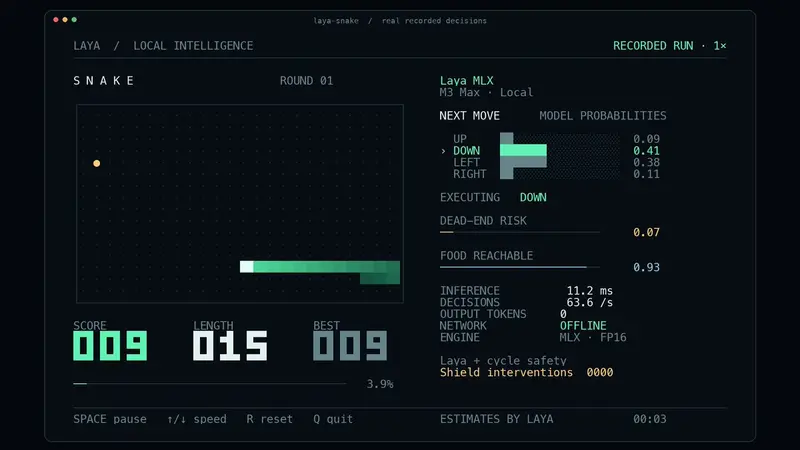
An independent MLX port of Laya for Apple Silicon, 13.4ms median for a short English decision and 7.4ms on the multilingual checkpoint, with a Snake demo that plays at up to 75 moves per second under 1GB of memory.
 mizorewwwOpenLaya-MLX on github.com
6.1k starsShort decision 13.4 ms P50Snake demo 75.4 moves/s
Compact encoder model that takes the label set as input at inference time and extracts arbitrary entity types zero-shot on CPU. Same classifier-that-takes-its-categories-as-input shape, for extraction rather than decisions. Star count is GitHub's rounded display figure.
Fine-tunes Sentence Transformer embeddings plus a lightweight head for high-accuracy classification from a handful of labeled examples, with no prompting. The standard cheap alternative to an LLM classification call when the label set is fixed. Star count is GitHub's rounded display figure.
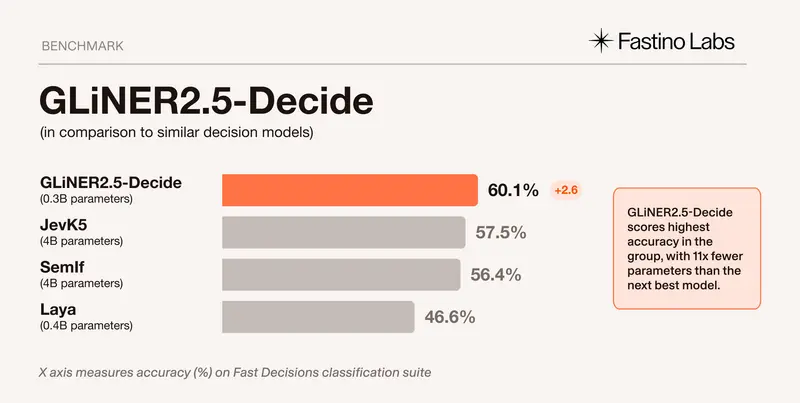
Open-weights 340M-parameter decision model from Fastino Labs. It jointly decodes typed classification questions and, per Fastino's own internal benchmark, leads 9 of 17 datasets against JevK5, SemIf and Laya.
 Fastino Labs (@fastinoAI)OpenGLiNER2.5-Decide on huggingface.co
2.2k starsCPU latency 167 msGPU latency 38-47 ms
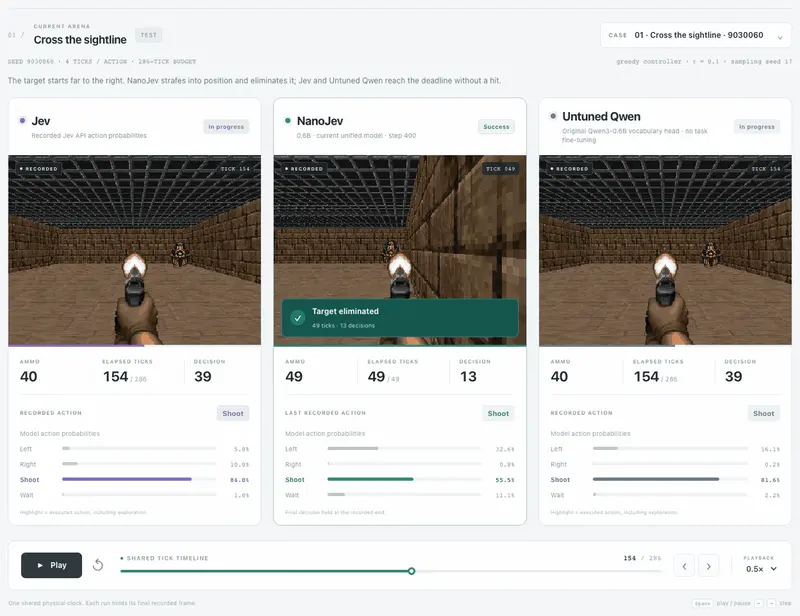
NanoJev is a 0.6B open-source replica of Jev that takes states and questions and returns complete probability distributions with zero output-token decoding. Ships with model weights, dataset and an end-to-end training pipeline, plus a side-by-side demo running Jev, NanoJev and untuned Qwen through Snake and a 50x50 maze.
Modernized BERT encoder used as the backbone for fast fine-tuned classifiers and rerankers. The non-generative baseline Jev's cost and latency claims are usually measured against. Star count is GitHub's rounded display figure.
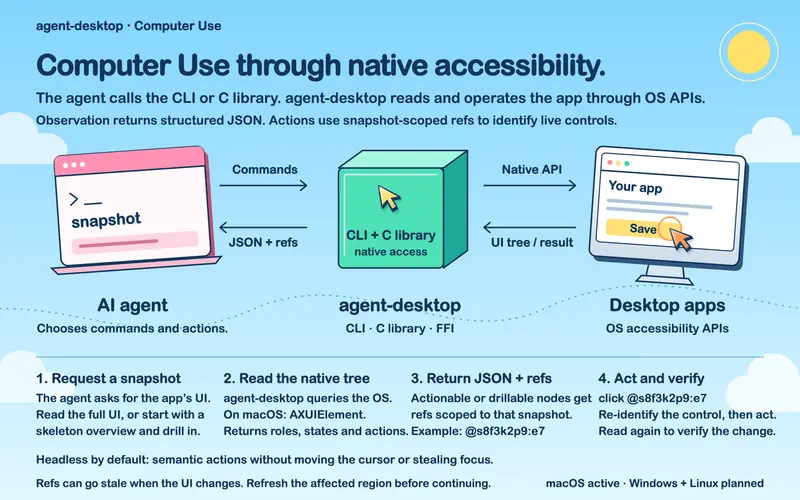
Rust desktop automation that reads apps through the OS accessibility tree instead of pixels. Its jev-desktop skill takes a plain-language goal and has Jev pick one operation and one target element per turn, so the 150-element tree never enters the agent's context.
1.6k starsToken reduction 78-96%

Core ML ports of all three Laya checkpoints for Apple Silicon, reaching 4.98ms P50 on the Neural Engine for a short multilingual decision, with a Snake demo sustaining about 50 decisions per second.
 mizorewwwOpenLaya-CoreML on github.com
1.4k starsShort decision 4.98 ms P50Snake demo 49-50 dec/s
macOS computer-use loop that OCRs the screen, classifies the next action with Jev, then clicks. Author reports roughly $0.0002 per step.
 Aaron Levin (awlevin)Opentypesafe-computer-use on github.com
935 starsCost/decision $0.0002, 155xLatency 0.13-0.38s
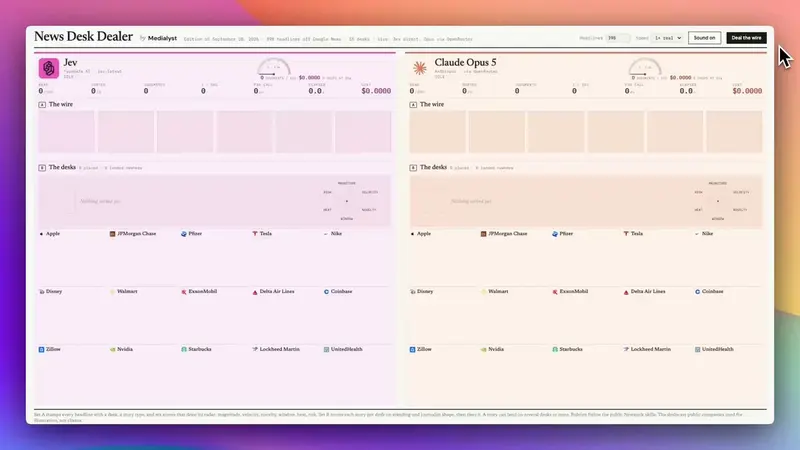
Open source skills that read a morning's news feed with Jev and tell a list of brands which stories to act on. In a demo run it read 384 headlines and matched them to 15 brands in 24.9 seconds for $0.19, against 4 of 384 for $0.77 on Claude Opus 5 over the same feed.
 Elvis (@elvissun)Opennewsjack on newsjack.sh
851 starsCost $0.19vs Opus/headline ~390x cheaper
Vercel Labs CLI for generating from the terminal. Its evaluate command takes a state plus typed questions and defaults its evaluation model to typesafe-ai/jev on the AI Gateway, with -m jev as the shorthand and an --input flag for text or JSON state.
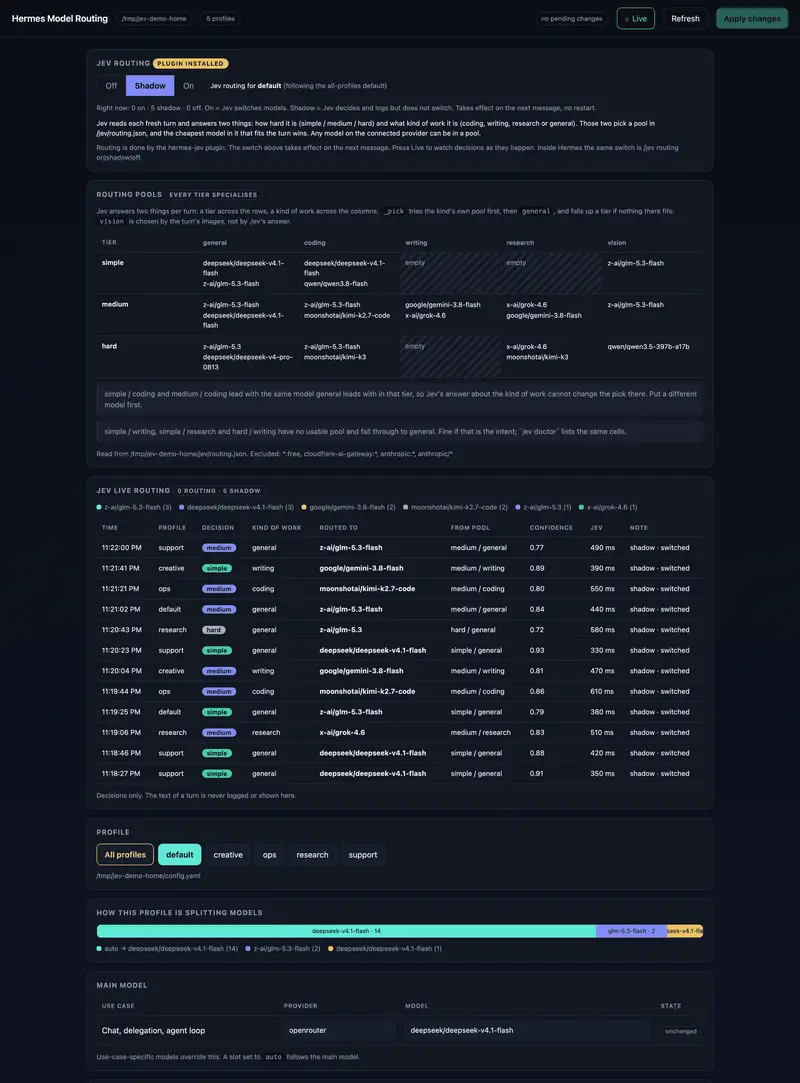
Agent skills for Hermes, Claude Code and Codex that hand Jev the routing decisions: which model tier to use, which search results to open, which memory passages to read and which hide injected instructions. Ships a dashboard with an on, shadow and off switch and publishes measured latencies per skill.
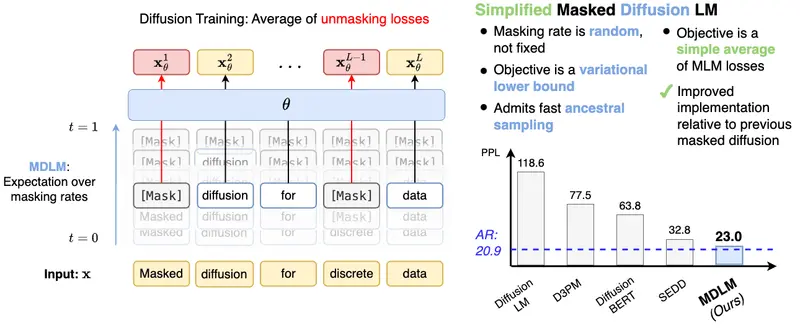
NeurIPS 2024 masked discrete diffusion language model that produces outputs in parallel rather than token by token. Cited in Jev coverage as the open non-autoregressive research line closest to Jev's parallel sampler.
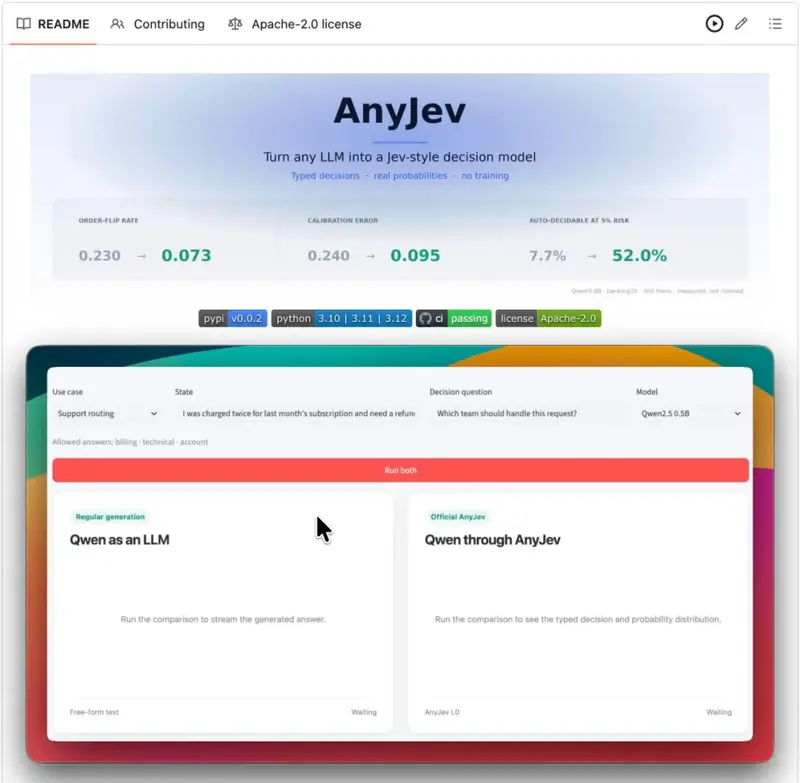
Python library from Nokia researchers that reads typed Choice, Noul and Score answers with probabilities from an open LLM's logits or hidden states, without fine-tuning. Its zero-label level reduces option-order bias, and a head fit on 100 to 300 labels can run behind vLLM.

A macOS menu bar companion with two modes: type a task and Jev picks what to click from a local OmniParser running on CoreML, looping for up to 12 actions, or talk to Gemini Live, which takes one desktop action per turn.
 Milind S (@milindlabs)Openmilind-soni/tiptour-macos on github.com
662 starsAction limit 12 actions

Apache 2.0 decision model on a 395M ModernBERT encoder that serves the same /v1/systemone API as Jev, installed as von-sdk from pip or npm. Version 1.2 scores each option on its own, so reordering options no longer changes answers. Its own table puts Von 1.1 at 72.0% on the 49-task jabr v2 suite against 96.6% for Jev.
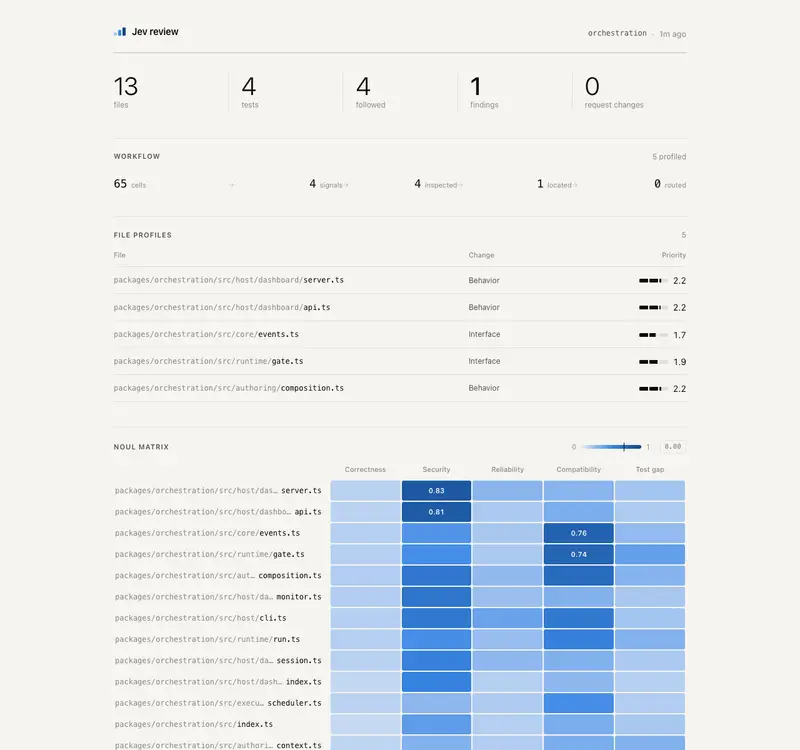
Staged code-review workflow with a local dashboard, where Jev judges code changes or a whole codebase.
Places Jev as a fast supervisor above slower Codex coding agents. Codex workers do the engineering while Foreman independently assesses whether the work is complete, requirements are met, tests suffice, or human input is needed.
A Minecraft agent that pairs an Astra planner with Jev as the real-time controller, with native run recording, tested routes and run verification.
536 starsFastest run 8m 43s, -40%Decisions used 131 Jev calls
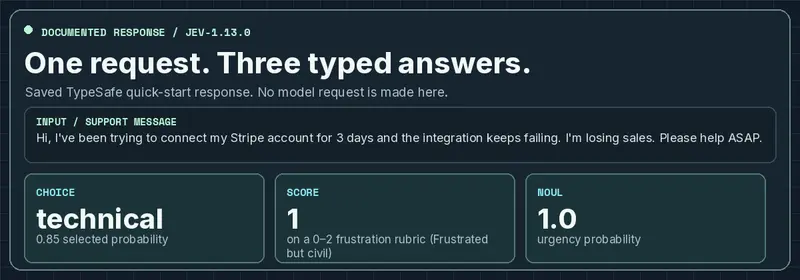
Curated list of official resources and community projects for TypeSafe, System One models and Jev, with a GitHub Pages site. Sections cover docs, SDKs, agent tooling, browser agents, games/robotics, evaluations and showcases.
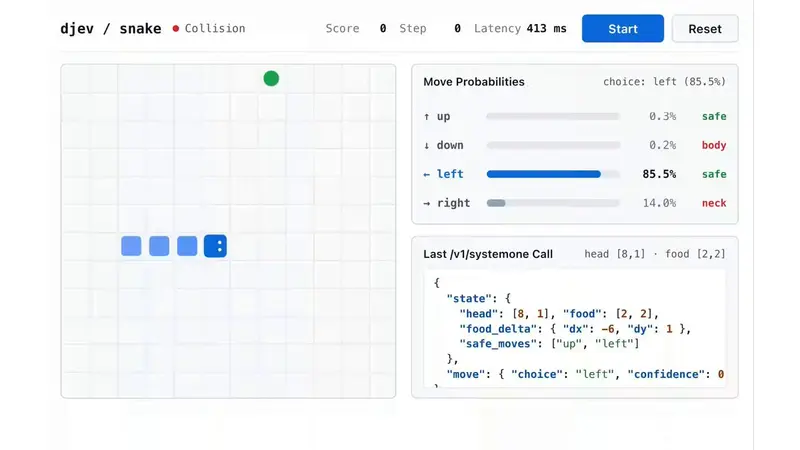
Deploys DiffusionGemma-Jev (djev) as a Jev API-compatible endpoint on Cloud Run with one RTX PRO 6000 GPU, scaling to zero when idle. The Gemma team's video demo reports 35 to 60 ms single-step latency at roughly $3 an hour.
 Google Gemma (@googlegemma)496 starsOpendjev-run: DiffusionGemma-Jev on Google Cloud Run on github.com
A browser skill for Codex where Jev handles navigation, clicks, toggles and scrolling while Codex stays in charge of text input, visual judgment and the final check.
447 starsSpeed 5-10x faster

Web search in plain language where Jev chooses sources, time ranges and search terms, then scores each result for relevance, with retrieval through Search1API. Returns links and snippets with visible relevance scores and editable filters, and writes no answers.
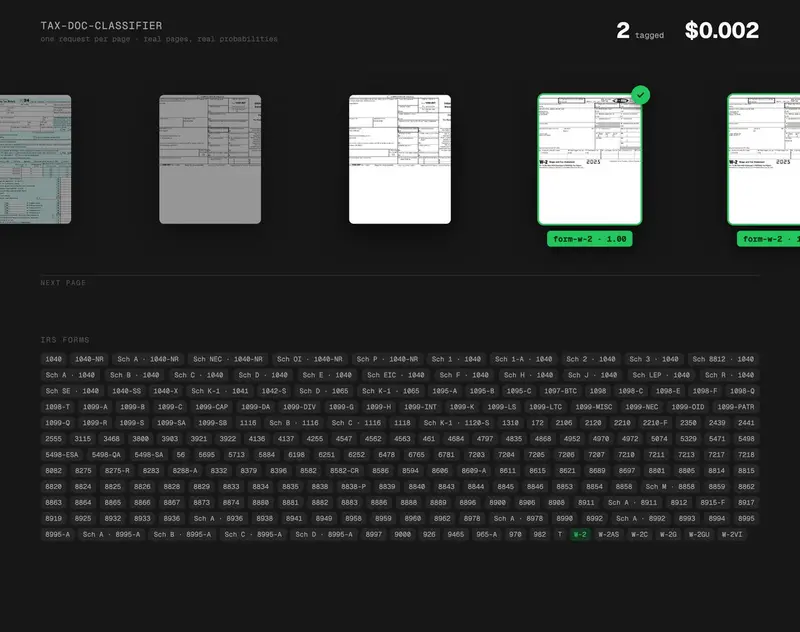
A TypeScript classifier that sends each PDF page's text to Jev as a choice over 261 IRS forms and 7 page kinds, with a second call only for five corporate forms and their schedules. Its eval reports 0 wrong pages on 314 filled TaxCalcBench forms at about $0.001 per page, 34x cheaper and 6x faster than the Sonnet pipeline it replaced.
 Nakshatra Saxena (@nedwize)Openkyotofin/tax-doc-classifier on github.com
419 starsCost per page $0.001vs prior setup 34x cheaper
Nothing matches those filters
Clear a filter to widen the search, or send us the thing you were looking for.
The same entries, sorted by the job they do.
The twelve most recent additions.
Send the link. Entries are checked by hand and added most days.


