lahfir/agent-desktop on GitHub
- Stars
- 1,612
- Forks
- 109
- Language
- Rust
- License
- Apache-2.0
- Last push
- 23 Sep 2026
Post on X
- Views
- 100,040
- Likes
- 558
- Reposts
- 56
Read from GitHub and X on . Counts change daily.
Reported by the author
- Token reduction
- 78-96%
78–96% token reduction on dense apps
github.com
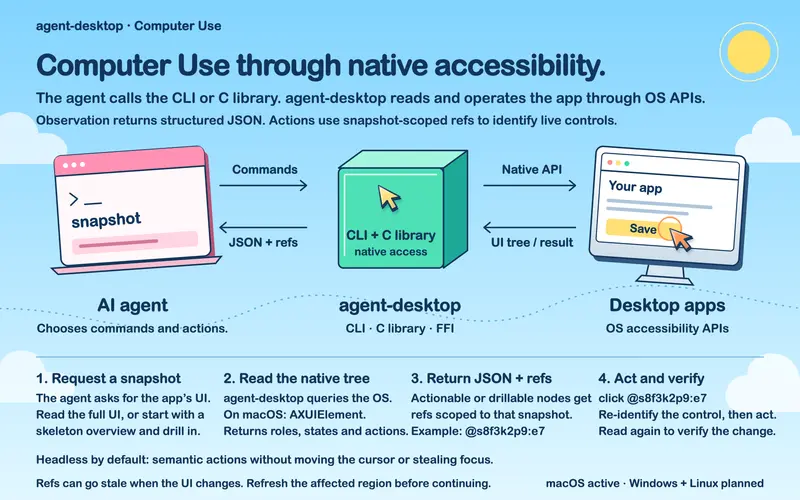
agent-desktop drives desktop apps through the OS accessibility tree, the structured view of buttons, fields and menus that screen readers use, instead of taking screenshots and guessing at pixel coordinates. Its jev-desktop skill takes a plain-language goal and loops: read the screen, ask Jev for one operation (CLICK, TYPE_TEXT, SCROLL, DRILL, DONE and others) and a target element for that operation in the same request, act, then read again. The calling agent never has to put the tree, which can hold 150 elements or more, in its own context.
The same request asks how hard the step would be to undo: an ordinary step needs 0.70 confidence in its target, a destructive one needs 0.90, and below 0.55 nothing runs.
Progressive skeleton traversal, a shallow overview of the UI followed by a drill-down only into the parts a turn needs, cuts token use by 78 to 96% on dense apps according to the README. The core is a native Rust CLI with a C-ABI library that other languages can load once instead of forking a new process per call, and it can drive Chromium-based apps over the DevTools protocol while native windows and dialogs stay on the accessibility path.