Specifications side by side
Read from each model's page, so a change there updates this table. A blank field is dated to the day that model's page was last checked.
| Specification | Jev | Clairic |
|---|---|---|
| Vendor | TypeSafe AI | Cloudflare |
| Status | Generally available | Early access |
| Access | Hosted API | Hosted API |
| Question or field types | Choice, Score, Noul | Text, Number, Date, Time, Datetime, Duration, List, Estimate, Forecast |
| Input price | $0.042 per 1M tokens | $0.1 per 1M tokens |
| Output price | Free | Free |
| Total context | 64,000 tokens | 65,536 tokens |
| State budget | 32,000 tokens | Not applicable |
| Latency | 70 to 500 ms1 | Not published as of 20 Oct 2026 |
| Max Choice options | 255 | Not applicable |
| Score levels | Up to 10 | Not applicable |
| Rate limit | 100,000 tokens/sec and 40 requests/sec as of 2026-09-30, adjusting dynamically | Not published on the Workers AI model page as of 19 October 2026. |
| SDKs | Python, TypeScript | None listed |
| Licence | Not published as of 16 Oct 2026 | Not published as of 20 Oct 2026 |
| Jev Decision Index, Full score | 60.11 scorev0.3.1, 10 Oct 2026 | Not published as of 20 Oct 2026 |
| Jev Decision Index, Public score | 57.96 scorev0.3.1, 10 Oct 2026 | Not published as of 20 Oct 2026 |
| Jev Decision Index, Expected calibration error | 0.074 ECEv0.3.1, 10 Oct 2026 | Not published as of 20 Oct 2026 |
| JevBench, Capability Score | 77.1 scorev1.7.46, 12 Oct 2026 | Not published as of 20 Oct 2026 |
| Microsoft 36-benchmark comparison, Average accuracy | 82.3 %vendor-run9 Oct 2026 | Not published as of 20 Oct 2026 |
| Microsoft 36-benchmark comparison, Calibration score | 93.7 scorevendor-run9 Oct 2026 | Not published as of 20 Oct 2026 |
| Artificial Analysis Decision Index, Index score | 57.1 scorev1.0, 16 Oct 2026 | Not published as of 20 Oct 2026 |
| Artificial Analysis Decision Index, Expected calibration error | 0.0952 ECEv1.0, 16 Oct 2026 | Not published as of 20 Oct 2026 |
| Artificial Analysis Decision Index, Cost per 1M tasks | 42 USDv1.0, 16 Oct 2026 | Not published as of 20 Oct 2026 |
| Artificial Analysis Decision Index, Time per task | 78 msv1.0, 16 Oct 2026 | Not published as of 20 Oct 2026 |
| TSA checkpoint forecast (Cloudflare), Mean error | Not published as of 16 Oct 2026 | 3.3 %vendor-run19 Oct 2026 |
| TSA checkpoint forecast (Cloudflare), Days inside the 80% interval | Not published as of 16 Oct 2026 | 17 of 21vendor-run19 Oct 2026 |
| Claims pipeline (Cloudflare), End-to-end latency | Not published as of 16 Oct 2026 | 19.3 svendor-run19 Oct 2026 |
| Claims pipeline (Cloudflare), Extract step latency | Not published as of 16 Oct 2026 | 0.46 svendor-run19 Oct 2026 |
| Claims pipeline (Cloudflare), Cost per million claims | Not published as of 16 Oct 2026 | 6032 USDvendor-run19 Oct 2026 |
| Docs and console | docs.typesafe.ai, Console | developers.cloudflare.com |
- 1 Jev: 70ms to 500ms end-to-end is TypeSafe's own figure from the launch post, as is the 3 to 329 seconds it compares frontier LLMs against and the resulting 40x to 200x multiple.
Examples in the directory
637 Jev examples
The top 3 by stars and views. All Jev examples.
Jev Ultrafast (Browser Use)
Browser Use's fast browser agent where Jev picks the operation and the DOM element in a single request; a small LLM is only invoked to write text when typing is required. Demoed on a Google Flights search.

19k starsFlight search 7.1 s
openjev
Attempt to run a Jev-style System One decision model locally on a single RTX 3090. Companion site at openjev.com. The repository was renamed to TheoLeeCJ/SemIf on GitHub, and the old openjev URL now redirects to it.
 TheoLeeCJOpenopenjev on github.com
4.1k starsJSON vs direct 5.21x slowerPeak throughput 20.03 dec/s
jev-trader
Makes one AI trade decision every Monad block on the Kuru MON-USDC market using Jev. The public deployment runs in dry-run mode with a mock model.
 jarrodwattsOpenjev-trader on github.com
2.2k starsLoop, mock model p50 100 msDecision window ~300 ms/block
2 Clairic examples
The top 2 by stars and views. All Clairic examples.

Introducing Clairic, a new System One class of extraction models
Cloudflare's launch post for Clairic, a preview extraction model on Workers AI that returns typed values such as spans, numbers, dates, estimates and forecasts with probabilities. It sets out extraction as a second System One class beside decision models and gives Cloudflare's own forecast and claims-pipeline results.
 Cloudflare122k viewsOpenIntroducing Clairic, a new System One class of extraction models on blog.cloudflare.com
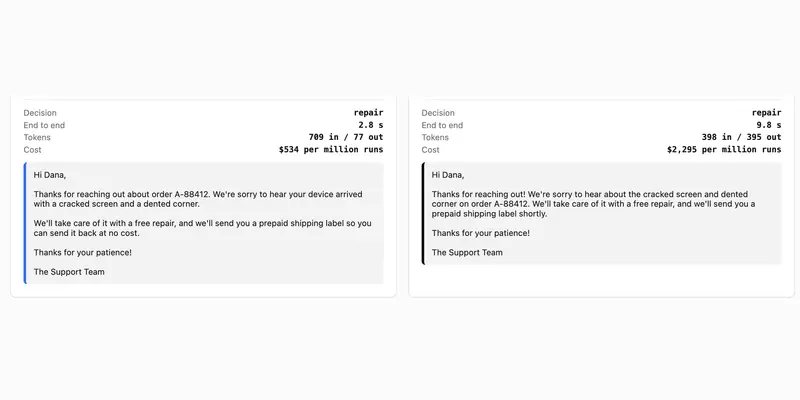
Cascade vs. one LLM: Clairic, Clef and an LLM on Workers AI
Cloudflare's live demo, linked from the Clairic launch post, that sets a cascade of Clairic, Clef and an LLM on Workers AI against a single LLM. Co-author Michelle Chen's X thread says it shows the cascade 3.5x faster and 77% cheaper; the blog's own table gives about 3.2x and 49%. The demo lets you pick the LLM and its reasoning level. All figures are vendor-run.
Shared use cases
Patterns both Jev and Clairic list on their pages.
The short answer
Use Jev when the answer is one of a set you can list: a queue, a yes or no, a severity level. Use Clairic when the answer is a value sitting in the input, or one or two steps of arithmetic away from it: an invoice total, a due date, the days since delivery. They do different jobs and fit in one pipeline. Clairic extracts the values, Jev decides on them, and an LLM writes anything that needs writing.
They come from different vendors with different APIs. Jev is TypeSafe AI’s decision model, generally available since 15 September 2026. Clairic is Cloudflare’s extraction model, in preview on Workers AI since 19 October 2026. Cloudflare calls both System One models and credits TypeSafe with the idea. TypeSafe had not commented on the extraction class as of 19 October 2026.
Jev vs Clairic at a glance
| Jev | Clairic | |
|---|---|---|
| Maker | TypeSafe AI | Cloudflare |
| Class | Decision | Extraction |
| Status | Generally available, no waitlist | Preview, which Cloudflare calls an early checkpoint |
| Request | state and questions |
state and fields |
| Answer types | Choice, Score, Noul; Box on the 1.14 preview only | text, number, date, time, datetime, duration, list, estimate, forecast |
| What comes back | A probability per option, or per level, or of yes | A value, or null, with p_null, confidence and guess; text answers carry a span |
| Where to call it | TypeSafe’s API, OpenRouter, and Cloudflare’s catalogue as typesafe/jev |
Workers AI as @cf/cloudflare/clairic |
| Input | Text; images behind an opt-in header TypeSafe says is not production-ready | Text, plus up to 4 PNG, JPEG or WebP images |
| Context window | 64,000 tokens per request, 32,000 for state plus the longest question | 65,536 tokens; fields split into parallel passes of 8,192 tokens |
| Input price per million tokens | $0.042, output free | $0.10, output free |
| Speed | 70ms to 500ms (TypeSafe’s claim); 127ms median per task for 1.13 on the Artificial Analysis Decision Index | No general figure; “typically under a second”; 0.46 s for one extract step (Cloudflare’s run) |
| Weights | Closed, API only | Not released; promised after “a few tweaks”, no date or licence |
| SDKs | Python and TypeScript | None listed; call from a Worker or the REST API |
| Independent benchmarks | Artificial Analysis Decision Index, Jev Decision Index, JevBench | None as of 19 October 2026 |
Sources: Jev’s figures from TypeSafe’s models page and the model page on this site; Clairic’s from the Workers AI model page, checked 19 October 2026, and Cloudflare’s launch post.
What each model returns
Jev answers questions you define. A Choice question lists options and gets a probability for each; a Choice takes up to 255 options. A Score gets a level on a scale you define. A Noul gets one number, the probability that the answer is yes. Choice, Score and Noul has full examples. Jev writes no text, and TypeSafe’s jaggedness page for 1.13 says it “is not trained to generate text.”
Clairic fills in fields you name. A text field returns a span copied from the input, with its offsets. A number field can be read or computed: Cloudflare’s support-email example adds $649.00 and $52.10 tax to get 701.1, a figure the email never states. date, time and datetime come back in ISO form, duration in the unit you choose, and list as matching items in input order. An estimate returns a distribution inside your bounds with a median and an 80% interval, and a forecast returns one estimate per future step. Every scalar answer carries p_null, the probability that the value is not in the input.
What Jev cannot return
Jev can only answer with something you offered it. It cannot write out an order number, a total or a name it was not given as an option. TypeSafe’s own workaround is to do extraction in reverse: code finds candidate values, a Choice question picks the right one, and code copies it. The structured extraction use case walks through it. That works when a regex or parser can find the candidates. It does not work for a value that has to be computed, or one no pattern can find.
When a list might be incomplete, TypeSafe’s Choice docs advise adding an “other” or “none of the above” option, so an unexpected input is not forced into a listed bucket. A Noul can screen for the same thing as a yes or no. Both tell you the answer is off your list. Neither tells you what it is.
Cloudflare’s graphic for the launch, “Clef decides. Clairic extracts.”, shared on X by co-author Michelle Chen, makes the same point with a llama that a pig, cow or horse Choice cannot name. It is an illustration, and the decision model in it is Clef. The Clef vs Clairic page covers it.
What Clairic cannot do
Clairic does not pick from options. It has no Choice, Score or Noul, so “which queue?” or “is this a refund request?” is not its shape. It also writes no prose.
Cloudflare lists the preview’s limits itself: long calculations, estimates without evidence, calibration on unfamiliar data and forecasting. The Clairic page has the detail. Cloudflare’s terms for the model also say it “may cease providing it”.
The APIs are not compatible
A Jev request has state and questions. A Clairic request has state and fields, each field with a type and optional instructions, plus optional images and a reference_date for dates written without a year. Clairic’s response puts one answer per field under answers, with a usage block that reports passes and schema tokens. Jev’s SDKs do not call Clairic, and Clairic has no SDK of its own listed. Running both means two request formats in your code.
Accounts can be one or two. Jev is on TypeSafe’s API with a TypeSafe key, and on OpenRouter. Cloudflare also lists Jev in its own model catalogue as typesafe/jev, with a 32,000-token context at $0.042 per million input tokens and $0.00 for output, checked 20 October 2026, so both models may run under one Cloudflare account. That listing does not say whether a TypeSafe key is also needed, so check it before you rely on it.
Price
Both bill only for input. Jev costs $0.042 per million input tokens and Clairic $0.10, so per token Clairic costs a little under two and a half times as much. At list prices, 10,000 calls of 500 input tokens each is 5 million tokens: $0.21 on Jev and $0.50 on Clairic.
That arithmetic leaves out Clairic’s schema tokens. Its input bill counts the field definitions as well as the state. In the invoice example on its model page, the field definitions took 472 of 655 input tokens. Cloudflare says thirty fields cost about the same as three, but long instructions still add up. Jev speed and pricing covers Jev’s side.
Using Jev and Clairic together
The two cover each other’s gaps. TypeSafe’s jaggedness page for Jev 1.13 lists arithmetic, counting and date comparison as weak spots; Jev “reads dates as text, not as ordered quantities.” Those are the things Clairic was built to read and compute.
A refund request shows the shape.
- Clairic reads the customer’s message and returns the order id as a span, the amount paid, and the days since delivery as a duration.
- Your code checks
p_nullon each field and compares the numbers against your policy. Jev’s jaggedness page lists numbers as weak too, so thresholds belong in code, not in a question. - Jev reads the message, with the extracted values added to the state, and answers the judgment questions: is this a damage claim, is the customer asking for a human, which team takes it.
- An LLM writes the reply, if one is needed.
Cloudflare’s own version of this pipeline uses its Clef for step 3, not Jev. In its claims test, Clairic, then Clef, then GLM-5.3 took 19.3 s end to end against 61.7 s for GLM-5.3 at every step, and $6,032 per million claims against $11,740. The blog calls that about 3.2x faster and 49% cheaper. Michelle Chen’s X thread says the live demo shows 3.5x faster and 77% cheaper. The two sets of figures disagree. The demo runs live and lets you pick the LLM and its reasoning level, so its figures depend on that setup. All are vendor-run, and nobody has published a measured Clairic and Jev pipeline.
When to use which
- The answer is one of a known set. Jev. Add an “other” option if the set might be incomplete.
- The answer is a value you cannot list. Clairic: totals, dates, durations, names, order numbers.
- The answer needs a sum or a date difference. Clairic for one or two steps; code for anything longer. Not Jev.
- You need a forecast or an interval. Clairic, within the limits Cloudflare states.
- You need a calibrated probability on a yes or no. Jev’s Noul.
- You need both. Clairic first, then Jev on the extracted values.
- You need an independent benchmark before you commit. Jev has three boards. Nobody outside Cloudflare has measured Clairic yet.
- You need a model out of preview. Jev. Clairic is a preview Cloudflare may withdraw.
FAQ
Is Clairic a Jev alternative?
No. Jev is a decision model and Clairic an extraction model, so they answer different kinds of question. Jev picks from options you list and gives each a probability. Clairic returns values you could not list, such as a total or a date. Their APIs are not compatible. If you want a Jev-compatible model on Cloudflare, that is Clef.
Can Jev extract values like Clairic?
Only in reverse. Jev cannot write out a value it was not offered. TypeSafe’s workaround is to find candidate values with code, ask a Choice question to pick the right one, and copy it. That works when a parser can find the candidates. For a computed value, such as a total with tax added, Jev has no way to return it.
Is Clairic more expensive than Jev?
Per input token, yes. Clairic costs $0.10 per million input tokens on Workers AI and Jev $0.042 on TypeSafe’s API. Neither charges for output. Clairic also counts the field definitions as input, which in the invoice example on its model page took 472 of 655 input tokens.
Can I use Jev and Clairic in one pipeline?
Yes, with two request formats. Clairic extracts typed values, your code checks them, and Jev decides on them. Cloudflare’s own pipeline uses Clef for the decision step, and nobody has published results for a Clairic and Jev pipeline. Cloudflare also lists Jev in its own model catalogue, so both may run under one Cloudflare account.
Does Jev read images like Clairic?
Clairic takes up to four PNG, JPEG or WebP images per request as part of its preview. Jev reads text by default. Since 14 October 2026 TypeSafe accepts PNG and JPEG images on Jev 1.13 and 1.14 behind an opt-in header, which it says is not ready for production.
Examples
Introducing Clairic, a new System One class of extraction models
Cloudflare's launch post for Clairic, a preview extraction model on Workers AI that returns typed values such as spans, numbers, dates, estimates and forecasts with probabilities. It sets out extraction as a second System One class beside decision models and gives Cloudflare's own forecast and claims-pipeline results.
Cloudflare122k viewsOpenIntroducing Clairic, a new System One class of extraction models on blog.cloudflare.comCascade vs. one LLM: Clairic, Clef and an LLM on Workers AI
Cloudflare's live demo, linked from the Clairic launch post, that sets a cascade of Clairic, Clef and an LLM on Workers AI against a single LLM. Co-author Michelle Chen's X thread says it shows the cascade 3.5x faster and 77% cheaper; the blog's own table gives about 3.2x and 49%. The demo lets you pick the LLM and its reasoning level. All figures are vendor-run.

Jev on Cloudflare Workers AI
Cloudflare Workers AI model catalog page for TypeSafe Jev, documenting the state plus questions request shape and the Noul, Choice and Score answer types. Examples cover ticket routing, refund review and risk assessment.