Specifications side by side
Read from each model's page, so a change there updates this table. A blank field is dated to the day that model's page was last checked.
| Specification | Clef | Clairic |
|---|---|---|
| Vendor | Cloudflare | Cloudflare |
| Status | Generally available | Early access |
| Access | Hosted API | Hosted API |
| Question or field types | Choice, Score, Noul | Text, Number, Date, Time, Datetime, Duration, List, Estimate, Forecast |
| Input price | $0.24 per 1M tokens | $0.1 per 1M tokens |
| Output price | Free | Free |
| Total context | 65,536 tokens | 65,536 tokens |
| State budget | Not published as of 14 Oct 2026 | Not applicable |
| Latency | 38.8 to 209.3 ms1 | Not published as of 20 Oct 2026 |
| Max Choice options | Not published as of 14 Oct 2026 | Not applicable |
| Score levels | Not published as of 14 Oct 2026 | Not applicable |
| Rate limit | Not published on the Workers AI model pages as of 2026-10-02. | Not published on the Workers AI model page as of 19 October 2026. |
| SDKs | None listed | None listed |
| Licence | Apache-2.0 | Not published as of 20 Oct 2026 |
| Jev Decision Index, Full score | 53.08 scorev0.3.1, 10 Oct 2026 | Not published as of 20 Oct 2026 |
| Jev Decision Index, Public score | 61.71 scorev0.3.1, 10 Oct 2026 | Not published as of 20 Oct 2026 |
| Jev Decision Index, Expected calibration error | 0.0395 ECEv0.3.1, 10 Oct 2026 | Not published as of 20 Oct 2026 |
| JevBench, Capability Score | 75.3 scorev1.7.46, 12 Oct 2026 | Not published as of 20 Oct 2026 |
| CLINC150+OOS, macro-F1 | 97.43 scorevendor-run1 Oct 2026 | Not published as of 20 Oct 2026 |
| BANKING77, macro-F1 | 94.2 scorevendor-run1 Oct 2026 | Not published as of 20 Oct 2026 |
| Artificial Analysis Decision Index, Index score | 48.6 scorev1.0, 13 Oct 2026 | Not published as of 20 Oct 2026 |
| Artificial Analysis Decision Index, Expected calibration error | 0.1224 ECEv1.0, 13 Oct 2026 | Not published as of 20 Oct 2026 |
| Artificial Analysis Decision Index, Cost per 1M tasks | 199 USDv1.0, 13 Oct 2026 | Not published as of 20 Oct 2026 |
| Artificial Analysis Decision Index, Time per task | 309 msv1.0, 13 Oct 2026 | Not published as of 20 Oct 2026 |
| TSA checkpoint forecast (Cloudflare), Mean error | Not published as of 14 Oct 2026 | 3.3 %vendor-run19 Oct 2026 |
| TSA checkpoint forecast (Cloudflare), Days inside the 80% interval | Not published as of 14 Oct 2026 | 17 of 21vendor-run19 Oct 2026 |
| Claims pipeline (Cloudflare), End-to-end latency | Not published as of 14 Oct 2026 | 19.3 svendor-run19 Oct 2026 |
| Claims pipeline (Cloudflare), Extract step latency | Not published as of 14 Oct 2026 | 0.46 svendor-run19 Oct 2026 |
| Claims pipeline (Cloudflare), Cost per million claims | Not published as of 14 Oct 2026 | 6032 USDvendor-run19 Oct 2026 |
| Docs and console | developers.cloudflare.com | developers.cloudflare.com |
- 1 Clef: Vendor-run, from Cloudflare's launch post, across the 43 evals it ran: median latency 209.3ms for Clef and 38.8ms for Clef-flash, against 524.1ms for Jev, 51.4ms for Kev-9B and 5.8ms for Laya.
Examples in the directory
7 Clef examples
The top 3 by stars and views. All Clef examples.

Introducing Clef: our open-source decision models, and new RL fine-tuning platform
Cloudflare's launch post for Clef and Clef-flash, two decision models on Workers AI that accept the Jev request format and open weights under Apache 2.0. It covers the architecture, Cloudflare's own benchmark tables against Jev, Kev and Laya, and a new reinforcement learning service.
 Michelle Chen (@michellechen)140k viewsOpenIntroducing Clef: our open-source decision models, and new RL fine-tuning platform on blog.cloudflare.com
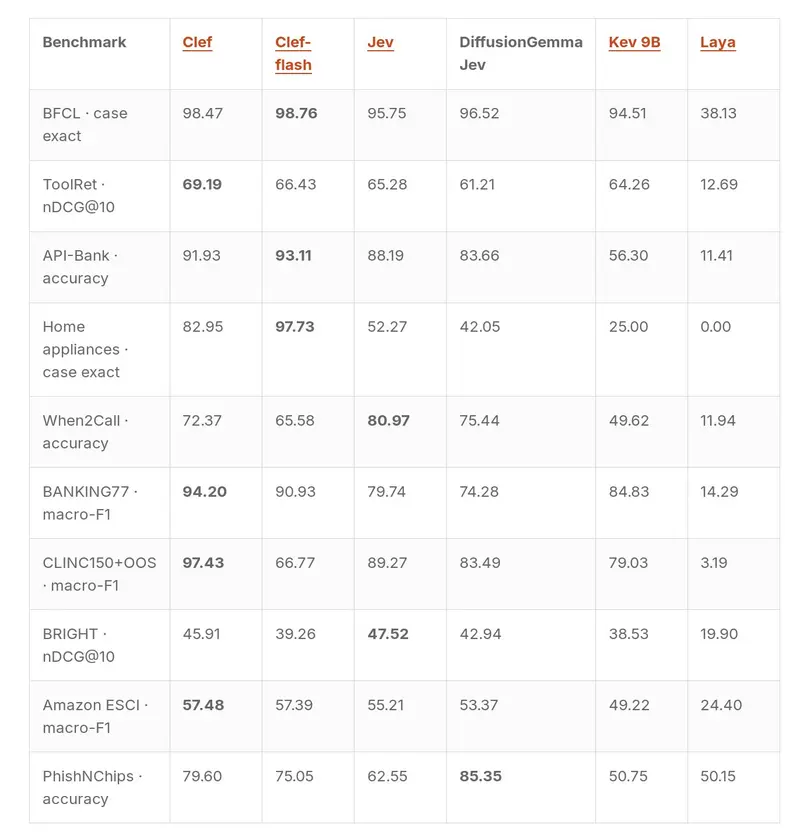
Decision Model Leaderboard
Cloudflare's live leaderboard for decision models on the Jev Decision Index suite, with Clef, Clef-flash, Jev, Kev-9B and Laya plotted by score and latency. Cloudflare built and ran it, so treat the ranking as vendor-run.
 Cloudflare (@ritakozlov)41k viewsOpenDecision Model Leaderboard on clef-evals.workers-ai-mle.workers.dev
Cloudflare/clef: open weights on Hugging Face
Apache 2.0 weights for Cloudflare's 27B Clef decision model, post-trained from Qwen3.8-27B, that reads text and images. The smaller 9B Clef-flash is published next to it as Cloudflare/clef-flash.
2 Clairic examples
The top 2 by stars and views. All Clairic examples.

Introducing Clairic, a new System One class of extraction models
Cloudflare's launch post for Clairic, a preview extraction model on Workers AI that returns typed values such as spans, numbers, dates, estimates and forecasts with probabilities. It sets out extraction as a second System One class beside decision models and gives Cloudflare's own forecast and claims-pipeline results.
 Cloudflare122k viewsOpenIntroducing Clairic, a new System One class of extraction models on blog.cloudflare.com
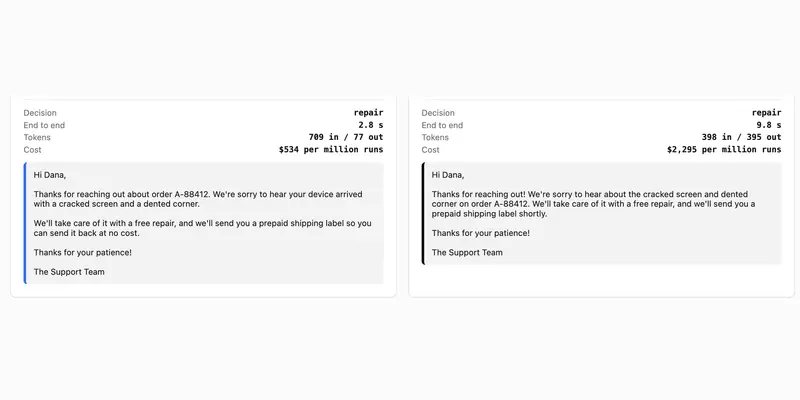
Cascade vs. one LLM: Clairic, Clef and an LLM on Workers AI
Cloudflare's live demo, linked from the Clairic launch post, that sets a cascade of Clairic, Clef and an LLM on Workers AI against a single LLM. Co-author Michelle Chen's X thread says it shows the cascade 3.5x faster and 77% cheaper; the blog's own table gives about 3.2x and 49%. The demo lets you pick the LLM and its reasoning level. All figures are vendor-run.
The short answer
Use Clef when you know the possible answers and want a probability for each. Use Clairic when the answer is a value in the input, or computed from it, that you could not list in advance: a total, a date, the number of days a parcel is late. Cloudflare built them to run in sequence. Its test pipeline has Clairic extract the values, Clef decide on them and an LLM write the reply.
Both are Cloudflare models on Workers AI that answer in one parallel pass and bill only for input tokens. Clef is a decision model, generally available since 1 October 2026, with open weights under Apache 2.0. Clairic is the first extraction model, in preview since 19 October 2026, with weights promised but not released as of 19 October 2026.
Clef vs Clairic at a glance
| Clef | Clef-flash | Clairic | |
|---|---|---|---|
| Class | Decision | Decision | Extraction |
| Status | Generally available | Generally available | Preview, which Cloudflare calls an early checkpoint |
| Workers AI id | @cf/cloudflare/clef |
@cf/cloudflare/clef-flash |
@cf/cloudflare/clairic |
| Request | state and questions |
state and questions |
state and fields |
| Answer types | Choice, Score, Noul | Choice, Score, Noul | text, number, date, time, datetime, duration, list, estimate, forecast |
| What comes back | A probability for every option you listed | A probability for every option you listed | A value, or null, with p_null, confidence and guess; text answers carry a span |
| Questions or fields per request | 1 to 64 | 1 to 64 | No limit; split into parallel passes of 8,192 tokens |
| Input | Text, JSON, images, video; up to 4 images per request | Text, JSON, images, video; up to 4 images per request | Text, plus up to 4 PNG, JPEG or WebP images |
| Context window on Workers AI | 65,536 tokens | 24,576 tokens | 65,536 tokens |
| Input price per million tokens | $0.24, output free | $0.038, output free | $0.10, output free |
| Speed | 209.3ms median across 43 evals at launch; 152ms at about 800 tokens after the 9 October speedup (Cloudflare’s runs) | 38.8ms median at launch (Cloudflare’s run) | No general figure; “typically under a second”; 0.46 s for one extract step (Cloudflare’s run) |
| Weights | Apache 2.0 on Hugging Face | Apache 2.0 on Hugging Face | Not released; promised after “a few tweaks”, no date or licence |
| Independent benchmarks | Jev Decision Index, Artificial Analysis Decision Index, JevBench | Same three | None as of 19 October 2026 |
Sources: the Workers AI model pages for Clef and Clef-flash, checked 10 October 2026, and for Clairic, checked 19 October 2026; Cloudflare’s Clef and Clairic launch posts. Every speed figure here is vendor-run.
What each model does
Clef reads a state and answers typed questions. A Choice question names the options and gets a probability for each. A Score question gets a level on a scale, and a Noul gets the probability of yes. Choice, Score and Noul covers all three. Clef’s request format is the one Jev uses, which Cloudflare calls “fully Jev-API compatible”.
Clairic reads a state and fills in named fields. Each field has a type and optional plain-language instructions. A text field returns a span of the input with its start and end offsets. A number field can be read or computed: in Cloudflare’s support-email example, Clairic adds $649.00 and $52.10 tax to get 701.1, a figure the email never states. An estimate returns a distribution inside the bounds you set, with a median and an 80% interval. Every scalar answer carries p_null, the probability that the value is not in the input. When it is missing, value is null and guess shows what the model would have picked.
The two APIs are not interchangeable. Clairic takes fields and returns answers keyed by field name. A Clef client cannot call Clairic without new request and response code.
What Cloudflare’s “Clef decides. Clairic extracts.” graphic shows
Cloudflare published a graphic, shared on X by Michelle Chen, a co-author of the Clairic launch post, with one input: “Spotted a llama grazing by the barn this morning.” Clef is given a Choice of pig, cow and horse, and returns cow at 60% with a confidence of 0.19. Clairic is given a text field and returns “llama” with a confidence of 0.99. The caption says Clef “can only pick from your list”.
It is an illustration of the two shapes. Nothing in the post says these are real model outputs.
The point it makes is fair: a decision model cannot name an answer you did not list. The graphic leaves out two things a decision-model user would do. TypeSafe’s Choice docs advise adding an “other” or “none of the above” option when your list might not cover every case, so an off-list animal has somewhere to go. Clef takes the same Choice type. And a confidence of 0.19 is low enough that a confidence gate would send the answer to review rather than act on it. Neither fix gets you the word “llama”. For that you need an extraction model or an LLM.
Price
All three bill only for input tokens. Clairic, at $0.10 per million, costs more than twice as much as Clef-flash at $0.038 and less than half as much as Clef at $0.24.
Count the field definitions. Clairic’s input bill covers the state, any images and the schema. In the invoice example on its model page, the field definitions took 472 of the 655 input tokens. Cloudflare says asking for thirty fields costs about the same as three, but the definitions you write still count. Clef bills images at the input rate.
Speed
Cloudflare publishes medians for Clef and none for Clairic. At launch it measured 209.3ms for Clef and 38.8ms for Clef-flash across 43 evals. After its 9 October serving changes, Clef’s median was 152ms at about 800 tokens. For Clairic, Cloudflare says only that Clairic and Clef “typically respond in under a second”. In its claims pipeline, the Clairic extract step took 0.46 s and the Clef decide step 0.22 s. All of these are Cloudflare’s own runs. Time both from your own region.
Using them together
Cloudflare’s summary of the split: “Extraction models turn raw input into typed values, decision models turn values into decisions, and LLMs turn decisions into words.” In practice the chain looks like this.
- Clairic reads the raw message and returns typed fields: an order id as a span, the amount paid, the days since delivery.
- Your code checks
p_nulland confidence, and does any longer arithmetic itself. - Clef takes the message plus those values as its state and answers the decision questions: approve, escalate or refuse.
- An LLM writes the reply, given the decision.
Cloudflare ran this as a claims pipeline: Clairic, then Clef, then GLM-5.3 for the reply, against GLM-5.3 doing every step. These figures are vendor-run.
| Step | Cascade | GLM-5.3 for every step |
|---|---|---|
| Extract | Clairic, 0.46 s | 16.1 s |
| Decide | Clef, 0.22 s | 21.9 s |
| Reply | GLM-5.3, 18.6 s | 16.4 s |
| End to end | 19.3 s | 61.7 s |
| Cost per million claims | $6,032 | $11,740 |
The blog’s table calls that about 3.2x faster and 49% cheaper. Michelle Chen’s X thread says Cloudflare’s live demo shows the same cascade 3.5x faster and 77% cheaper. The two sets of figures disagree. The demo runs live and lets you pick the LLM and its reasoning level, so its figures depend on that setup. Neither is independent. Cloudflare says both pipelines got the facts and the decision right in every run, and that Clairic’s repair estimate was the same each time while GLM-5.3’s varied.
Most of the cascade’s remaining time is the LLM reply. The saving comes from taking extraction and the decision out of the LLM.
Where each one stops
Clef writes no text and cannot return a value that is not one of its options. Clef-flash scores well below Clef on some of Cloudflare’s own tasks, such as CLINC150+OOS.
Clairic does not pick from options. Cloudflare lists the preview’s limits itself: long calculations, estimates without evidence, calibration on unfamiliar data and forecasting. One- and two-step calculations “seem reliable”, in Cloudflare’s words. The Clairic page has the detail. Cloudflare’s terms for the model also say it “may cease providing it”.
When to use which
- The answer is one of a known set. Clef. Add an “other” option if the set might be incomplete.
- The answer is a value you cannot list. Clairic: amounts, dates, durations, names, order numbers.
- The answer needs one or two steps of arithmetic on values in the text. Clairic, with longer sums left to code.
- You need a forecast or an estimate with an interval. Clairic, within the limits Cloudflare states.
- You need both. Clairic first, then Clef on the extracted values.
- Cost per call is the main limit for a decision. Clef-flash, at $0.038 per million input tokens.
- You need weights you can run yourself today. Only Clef. Clairic’s are promised, with no date.
- You need an independent benchmark before you commit. Only Clef has one. Nobody outside Cloudflare has measured Clairic yet.
FAQ
Is Clairic a replacement for Clef?
No. They do different jobs. Clef picks from options you list and gives each a probability. Clairic returns values you could not list in advance, such as a total or a date. Cloudflare’s own pipeline runs Clairic first and Clef second, then an LLM for the reply. Most workflows that need both will chain them rather than choose.
Can Clef extract values like Clairic?
Not directly. Clef can only return one of the options you give it, so it cannot write out a total or a date. You can find candidate values in code and ask a Choice question to pick the right one. For values you cannot list, such as a free-text name or a computed sum, Clairic is the Cloudflare model built for it.
Is Clairic cheaper than Clef?
Cheaper than Clef, dearer than Clef-flash. On Workers AI, Clairic costs $0.10 per million input tokens, Clef $0.24 and Clef-flash $0.038. None charges for output. Clairic’s input includes the field definitions, which in the invoice example on its model page took 472 of 655 input tokens, so long field instructions add to the bill.
Are Clairic’s weights open like Clef’s?
Not yet. Clef and Clef-flash are on Hugging Face under Apache 2.0. Cloudflare says it intends to release Clairic’s weights soon, and co-author Michelle Chen says the team wants to make “a few tweaks” first. No date or licence has been given as of 19 October 2026.
Is the llama example a real Clef output?
Nothing says so. It comes from a graphic Cloudflare published to show the difference between the two models, and should be read as an illustration. Its point stands: a Choice question cannot name an answer you did not list. An “other” option and a confidence gate would catch the miss, but not name the animal.
Examples
Introducing Clef: our open-source decision models, and new RL fine-tuning platform
Cloudflare's launch post for Clef and Clef-flash, two decision models on Workers AI that accept the Jev request format and open weights under Apache 2.0. It covers the architecture, Cloudflare's own benchmark tables against Jev, Kev and Laya, and a new reinforcement learning service.
Michelle Chen (@michellechen)140k viewsOpenIntroducing Clef: our open-source decision models, and new RL fine-tuning platform on blog.cloudflare.comIntroducing Clairic, a new System One class of extraction models
Cloudflare's launch post for Clairic, a preview extraction model on Workers AI that returns typed values such as spans, numbers, dates, estimates and forecasts with probabilities. It sets out extraction as a second System One class beside decision models and gives Cloudflare's own forecast and claims-pipeline results.
Cloudflare122k viewsOpenIntroducing Clairic, a new System One class of extraction models on blog.cloudflare.comCascade vs. one LLM: Clairic, Clef and an LLM on Workers AI
Cloudflare's live demo, linked from the Clairic launch post, that sets a cascade of Clairic, Clef and an LLM on Workers AI against a single LLM. Co-author Michelle Chen's X thread says it shows the cascade 3.5x faster and 77% cheaper; the blog's own table gives about 3.2x and 49%. The demo lets you pick the LLM and its reasoning level. All figures are vendor-run.