 Play the video (opens in a new tab)
Video on YouTube by Rob Shocks
- Views
- 389,036
- Duration
- 10:36
Read from YouTube on . Counts change daily.
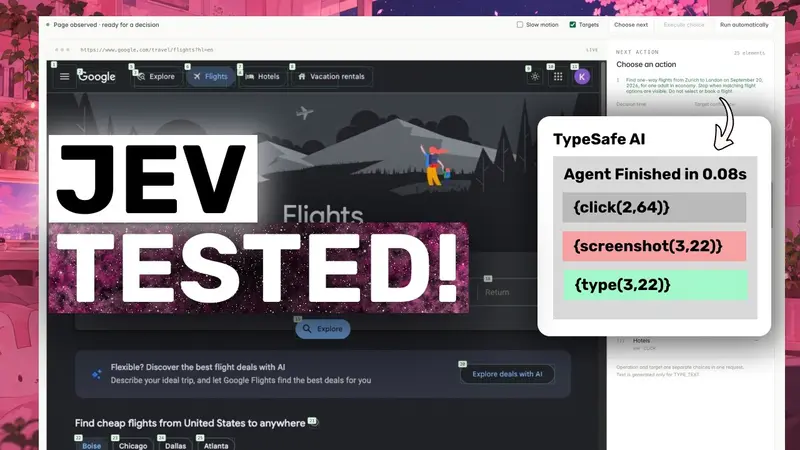
Rob Shocks explains Jev as a model that returns decisions for code to act on instead of text for people to read. He covers the three question types with a support-ticket example: a choice between billing, technical and sales, a score for how frustrated the customer sounds, and a noul (a yes/no question answered with a probability) such as “is this urgent?”. He also relays numbers from TypeSafe and early users, including Vercel’s report that swapping Gemini 2.5 Flash Lite for Jev on a classification task was 6x faster, and a Doom-playing demo that cost about $7 to run for an hour.
The second half is hands-on in the TypeSafe playground. He runs the Wikipedia link race (Jev finishes in 1.7 seconds), the smart-home demo, where commands like “turn on the living room lights” come back in 185 ms, and the sample requests for sky color, help-desk priority, team routing and tool selection. Each result shows the probability per option and a confidence value.
His takeaway for developers: look for the decision points in your system that currently go through an LLM, and check whether they can be recast as a typed question with fixed answers. He points to model routing, guardrail checks and tool selection in agents as the obvious first candidates.