Jev returns a confidence value from 0 to 1 alongside every Choice and Score answer. Your code treats it as a separate axis: act automatically when it's high, confirm or flag when it's middling, hand the decision to a person when it's low. Riskier actions get higher bars.
One Jev call reads an incoming request and returns its intent as a label plus a difficulty rating on a scale you wrote. Your router reads both numbers and picks the handler: deterministic code, a cheap model, an expensive one, or a human queue.
Send a support ticket to Jev once with every question attached. Category comes back as a selected label, severity and frustration as numbers on scales you wrote, refund intent as a probability. Your code reads those values and decides what happens to the ticket.
Ask Jev one Choice question over your tool names and one per closed-set argument, so every value that comes back is a value the function already accepts. Nouls decide whether an optional argument was mentioned at all. Your code assembles the call and runs it.
Browser Use's fast browser agent where Jev picks the operation and the DOM element in a single request; a small LLM is only invoked to write text when typing is required. Demoed on a Google Flights search.
Official agent skill for Claude Code, Codex and other agent environments; installs via claude plugin marketplace add typesafe-ai/skills or npx skills add typesafe-ai/skills. MIT licensed.
MCP server that gives Claude Code, Codex, Amp, OpenCode and other agents ten Jev judgment tools, each returning typed probabilities they can branch on. The author calls it early software.
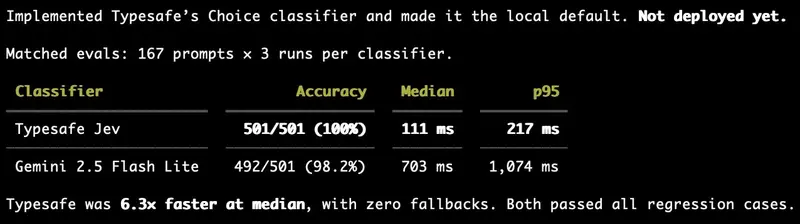
Vercel CTO reports Jev saturated an existing classifier eval that had used Gemini 2.5 Flash Lite and ran about 6x faster. Original post; TypeSafe's quote-tweet is a separate item.
Cloudflare's launch post for Clef and Clef-flash, two decision models on Workers AI that accept the Jev request format and open weights under Apache 2.0. It covers the architecture, Cloudflare's own benchmark tables against Jev, Kev and Laya, and a new reinforcement learning service.
AI News daily roundup leading with the Jev launch, summarising RLCD and TypeSafe's 20-200x speed and 40-400x cost claims. Its recap of reactions notes posters using Jev as a structured classifier, judge and routing policy where text generation is unnecessary.
The 1,978-point, 513-comment launch thread. The top comment calls the speed comparison misleading, since Jev only returns structured output, and disputes the cannot-hallucinate claim because a valid type can still hold a wrong value. Others note ordinary LLMs can already be forced into structured output.
Declares typed input/output Signatures for LLM modules and optimizes the underlying prompts and weights against a metric. Its Signature abstraction is the closest widely-used open equivalent of Jev's typed-question interface. Star count is GitHub's rounded display figure.
Guarantees valid structured output during generation by constraining decoding to a grammar or schema. The mechanism HN commenters repeatedly cited as already covering Jev's cannot-produce-a-type-error guarantee on ordinary LLMs. Star count is GitHub's rounded display figure.
Pydantic-based library that extracts typed, validated structured data from LLMs across providers with automatic retries. The established way teams get Jev-style typed answers today, at LLM latency and cost. Star count is GitHub's rounded display figure.
Fine-tunes Sentence Transformer embeddings plus a lightweight head for high-accuracy classification from a handful of labeled examples, with no prompting. The standard cheap alternative to an LLM classification call when the label set is fixed. Star count is GitHub's rounded display figure.