
What GLiDE is
GLiDE, short for Generalized Lightweight Decision Engine, is Fastino’s hosted System One model. It reads a state, which can be a string, an object or a list of messages, and answers typed questions about it: Noul for yes or no, Choice for one option from 2 to 255, and Score for a level on an ordered scale of up to 255. Each answer comes back with a probability for every option and a confidence value, and nothing is written as prose. You call POST /v1/systemone with model set to fastino/GLiDE, the same request shape Jev uses. Fastino launched it on 30 September 2026.
Thinking on uncertain cases
Fastino says GLiDE gives a fast first answer, then spends extra reasoning when the leading option is not clear, and folds that reasoning into the final probabilities. Fastino aims this at arithmetic, code tracing, dates and policy questions, where a single fixed pass struggles. The thinking tokens share the 40,000-token context with the state and are reported as output tokens, which are billed at zero. Fastino’s pages do not give a parameter count or a base model.
Price and access
The price is $0.15 per million input tokens, against $0.042 for Jev. You need a Fastino account and API key. The endpoint does not stream, does not take a batch of separate states, and does not accept fine-tuned deployments. GLiDE was not on OpenRouter’s decisions list on 12 October. No weights are published: the Jev Decision Index row carries the note “Open weights coming soon”.
What the benchmarks show
The row on the Jev Decision Index (multimodalart’s community board on Hugging Face) is named “Fastino GLiDE no-thinking (28B)”, so it is a checkpoint with thinking switched off. The Index does not say whether it is the hosted endpoint. In the file generated on 12 October 2026, its Full score is 60.21 against Jev’s 60.11, its public score is 59.06 against 57.96, and its expected calibration error, the average gap between stated confidence and actual accuracy, is 0.0398 against 0.074. A gap of 0.1 on the Full score is inside the board’s own tie margin.
Fastino reports 64.81 on the older 0.2.1 version of the Index, which it ran itself. That figure is vendor-run, and the Index changed its suite in 0.3.
JevBench on Benchmark Heaven measured the hosted API on 6 October and gives it a Capability Score of 77.0, with Intelligence 66.1 and Calibration 87.95. The board shows hosted APIs for comparison and does not rank them. It measured a median of 0.743 seconds per decision.
The Artificial Analysis Decision Index v1.0, published on 13 October 2026, ranks GLiDE second of the 11 decision models it lists, at 53.9 against 57.5 for Jev. It has the best WildGuardTest safety F1 of the 11, 95.1, and When2Call tool-calling accuracy of 83.7%, level with Celeris-1 Decision at the top. Its weakest test is the Humanity’s Last Exam reasoning questions, at 10.5%. Its calibration error, which this site computed from AA’s published bins, is the lowest of the 11 at 0.081. It cost $119 per million tasks, the third most, and took a median 217 ms per task. The Jev Decision Index puts GLiDE 0.1 above Jev on its Full score; Artificial Analysis puts it 3.6 below.
What it is not for
Fastino’s docs say to use a generative model for open-ended writing, conversation, summaries and code. Every question is single-label, so there is no multi-label type. Ask several named questions instead. The two Index figures come from a no-thinking checkpoint, so they may not describe what the hosted model does when it thinks.
Specifications
| System One Score | 94.2 from 3 of 3 boardsArtificial Analysis Decision Index 93.7, Jev Decision Index 96, JevBench 93. How the score works |
| Question types | ChoiceScoreNoul |
| Max Choice options | 255 |
| Score levels | Up to 255 |
| Questions per call | Not documented |
| Total context | 40,000 tokens |
| State budget | Not documented |
| Rate limit | Fastino's rate-limits page lists no limit for /v1/systemone. Its default for endpoints it does not list is 20,000 requests per minute and 1,000,000 per hour per client IP. Spending is capped by plan credits. |
| Endpoint | https://api.fastino.ai/v1/systemone |
| Licence | Not published as of 14 Oct 2026 |
| SDKs |
Each rendered prompt, the state plus one question, must fit in 40,000 tokens, and thinking tokens share that window. Oversized requests are rejected, not truncated. Choice takes 2 to 255 options and Score up to 255 levels. Every question is single-label. The endpoint does not stream, does not accept a batch of separate states, and does not take fine-tuned deployment IDs.
Versions
- fastino/GLiDE, 30 Sep 2026, The hosted model, called with model set to fastino/GLiDE. Fastino's pages checked do not state a parameter count or base model. Release notes
- Fastino GLiDE no-thinking (28B), The name of the Jev Decision Index row. The Index lists 27.8B served parameters, a full fine-tune, no base model, and the note "Open weights coming soon". No GLiDE weights were on Hugging Face under the fastino organisation on 2026-10-12. Release notes
Use cases
What people use GLiDE for, one page per pattern.
Agent routing and skill selection with System One models
An agent choosing from a long skill roster reads one truncated line per entry and often loads the wrong thing. Jev ranks every entry in one request and separately answers whether any skill applies at all, so the agent gets a short hint instead of a guess.
Confidence-gated actions with System One models
Jev returns a confidence value from 0 to 1 alongside every Choice and Score answer. Your code treats it as a separate axis: act automatically when it's high, confirm or flag when it's middling, hand the decision to a person when it's low. Riskier actions get higher bars.
LLM guardrails with System One models
Put one Jev request in front of an LLM and one behind it. Yes/no questions return the probability that each hazard holds, a Score rates how much harm complying would do, and your thresholds turn those numbers into pass, review, block, or a crisis path.
Support inbox triage with System One models
Send a support ticket to Jev once with every question attached. Category comes back as a selected label, severity and frustration as numbers on scales you wrote, refund intent as a probability. Your code reads those values and decides what happens to the ticket.
Semantic reranking with System One models
Keyword or vector search narrows thousands of documents to a shortlist but rarely puts the right one first. Ask Jev one yes/no question about each query and candidate pair, take the probability it returns as the score, and sort the shortlist by it, highest first.
Examples built with GLiDE
The most-starred and most-viewed entries in the directory. All GLiDE examples.
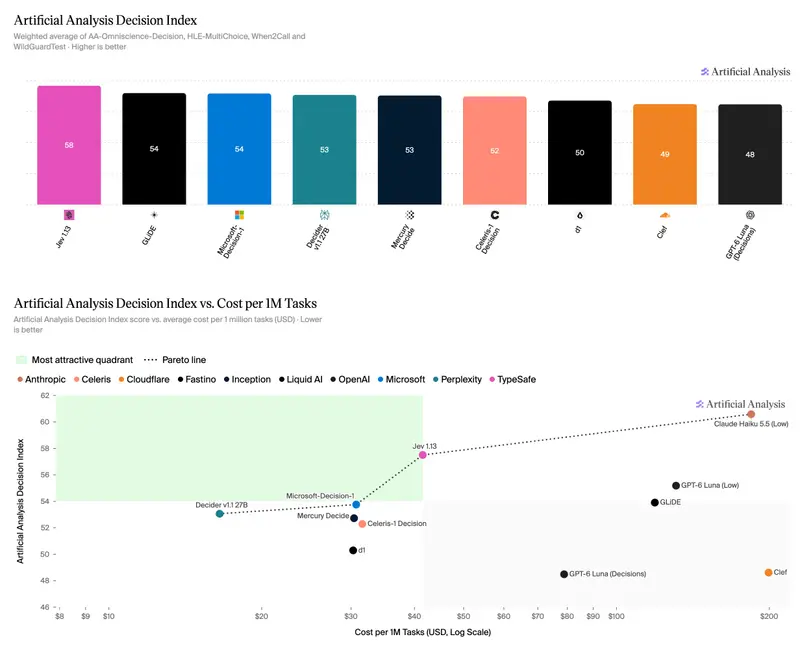
Artificial Analysis Decision Index: 11 hosted decision models against language models
Artificial Analysis scores 11 hosted decision models on knowledge, reasoning, tool-calling and safety tests, with cost and time per task, and runs language models on the same tests. Jev 1.13 leads the decision models at 58; Claude Haiku 5.5 (Low) scores 61 but takes 1.4 seconds per task against 0.13.
 Artificial Analysis (@ArtificialAnlys)45k viewsOpenArtificial Analysis Decision Index: 11 hosted decision models against language models on artificialanalysis.ai
Benchmarks
Published scores, each linked to its source. A row marked vendor-run was measured by the vendor itself, so read it as one side's result. The compare hub sets these beside the other models.
| Benchmark | Metric | Score | Run by | Date |
|---|---|---|---|---|
| Artificial Analysis Decision Index 1.0 | Index score | 53.9 score | Independent | 13 Oct 2026 |
| Artificial Analysis Decision Index 1.0 | Expected calibration error | 0.0812 ECE | Independent | 13 Oct 2026 |
| Artificial Analysis Decision Index 1.0 | Cost per 1M tasks | 119 USD | Independent | 13 Oct 2026 |
| Artificial Analysis Decision Index 1.0 | Time per task | 217 ms | Independent | 13 Oct 2026 |
| Jev Decision Index 0.3.1 | Full score | 60.21 score | Independent | 12 Oct 2026 |
| Jev Decision Index 0.3.1 | Public score | 59.06 score | Independent | 12 Oct 2026 |
| Jev Decision Index 0.3.1 | Expected calibration error | 0.0398 ECE | Independent | 12 Oct 2026 |
| JevBench 1.7.46 | Capability Score | 77 score | Independent | 12 Oct 2026 |
| Jev Decision Index (Fastino report) 0.2.1 | Overall skill score | 64.81 score | vendor-run | 30 Sep 2026 |
- Artificial Analysis Decision Index, Index score: Row: GLiDE. Sub-scores: Omniscience accuracy 36.4, non-hallucination 16.4, HLE-MultiChoice 10.5, When2Call 83.7, WildGuardTest F1 95.1.
- Artificial Analysis Decision Index, Expected calibration error: Row: GLiDE. Computed by this site from AA's published calibration bins (all answers pooled); AA does not publish an ECE. Lower is better.
- Artificial Analysis Decision Index, Cost per 1M tasks: Row: GLiDE. AA's measured cost at list prices on its four evals.
- Artificial Analysis Decision Index, Time per task: Row: GLiDE. Median time per task.
- Jev Decision Index, Full score: Row: Fastino GLiDE no-thinking (28B). Counts 20% public benchmarks and 80% private tests; 0 is random guessing, 100 is perfect. Jev scores 60.11.
- Jev Decision Index, Public score: Row: Fastino GLiDE no-thinking (28B). Jev scores 57.96.
- Jev Decision Index, Expected calibration error: Row: Fastino GLiDE no-thinking (28B). Lower is better. Jev scores 0.074.
- JevBench, Capability Score: Row: Fastino GLiDE, a hosted API offering that the board shows for comparison and does not rank. Intelligence 66.1, Calibration 87.95, measured 2026-10-06 on 600 items. The board re-measures rows, so this can differ from earlier editions.
- Jev Decision Index (Fastino report), Overall skill score: Fastino ran the official 0.2.1 scorer itself; Jev's published score on that version was 57.91. The Index has since moved to 0.3, which changed the suite and the headline score.