
What d1-ultra is
d1-ultra is Liquid AI’s larger hosted decision model, released on 15 October 2026. Liquid calls it its most powerful decision model and says it is built for hard cases, such as spotting a defect on a circuit board against its spec or checking a damage claim against the customer’s photo. It sits beside the smaller hosted d1 and uses the same request shape as Jev, so it is a System One model. Liquid says it is built on a larger open-weight model than d1, with Liquid’s own changes. It does not name that model or publish a parameter count. Liquid says it supports 44 languages.
What it returns
You send a state as text, images or both, plus one or more typed questions. A Noul returns a probability that the answer is yes. A Choice returns one label with a probability per label. A Score returns a position on a scale you define. It reads the input in one pass and generates no tokens.
What it is good at
The Artificial Analysis Decision Index scores it 65.2, the highest of the 13 decision models it lists, against 57.5 for Jev 1.13 and 50.3 for d1. Liquid’s blog says the lead is at least 8 points. AA’s own figures put it at 7.7. Five language model settings on the same board score higher. d1-ultra has the best When2Call tool-calling and WildGuardTest safety results of the 13, at 92.6% and 95.4 F1. Its calibration error, computed by this site from AA’s bins, is 0.018, also the lowest of the 13. That suits confidence-gated actions and LLM guardrails.
Liquid’s other numbers are its own. On a 112-evaluation suite it built, ran and has not published, it gives d1-ultra an average of 76.7 against 69.4 for Jev 1.14. It also reports a calibration error of 1.5 points against 2.7 for Jev 1.14 and 4.6 for d1. Nobody outside Liquid has reproduced these, and d1-ultra is not on the Jev Decision Index or JevBench as of 16 October 2026.
What it is not for
It writes no text, so drafts and explanations belong with a language model. Its knowledge accuracy on AA is 31.6%, below d1’s 41.0%, though it answers “I don’t know” instead of a wrong answer far more often. Test fact-heavy questions before you rely on it.
Access
d1-ultra is generally available on Liquid’s API. Create a key at console.liquid.ai and call POST https://api.liquid.ai/decisions/v1/systemone with "model": "d1-ultra". It costs $0.042 per million input tokens, the same as Jev, and output is free. OpenRouter and Vercel’s AI Gateway both list it as liquid/d1-ultra, with a 32,768-token context. Liquid’s docs had no page for it as of 16 October 2026. There are no downloadable weights.
Specifications
| System One Score | 100 from 1 of 3 boardsArtificial Analysis Decision Index 100. How the score works |
| Question types | ChoiceScoreNoul |
| Max Choice options | Not documented |
| Score levels | Not documented |
| Questions per call | Not documented |
| Total context | 32,768 tokens |
| State budget | Not documented |
| Rate limit | Liquid documents no rate limits for d1-ultra. |
| Endpoint | POST https://api.liquid.ai/decisions/v1/systemone |
| Licence | Not published as of 16 Oct 2026 |
| SDKs | Python: typesafe-sdkTypeScript: @typesafe-ai/sdk |
Liquid publishes no context length for d1-ultra. OpenRouter lists 32,768 tokens with a 29,491-token maximum completion, and Vercel's AI Gateway lists 32,768, both checked on 2026-10-16. Treat both as the gateways' figures. Liquid gives no limit on images per request, image size, Choice options, Score levels or questions per call for d1-ultra, and its docs did not mention the model as of 2026-10-16.
Versions
- d1-ultra, 15 Oct 2026, The launch model id on Liquid's API, called with "model": "d1-ultra" on the same endpoint as d1. Reads text, images or both. Liquid says it supports 44 languages and is built on a larger open-weight model than d1. It does not name that model or give a parameter count. Release notes
- liquid/d1-ultra on OpenRouter, 15 Oct 2026, OpenRouter's listing, snapshot liquid/d1-ultra-20261015, named LiquidAI: d1-ultra and served by Liquid. Text and image input, $0.042 per million input tokens, 32,768-token context. The launch post had called OpenRouter coming soon. Release notes
- liquid/d1-ultra on Vercel AI Gateway, 15 Oct 2026, Vercel's listing, named Liquid d1 Ultra, with a release date of 15 October 2026. Text and image input, $0.042 per million input tokens, 32,768-token context, checked on 2026-10-16. Release notes
Use cases
What people use d1-ultra for, one page per pattern.
Confidence-gated actions with System One models
Jev returns a confidence value from 0 to 1 alongside every Choice and Score answer. Your code treats it as a separate axis: act automatically when it's high, confirm or flag when it's middling, hand the decision to a person when it's low. Riskier actions get higher bars.
LLM guardrails with System One models
Put one Jev request in front of an LLM and one behind it. Yes/no questions return the probability that each hazard holds, a Score rates how much harm complying would do, and your thresholds turn those numbers into pass, review, block, or a crisis path.
Examples built with d1-ultra
The most-starred and most-viewed entries in the directory. All d1-ultra examples.
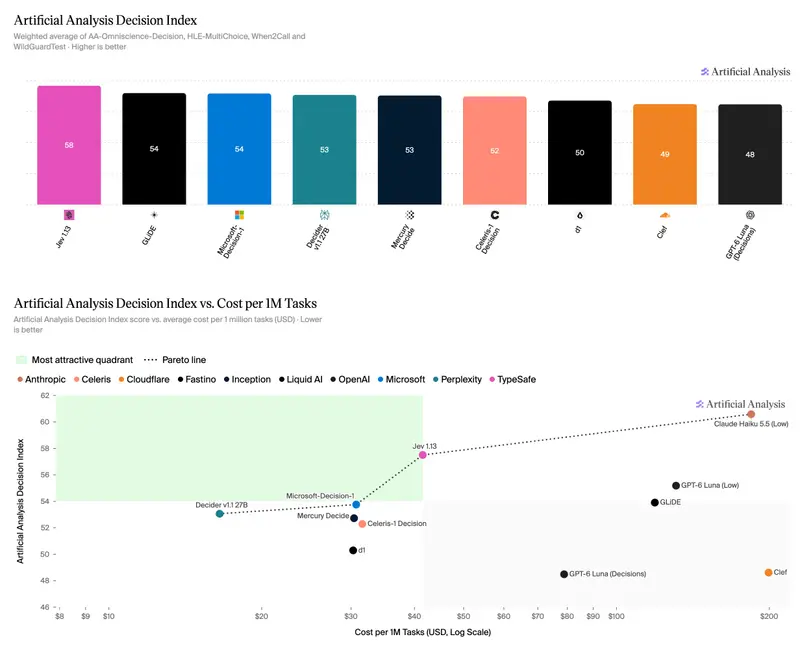
Artificial Analysis Decision Index: 11 hosted decision models against language models
Artificial Analysis scores 11 hosted decision models on knowledge, reasoning, tool-calling and safety tests, with cost and time per task, and runs language models on the same tests. Jev 1.13 led the decision models at launch at 58, and Liquid's d1-ultra, added by 15 October, now leads at 65; Claude Haiku 5.5 (Low) scores 61 but takes 1.4 seconds per task against 0.13.
 Artificial Analysis (@ArtificialAnlys)45k viewsOpenArtificial Analysis Decision Index: 11 hosted decision models against language models on artificialanalysis.ai
Benchmarks
Published scores, each linked to its source. A row marked vendor-run was measured by the vendor itself, so read it as one side's result. The compare hub sets these beside the other models.
| Benchmark | Metric | Score | Run by | Date |
|---|---|---|---|---|
| Artificial Analysis Decision Index 1.0 | Index score | 65.2 score | Independent | 15 Oct 2026 |
| Artificial Analysis Decision Index 1.0 | Expected calibration error | 0.0181 ECE | Independent | 15 Oct 2026 |
| Artificial Analysis Decision Index 1.0 | Cost per 1M tasks | 32 USD | Independent | 15 Oct 2026 |
| Artificial Analysis Decision Index 1.0 | Time per task | 93 ms | Independent | 15 Oct 2026 |
| Liquid 112-evaluation suite | Average | 76.7 score | vendor-run | 15 Oct 2026 |
- Artificial Analysis Decision Index, Index score: Row: d1-ultra. Sub-scores: Omniscience accuracy 31.6, non-hallucination 84.5, HLE-MultiChoice 15.0, When2Call 92.6, WildGuardTest F1 95.4. Highest of the 13 decision models AA lists, checked on 2026-10-16. Liquid's launch post cited the score on 15 October 2026.
- Artificial Analysis Decision Index, Expected calibration error: Row: d1-ultra. Computed by this site from AA's published calibration bins (all answers pooled); AA does not publish an ECE. Lower is better.
- Artificial Analysis Decision Index, Cost per 1M tasks: Row: d1-ultra. AA's measured cost at list prices on its four evals.
- Artificial Analysis Decision Index, Time per task: Row: d1-ultra. Median time per task.
- Liquid 112-evaluation suite, Average: Row: d1-ultra. Liquid built and ran this suite itself and has not published it. Its chart gives Jev 1.14 69.4 and d1-ultra the top score in all eight categories.