An answer with citations is only as good as the citations. Match each quote against the source in code to catch fabrications, then ask Jev one Choice question about how the surrounding section relates to the claim. Confidence decides which verdicts a human reviews.
Two catalogues describe overlapping sets of the same products, and a rough first pass hands you candidate pairs. One Jev Score question with a level per outcome decides each pair, and yes/no questions about individual fields tell a curator where the two sources disagree.
Retrieval returns whatever looks similar, including noise and hostile text. Put a Jev call between retrieval and generation: four yes/no questions per passage return probabilities, and your code decides which passages become evidence, which get flagged as conflicts, and which never reach the prompt.
Keyword or vector search narrows thousands of documents to a shortlist but rarely puts the right one first. Ask Jev one yes/no question about each query and candidate pair, take the probability it returns as the score, and sort the shortlist by it, highest first.
AI News daily roundup leading with the Jev launch, summarising RLCD and TypeSafe's 20-200x speed and 40-400x cost claims. Its recap of reactions notes posters using Jev as a structured classifier, judge and routing policy where text generation is unnecessary.
Compact encoder model that takes the label set as input at inference time and extracts arbitrary entity types zero-shot on CPU. Same classifier-that-takes-its-categories-as-input shape, for extraction rather than decisions. Star count is GitHub's rounded display figure.
Modernized BERT encoder used as the backbone for fast fine-tuned classifiers and rerankers. The non-generative baseline Jev's cost and latency claims are usually measured against. Star count is GitHub's rounded display figure.
Agent skills for Hermes, Claude Code and Codex that hand Jev the routing decisions: which model tier to use, which search results to open, which memory passages to read and which hide injected instructions. Ships a dashboard with an on, shadow and off switch and publishes measured latencies per skill.
Web search in plain language where Jev chooses sources, time ranges and search terms, then scores each result for relevance, with retrieval through Search1API. Returns links and snippets with visible relevance scores and editable filters, and writes no answers.
A grep that matches lines by meaning instead of regular expressions: Jev scores each line against a plain-language description and the tool applies a threshold, combining meanings with AND, OR and NOT.
Fish-style autosuggestions for zsh ranked by Jev. As you type, the plugin sends your last 100 distinct history entries and asks which one you are most likely completing, then shows the best match in grey with its score for you to accept.
Independent reimplementation inspired by jevlike that scores pre-written options in one batched forward pass by log-probability over a local Gemma 3 4B, shipping an HTTP server, CLI and a TypeSafe System One API implementation.
Browser agent that indexes the page into candidate actions and has Jev pick one, so it cannot click something that was never on the page, while an LLM plans and reads. Every claim in an answer cites a quote stored verbatim from the page, and Jev checks the claim against its quote.
A VS Code extension that finds past Claude Code, Codex and OpenCode conversations from a plain-language description, using a local Laya model to rerank the keyword search results.
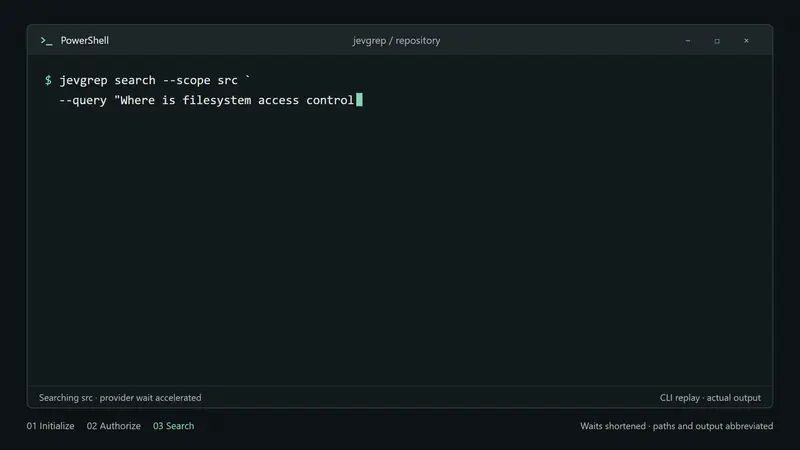
Semantic code search for coding agents: it scans an authorized repository, asks Jev to score all eligible fragments against a plain-English question, and returns the original source excerpts with their paths and line numbers.