aoprisan/typesafe-ai-rust-sdk
Unofficial Rust client mirroring the official Python SDK's environment variables, defaults, retry semantics and error classification. Published as the typesafe-ai-sdk crate.
Entries 193 to 240 of 250, in the hub's default order. The introduction is on page 1.
Showing 193 to 240 of 250
Unofficial Rust client mirroring the official Python SDK's environment variables, defaults, retry semantics and error classification. Published as the typesafe-ai-sdk crate.
Unofficial PHP SDK for the System One API supporting yes/no, category and scoring questions, with synchronous calls and asynchronous requests via Guzzle promises.
LLM-agnostic guardrails library using Jev to detect prompt injection, jailbreak attempts, PII exposure and credential leaks in one batched request. Not published to PyPI at time of check.
Unofficial Go SDK for the Jev API with deliberately minimal abstractions over Choice, Noul and Score.
Answers four routing questions about an agent turn, model tier, effort, tools and skill, in a single Jev call under 350ms with a hard deadline, and ships a Claude Agent SDK adapter.
A macOS menu bar app that serves Laya over an OpenAI-compatible HTTP endpoint, so n8n's Text Classifier node can run email classification locally with no cloud call and no Dock window.
Idiomatic Elixir client for the TypeSafe AI API with configuration-driven auth, retries, telemetry and test support. Returns judgments as data structures the caller thresholds itself.
PostgreSQL extension that runs Laya decision-model inference natively inside the database, using Rust and Candle.
Runs Laya's English typed-decision checkpoint on a Windows machine with an AMD Radeon RX 6900 XT (gfx1030) GPU through a pinned PyTorch ROCm build, with an optional Jev-compatible HTTP loopback service.
A community Unity package, installable via the Package Manager git URL, giving a backend-independent C# client for typed Choice/Score/Noul decisions against local Laya servers or TypeSafe-compatible endpoints.
 0x440-1meOpenLaya Unity on github.com
A Home Assistant conversation integration that routes spoken or typed commands through Jev for intent classification and device control instead of a general-purpose LLM.
A local computer-use runtime for Codex and Waku that adds a Jev fast path alongside Cua.
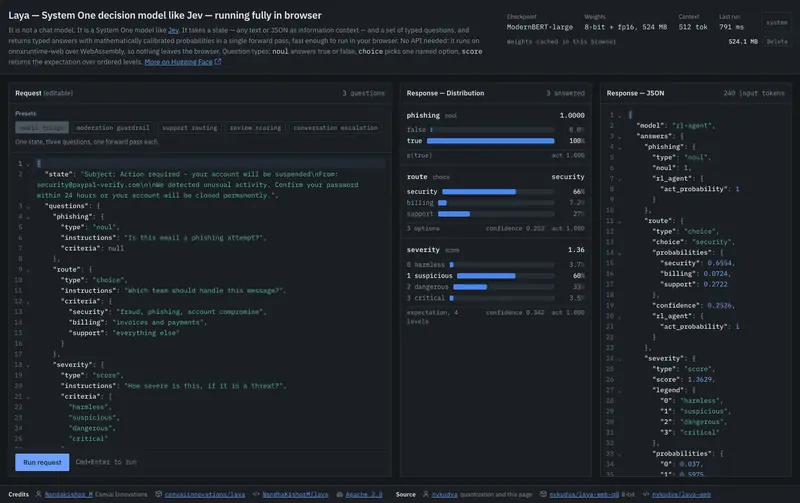
Laya's English checkpoint quantized to 8-bit and run entirely client-side via onnxruntime-web WebAssembly, with an editable JSON playground, three question types, calibrated confidence and weights cached in the browser.
A Clay agent skill and Python workflow that scores and ranks B2B leads with Jev for prospect qualification and people search.
 promptgtm-sharedOpenpromptgtm-shared/clay-jev-people-ranker on github.com
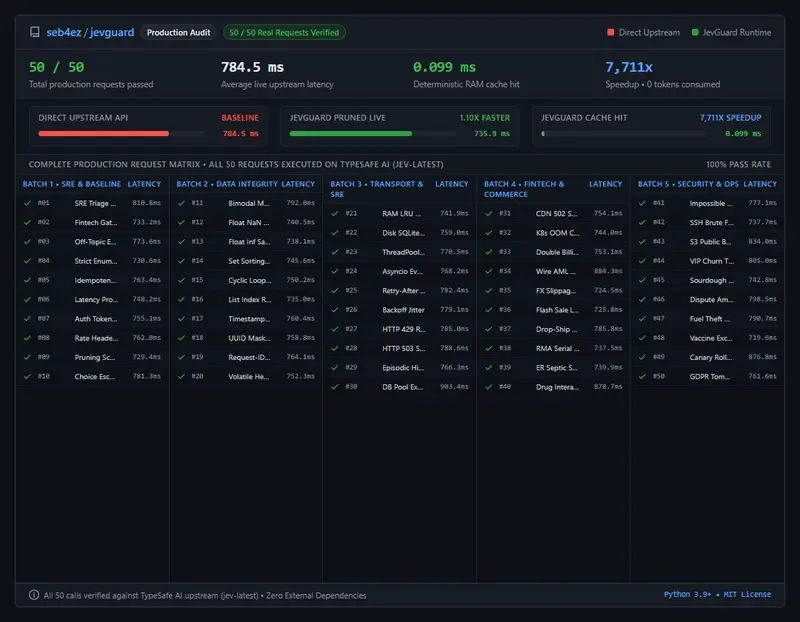
A deterministic decision runtime for Jev with zero-token caching and a certainty calibrator for gating actions on confidence.
TypeScript library for typed decisions across Jev, Cloudflare AI Gateway and Laya, with both Promise-based and Effect-native clients.
 lukeramsdenOpensystem-one on github.com
Watches recent agent steps for semantic stagnation, meaning different actions that still chase the same contradicted assumption. Jev reads the trajectory and a small deterministic policy returns CONTINUE, WARN, REPLAN or HALT.
 AshutoshVJTIOpenAshutoshVJTI/progressgate on github.com
A local MCP gateway that uses Jev for tool discovery across connected MCP servers, with credential storage, a CLI and a dashboard.
 prasanth263Openprasanth263/maza on github.com
A Go client library for the TypeSafe API, wrapping Jev's endpoints for Go projects.
 RadixILS-DevOpenRadixILS-Dev/typesafe-sdk-go on github.com
n8n community node for the System One API exposing typed yes/no, choice and score questions with calibrated probabilities a workflow can branch on. Self-hosted n8n only until n8n verifies the package.
A speed layer for computer-use tasks on Solari: one structured observation, one Jev decision, and one verified action per step, for both browsers and Linux desktops, with no screenshots in the loop.
A Rust CLI that reads completed Claude Code and Codex sessions, scores them with Jev, and suggests specific changes to your agent instructions, skills and tools based on where work went well or got stuck.
Four Claude Code hooks that use Jev for cheap, calibrated judgment calls inside the agent loop: a danger gate that blocks destructive tool calls, a failure notice, a completion check, and a scope check.
Searches an Obsidian vault locally and offline with a BM25 engine, then reranks the top results with Jev only after you approve exactly what gets sent to it.
Go 1.27 client with generic typed questions (jev.Noul, jev.Choice, jev.Score, plus jev.Raw). Supports batching, retries, and Vercel AI Gateway as an alternative backend.
A native Swift library that runs Laya inside a macOS app on Apple MLX, with no Python, ONNX or helper process, answering typed choice, boolean and score questions at 27.1ms p50 on an M3 Max.
An MCP server and HTTP sidecar around Laya that fixes its silent failure modes: a token-budget preflight before truncation happens, structured errors naming the bad question, and confidence labelled for what it actually measures.
A stateless CLI for typed judgments with Jev, turning a state plus typed questions into JSON on stdout and exit codes a shell script can branch on.
 model-clisOpenmodel-clis/jev on github.com
An MCP server that lets Claude hand a whole browser task to Jev, which makes each click, type or select decision in about 100ms while Claude keeps planning the task and verifying the result.
 MSalvalaggioOpenMSalvalaggio/jev-reflex on github.com
Moderation for communities and apps that scores every message for spam, scam, harassment and other categories with Jev, with thresholds and actions you set. Ships as Discord, Telegram and Reddit bots plus a CLI, Python and npm packages, an HTTP API and an MCP server.
 ohernandezdevOpenohernandezdev/jevmod on github.com
A capability kernel that gates every agent tool call: the model gets canaries and placeholders instead of real secrets, and Jev is one of the sensors deciding block, ask, or allow.
Unofficial typed Elixir client for TypeSafe AI and Jev with offline test stubs, concurrent fan-out and atom-keyed answers.
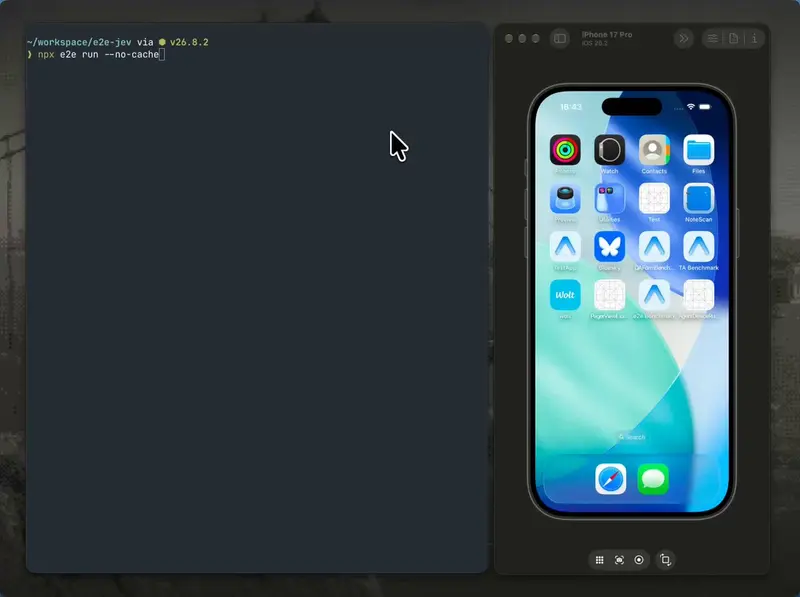
An open source framework for running end to end tests with agents, built with Jev, covering web and mobile targets.
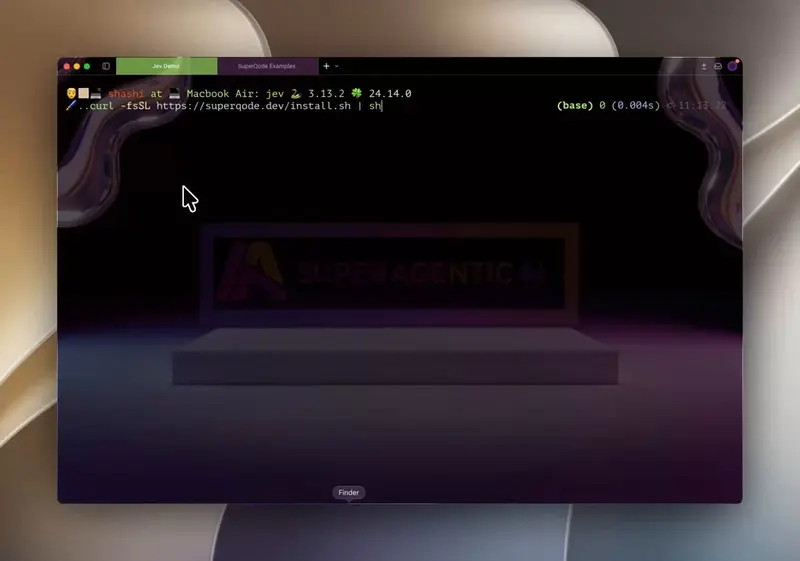
Open source harness layer for coding agents that added Jev as an opt-in System One decision layer, used for typed tool gates, decision packs, and rubric checks while coding models still write the code.
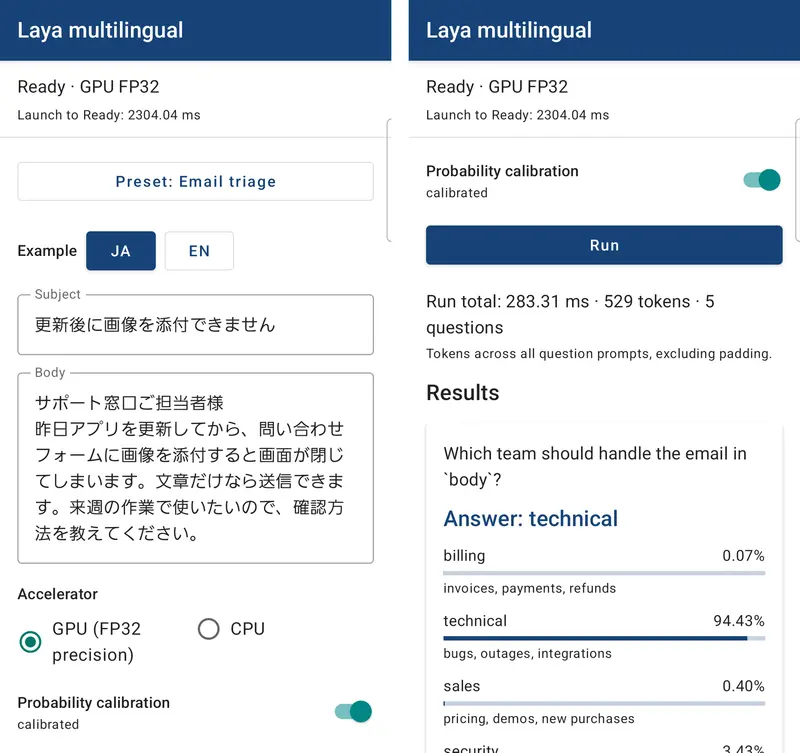
Google's LiteRT conversion of Laya's multilingual checkpoint for on-device Android GPU inference, matching the official CPU implementation on 201 validation rows with a Kotlin sample app answering typed choice, score and noul questions.
A vision variant of Laya, an independent SmolVLM-256M based fork, that answers calibrated choice, score and noul questions about an image plus optional text in one forward pass, with a trained score head.
Laya's multilingual checkpoint fine-tuned on 701 Burmese SIB-200 examples for seven-way topic classification, reaching 0.716 test accuracy versus a 0.441 zero-shot baseline, with temperature-scaled calibrated probabilities.
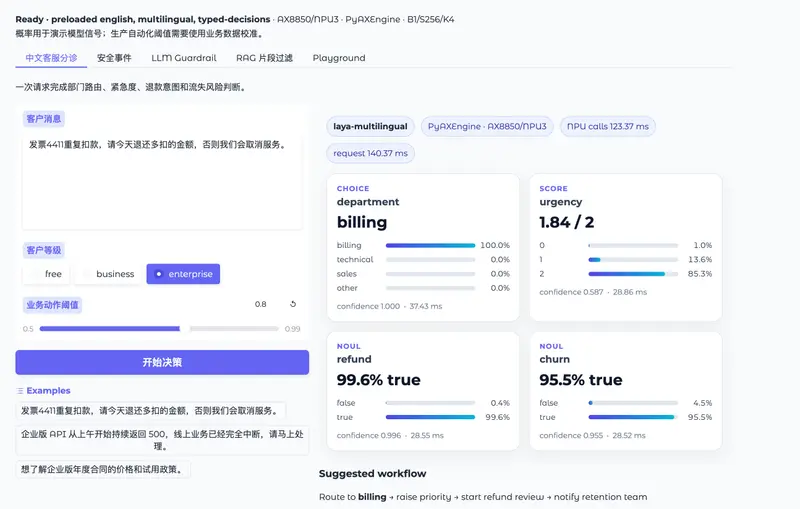
A ready-to-run deployment package for all three Laya checkpoints (English, multilingual, typed-decisions) on Axera AX650/AX8850 edge NPUs, with sample requests, outputs and a demo app via the axllm runtime.
Laya fine-tuned for Arabic NLU on laya-multilingual, covering intent classification, natural language inference and offensive-language detection. On MASSIVE ar-SA intent classification it reached 81.6 percent accuracy against 38.6 percent for stock Laya.
Laya's English checkpoint compiled to GGUF with ggmlc, scoring choice, score and noul questions in one encoder pass with a CLI that ships an injection-guard preset and a local serve/daemon mode.
Convai's own Gradio Space running Laya live across eight workflow tabs, including support triage, LLM guardrails, RAG passage filtering and multilingual checkpoint routing, each returning typed choice, score and noul probabilities.
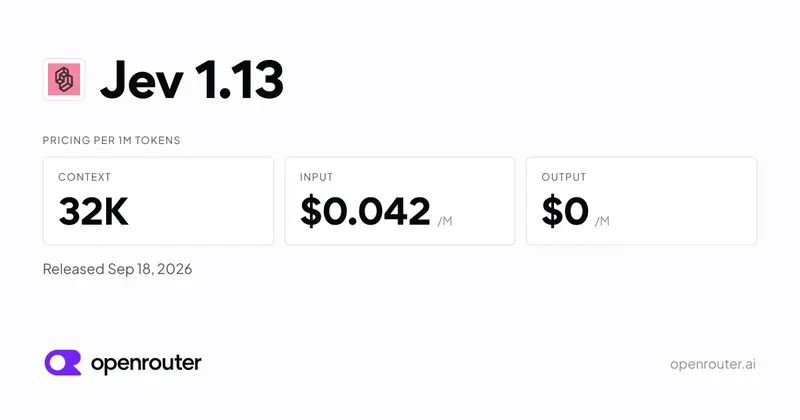
OpenRouter's model page for Jev 1.13, which runs on OpenRouter's Decisions API rather than its OpenAI-compatible chat endpoint. Listed at $0.042/M input and $0/M output with a 64,000-token context on 10 October 2026, up from 32,000 when added in September.
Laya fine-tuned on 671 Mind2Web examples to predict the next browser action, an operation and a target element index, from a page's DOM and a goal, reaching 74.3% validation accuracy.
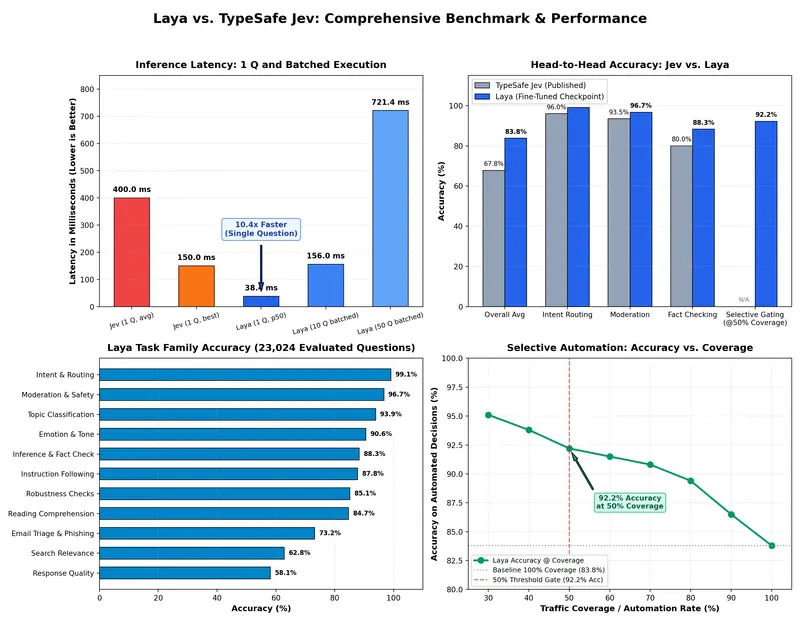
An ONNX export of Convai's Laya decision model, with int8 and fp16 variants and a Python quickstart that builds the marker-token sequence and runs one inference in about 15ms on CPU.
Async Python client for Jev, version 1.1.0, requiring Python 3.12+ and aiohttp. Supports Noul, Choice and Score and encourages batching multiple questions into one call.

Vercel changelog announcing Jev on AI Gateway under model ID typesafe-ai/jev. Evaluation calls appear in Gateway logs, count toward budgets and accept Gateway provider options.
PyPI listing for the official Python SDK, version 0.6.0, MIT licensed. Requires Python 3.10+.
Official AI SDK provider exposing Jev through the experimental evaluate API in AI SDK 7. Supports Choice (1-255 options), Score (2-10 ordered levels) and Boolean/Noul, batching all questions in one request against the same state.
Nothing matches those filters
Clear a filter to widen the search, or send us the thing you were looking for.


