madeye/pi-jev
A speed-focused Pi extension that pairs a local coding model with hosted Jev judgments, using file retrieval and exact-result caching to reduce context and repeated network calls.

Tool
Entries 97 to 144 of 250, in the hub's default order. The introduction is on page 1.
Showing 97 to 144 of 250
A speed-focused Pi extension that pairs a local coding model with hosted Jev judgments, using file retrieval and exact-result caching to reduce context and repeated network calls.
A task-boundary model router for the Pi coding agent: Jev judges task tier, context sufficiency and consequences, and deterministic code decides whether to switch models based on your configured capabilities and costs.
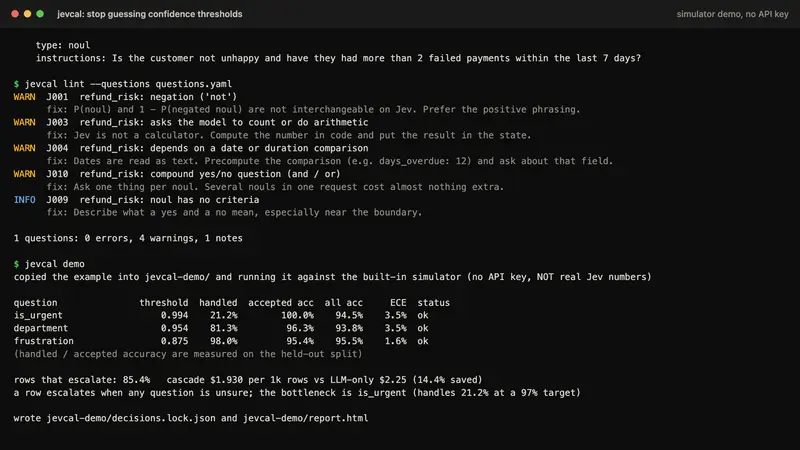
Fits a per-question confidence threshold to your accuracy target on your own labeled data, checks it on a held-out split, reports how much traffic still needs an LLM, and fails CI when a model update breaks the locked thresholds. Publishes no Jev numbers on purpose.

Agent skill for designing judgment-assisted systems with Jev, where code stays in control and the model supplies narrow typed judgments. It maps Choice, Score and Noul onto classical methods such as decision theory, reranking and routing, and requires a falsifying experiment before a design is treated as settled.
A GitHub App that routes pull-request review work: it sends the PR context to Jev, gets back a structured risk decision such as low, normal or specialist, and a policy layer maps that to auto-approval, a review request, or a check-run update.
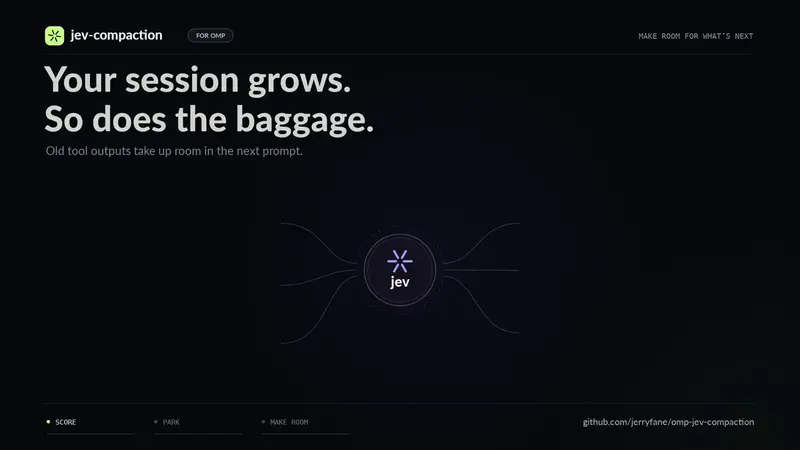
An omp plugin that scores every old tool output with Jev, keeps what is still needed, and parks the rest on disk, cutting context by 29 to 55 percent across the author's own sessions at about $0.0005 per scoring pass.
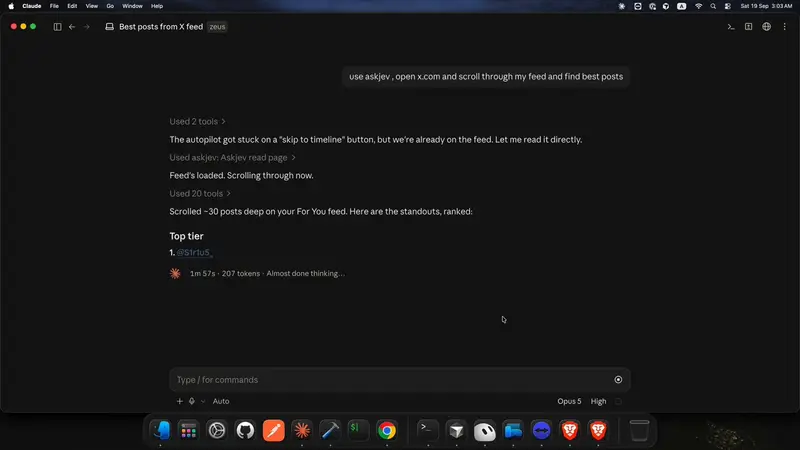
An MCP server and Chrome/Brave extension that lets Claude drive a real browser in plain English, with Jev deciding each click, tab switch, or form fill and a guard freezing irreversible actions.
Laya inference ported to Jolt, running Clojure on Chez Scheme, with a confidence gate that escalates uncertain answers from the Laya encoder to a GGUF chat model scored by token log probabilities.
Recursive Choice over a taxonomy. Jev can only list 255 options in one choice question, so jev-tree walks a JSON shape and calls it once per level or partition, letting you select among thousands of leaves.
Community .NET SDK for the System One API with typed noul, choice and score questions returning confidence-scored answers. States it is not affiliated with TypeSafe AI.
A GitHub Action that asks Jev a set of yes/no questions about a pull request, answered in parallel in one call, and approves it only when every answer clears a confidence threshold you set.
Pure-Rust inference for Laya built on candle, with CPU, Metal and CUDA backends, no Python, torch or ONNX export step, and weights pulled straight from the Apache-2.0 checkpoint.

A CLI that turns AGENTS.md preferences into Jev-checked semantic rules, reviewing code hunks or pull requests with typed choice and noul questions and feeding findings back to a coding agent.
MCP server exposing Jev as typed judgment tools (classify, score, check, batched ask) and shipping as a Claude Code plugin. Runs via npx jev-mcp.
Command line search that asks a yes/no question of every function in a codebase and ranks the answers by the probability that the answer is yes. It is grep whose pattern is a question, not embedding search, and the author measured 1,302 functions of gin-gonic/gin in 3.7 seconds for $0.018.
Ruby client for typesafe.ai, MIT licensed, requiring Ruby 3.1+. Defaults to jev-latest.
A TypeScript library for controlling websites with plain-English instructions on top of the full Playwright API, similar to Stagehand but with Jev making the browser decisions instead of a generative LLM.
Reproducible calibration and selective-risk benchmarks for Jev decisions inside DSPy workflows. Runs offline for confidence gating, latency and cost modelling without live API calls.
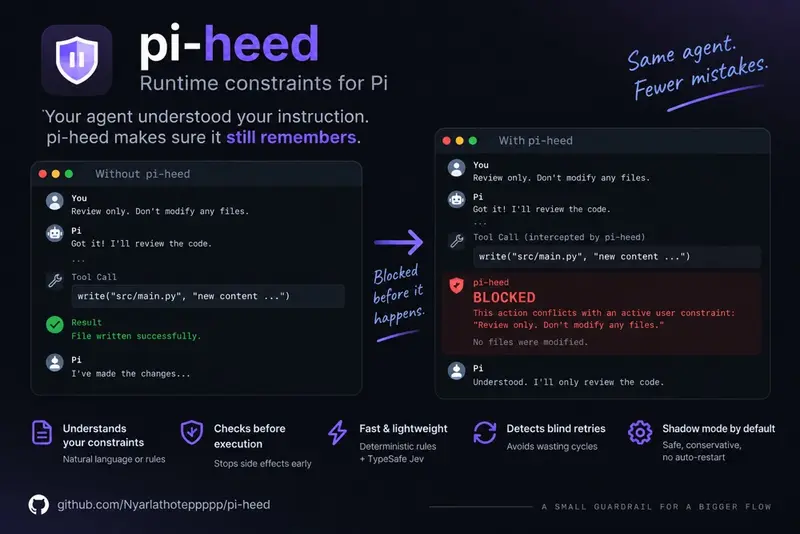
Runtime constraints for the Pi coding agent that check every side-effecting tool call against what you actually said before it runs, using your own words as the reason when it blocks a call.
Combines native Playwright browser operations with Jev decisions over actual page elements, exposed as a typed SDK, a CLI and an MCP server, with native actions running without any AI key.
Runs Laya and Kev decision models inside the browser: a zero-dependency Rust engine compiled to WebAssembly with WebGPU kernels, downloading a pinned int8 model pack and answering choice, score and noul questions with no server or API key.
A pure-Java 17+ SDK that ports the Python Laya decision framework into a deployable inference library, running on Apache 2.0 multilingual checkpoints via ONNX Runtime and the Hugging Face Hub.
Composable Python toolkit for the Jev decision API bundling question builders, confidence gates, an evaluator, calibration tooling, a CLI, an MCP server over stdio and an agent skill.
Hybrid coding harness for the Pi agent: any LLM writes the code while Jev returns typed probabilities, and deterministic policy code turns those into allow, confirm, block, warn or steer. Isolation stays with containers, so it is not a sandbox.
Routes MCP tool discovery for Codex through Jev instead of exposing hundreds of tool schemas directly to the agent: Jev sees the request and the tool names, and above a 0.90 threshold the agent gets one tool and its schema instead of the full list.
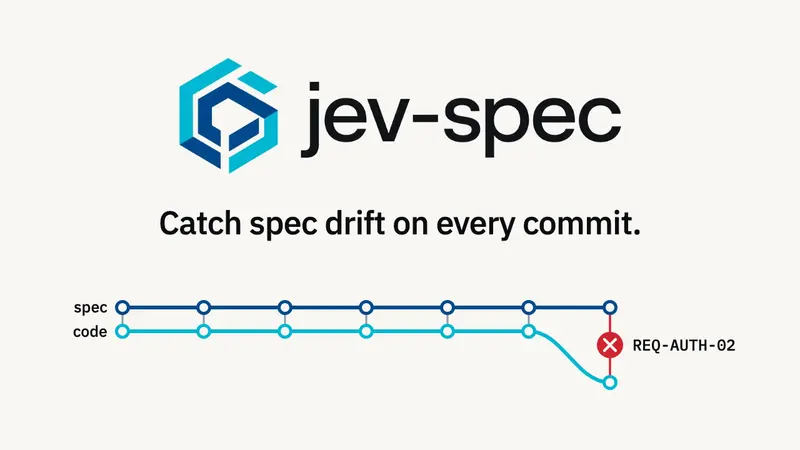
Checks your code against Markdown specs on every commit by asking Jev one focused question per requirement and comparing the returned probability with a threshold you set, failing the build on drift.
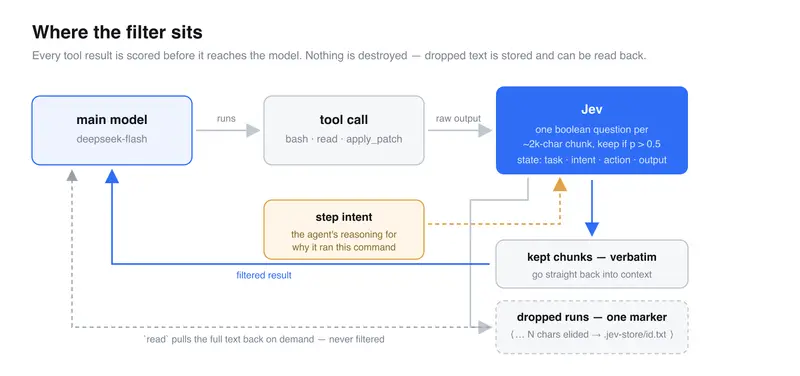
Filters every tool result through Jev before the coding model reads it, with an A/B harness that measures pass@1 and cost against an unfiltered control.
Independent Rust SDK with async and blocking clients, typed Noul/Choice/Score questions, model discovery, configurable retries and cancellation. Published to crates.io as typesafe-ai-rs.
Elixir SDK for the TypeSafe AI API, bringing Choice, Score and Noul decisions into OTP processes and GenServers. Published on Hex as typesafe_sdk.
Community Go SDK for the TypeSafe AI Jev / System One API.
A pi agent extension that curates the context sent to the LLM before each call, using a one-question-per-unit Jev judgment to decide which prior messages are still needed.
A dependency-free Zig CPU runtime that reads Laya's safetensors weights directly and runs the full forward pass, tokenizer included, in one binary; marked work in progress, with a CLI, browser UI and a Snake probe.

Browser automation for coding agents that the author reports as 3 to 5 times faster than browser-use, with Jev deciding each step in about 300ms.
Native Rust inference for Laya using the Candle framework, with fused Metal kernels and tiled attention tuned for M1 Pro, loading Laya's original safetensors with no Python runtime.
Labels GitHub pull requests using Jev's typed decisions, sizing changes by conceptual scope rather than lines changed.
Public HTTP gate running as a Neon Function: Jev inspects the request body, then optionally forwards the same bytes to a caller-chosen HTTPS URL. Endpoints cover prompt injections, unsafe images and unsafe replies, with a companion demo site at safer-with-jev.com.
Scala 3 and ZIO client for the Jev System One API, typed end to end with no raw JSON. Several questions go out in one round trip as a NamedTuple and come back keyed the same way, and illegal states are unrepresentable: criteria cannot be built out of range and every probability is provably within 0 to 1.
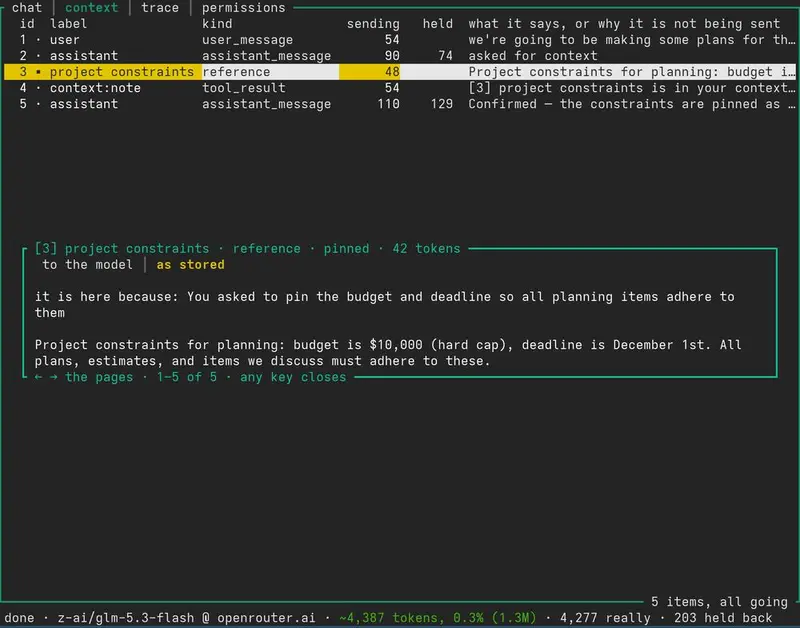
Agent runtime in Rust where the context, tools, permissions and requests are explicit state you can read, change and put back, plus an MCP bridge and the kamchatka terminal agent. The linked example uses Jev for content-aware compaction in that agent.
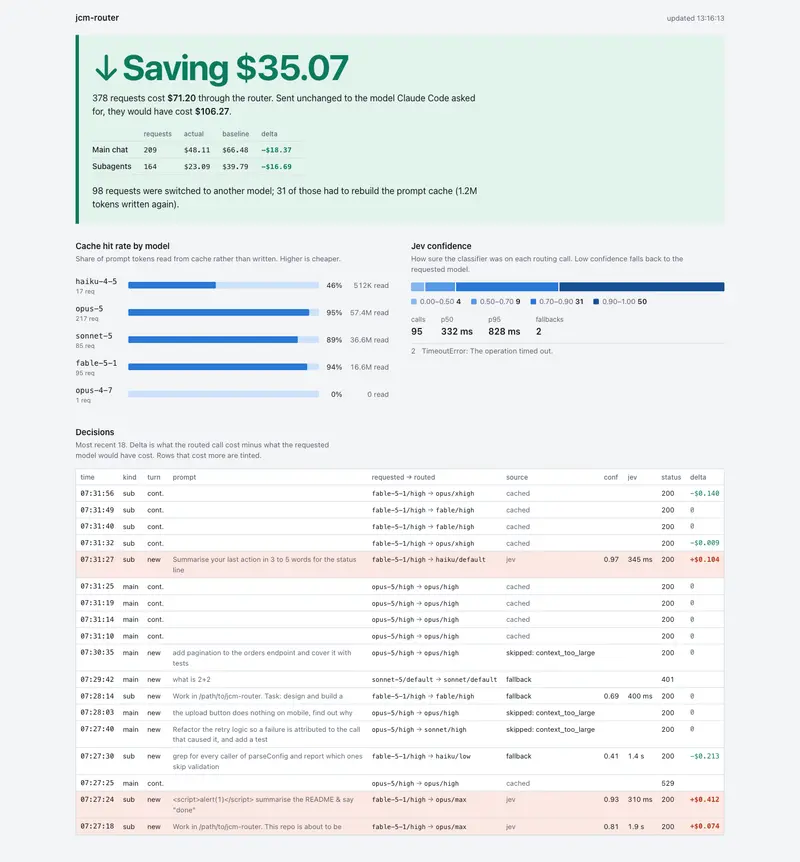
Local proxy between Claude Code and the Anthropic API that picks the model and effort level per message with a Jev decision. The author measured that routing subagents saves money while routing an established main chat loses it: 309 logged requests cost $106.73 against an $87.19 baseline, and $17.12 of the $19.53 loss came from the main chat alone.
A local-first test selector that asks one semantic relevance judgment per test to decide which e2e tests a code change can safely skip, failing open to the full suite on low confidence. Judge is pluggable between classifier.dev, Jev over HTTP, or self-hosted Laya via ONNX Runtime. Ships a bundled GitHub Action.
Go client for TypeSafe's System One API, returning typed judgments and calibrated probabilities instead of generated text. Questions are built in Go and answers are read back as Noul or Score values.
Lets a person or coding agent ask a plain-English question across a repository. Hunch sends each in-scope chunk to Jev and returns scored source locations, without needing to guess which words the code uses.

A Codex plugin that asks Jev which bulky tool results a session still needs, then replaces the rest with a bounded head and a one-line note, so long sessions don't resend stale output on every turn.

Checks an OpenAPI spec for breaking changes hidden in its prose, combining deterministic schema checks with Jev's semantic review.
A zero-dependency library that prunes large tool schema catalogs down to top candidates in 0.4 milliseconds, entirely pre-flight and offline, cutting the tokens spent listing tools by up to 92 percent. The author reports 100 percent on Berkeley's FCL v3 benchmark with Jev.
A client-side inference runtime for Laya-MLX decision models via ONNX Runtime Web, with WebGPU acceleration and automatic Wasm SIMD fallback, runnable in a Web Worker to keep the UI thread responsive.
An MCP server that hands small coding-agent decisions, such as which file to edit or whether a diff breaks tests, to Jev instead of spending reasoning tokens on them. Works with Cursor, Windsurf and Claude Code.
A Rust CLI for Jev with a built-in linter that checks your questions before you spend a call on them.
Nothing matches those filters
Clear a filter to widen the search, or send us the thing you were looking for.


