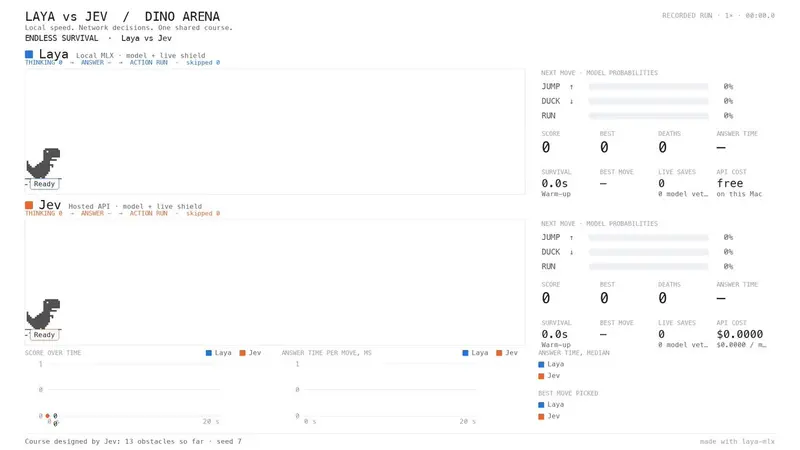
 Play the video in the post below
virajbhartiya/laya-vs-jev on GitHub
- Stars
- 93
- Forks
- 9
- Language
- Python
- License
- Apache-2.0
- Last push
- 21 Sep 2026
Post on X
- Views
- 240,842
- Likes
- 1,658
- Reposts
- 101
Read from GitHub and X on . Counts change daily.
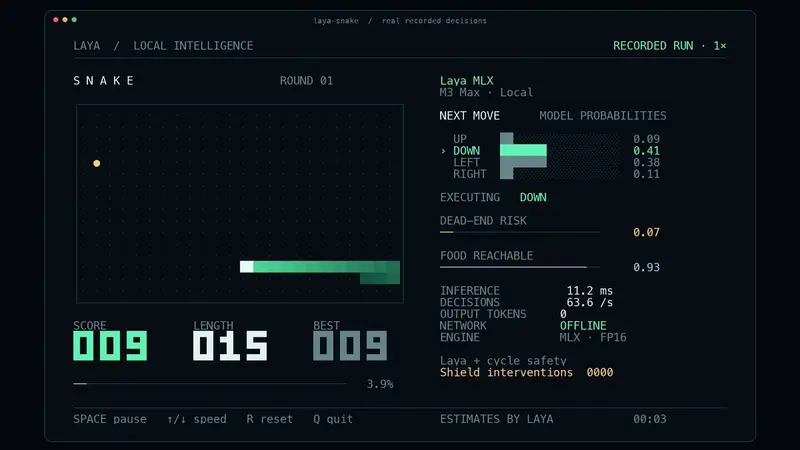
This project races two typed-decision models against each other in a clone of Chrome’s offline dinosaur game: Laya running locally on Apple Silicon through MLX, and Jev called over TypeSafe’s hosted API, both actually controlling their dinosaur’s jumps and ducks on a shared obstacle course rather than following a script. According to the author’s post, Jev also controls the obstacles.
A deterministic physics planner labels the available moves, and each model picks among them, with a safety check able to override an unsafe or stale choice. Because of that override layer, the README is explicit that the recorded scores measure the combined system, not the two models’ decision-making in isolation; a separate best-move statistic tracks how often each model agrees with the planner’s own suggestion instead. The demo records live latency charts, survival streaks and slow-motion replays of crashes, and can run timed three-round matches where a tie is broken by whichever side needed fewer safety interventions.
The project builds on mizorewww’s laya-mlx port for the local Laya side; its documented latency figures are for that library’s own benchmark, not for gameplay in this race.
How it uses Jev
    """
    decision = self.route(state, questions, model=model, task=task, lang=lang)
    agent = self.load(decision["model"])
    result = agent.system_one(state, questions)
    result["routing"] = dict(decision)
    return result

system_one = predict

def __repr__(self):
    return "Router(loaded=%s, max_loaded=%d, default=%r)" % (
        self.loaded,
        self.max_loaded,
        self.default,
    )