tumf/jev-cli
Dependency-free Python CLI that sends text, JSON, files or stdin to Jev and returns machine-readable noul, choice or score answers. Several questions go in one request, and output can be reduced to the primary value for shell scripts.
Entries 193 to 240 of 743, in the hub's default order. The introduction is on page 1.
Showing 193 to 240 of 743

Dependency-free Python CLI that sends text, JSON, files or stdin to Jev and returns machine-readable noul, choice or score answers. Several questions go in one request, and output can be reduced to the primary value for shell scripts.
Agent skill that runs a /jev-me planning interview. Jev scores which questions would change the plan and whether the user's answers actually settle them, and logs the interview for later inspection.

Three runnable experiments: support-message triage producing six independent judgments, a driving simulation where Jev picks lane and target speed against traffic and signs, and an alternative Fable implementation. Shows questions and probability distributions for each call.
Browser-native Doom agent using a Chocolate Doom WebAssembly runtime, structured spatial state, composable AI controls and live decision telemetry.
Rust client for the System One evaluation API with async and blocking backends, Noul, Choice and Score responses deserialised into typed enums, and several judgments batched over one shared state. Retries can be observed step by step and errors stay inspectable.
Open-source LLM router that uses Jev to pick a model, built on LiteLLM. Clients send a single model ID and Jev routes each request; it falls through without a TypeSafe API key.
A minimal grammY Telegram bot that deletes only the messages Jev is confident are spam.

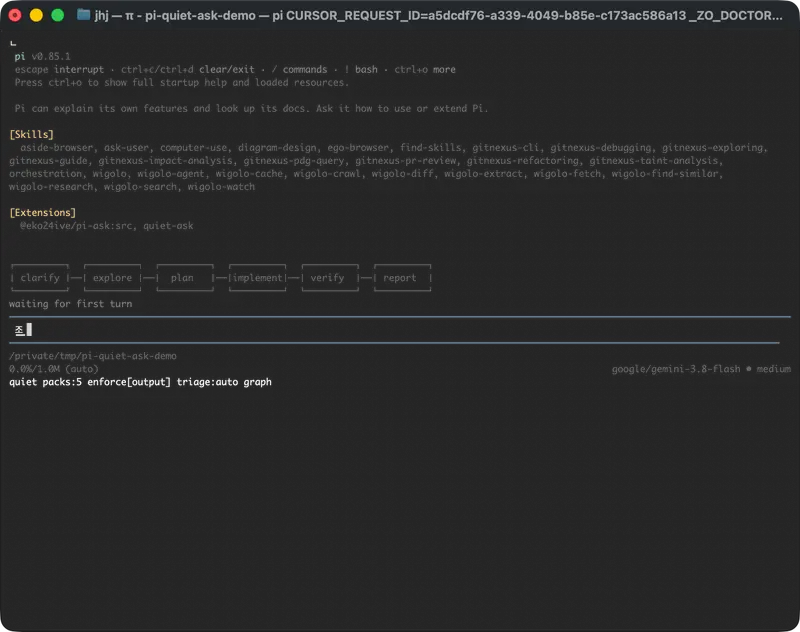
Decision layer for the Pi coding agent, where Jev answers the closed questions a harness asks dozens of times per session: is this command destructive, did that output leak a key, did the agent verify its claim. Rules live in JSON packs, every answer is recorded, and everything fails open.
TypeScript harness that connects evidence to Jev judgments, permitted actions and verified outcomes, with pluggable data sources, local JSONL traces and no runtime dependencies. Marked experimental at V0.2.0, with offline demos and mocked API tests passing.

Scores OpenTelemetry log records with Jev for diagnostic value, priority and routing, so expensive LLM analysis can be skipped for low-value traces. Every record stays in your archive.
Zero-shot robot tasks on a simulated Franka Panda in ManiSkill. Given a plain English goal and the scene, Jev picks one of about 30 hardcoded primitives per step and Python runs it, at roughly one second per pick. No training, demos or policy.
A speed-focused Pi extension that pairs a local coding model with hosted Jev judgments, using file retrieval and exact-result caching to reduce context and repeated network calls.
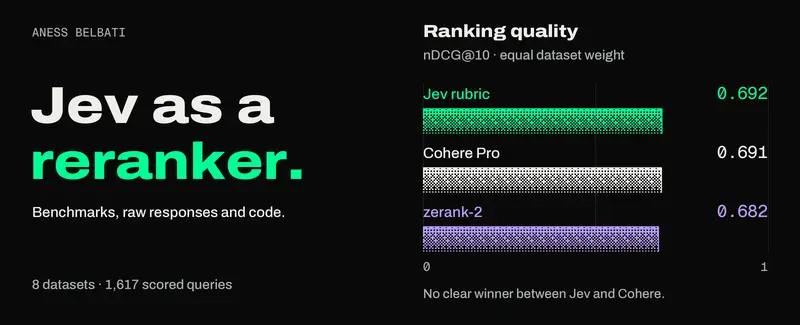
Uses Jev as a calibrated reranker: one relevance question per document, up to 30 documents per call, returning a probability usable both as a ranking score and an absolute threshold. Apache-2.0; benchmarked on SciFact, NFCorpus and FiQA. The repo now redirects to hev/reranker.
A task-boundary model router for the Pi coding agent: Jev judges task tier, context sufficiency and consequences, and deterministic code decides whether to switch models based on your configured capabilities and costs.

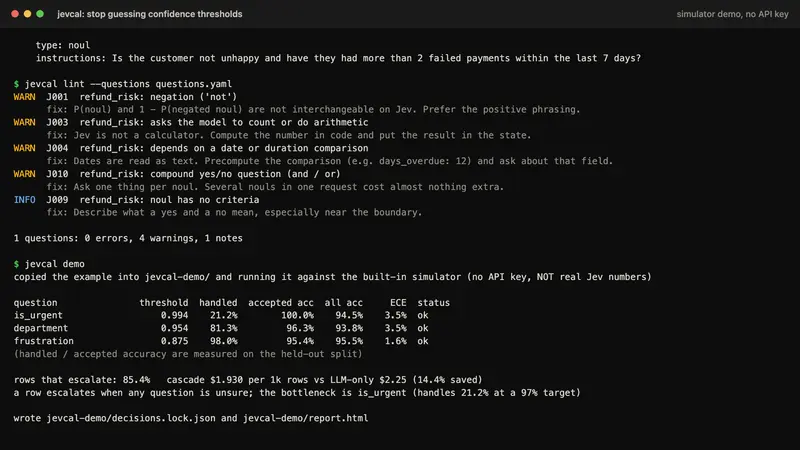
Fits a per-question confidence threshold to your accuracy target on your own labeled data, checks it on a held-out split, reports how much traffic still needs an LLM, and fails CI when a model update breaks the locked thresholds. Publishes no Jev numbers on purpose.
Judges every code file in a pull request against Robert C. Martin's Clean Code with Jev, one calibrated probability per question, then has a writing model turn those findings into two sentences per file and a decision for the change. Runs on Vercel's eve framework as one Next.js project.

Agent skill for designing judgment-assisted systems with Jev, where code stays in control and the model supplies narrow typed judgments. It maps Choice, Score and Noul onto classical methods such as decision theory, reranking and routing, and requires a falsifying experiment before a design is treated as settled.
Async LangGraph workflow that sends an email to Jev, gets back a typed Choice of invoice or general, and routes it to a demo handler. Ships 10 labeled mock emails, and an API failure stops the run rather than assigning a fabricated intent.
A GitHub App that routes pull-request review work: it sends the PR context to Jev, gets back a structured risk decision such as low, normal or specialist, and a policy layer maps that to auto-approval, a review request, or a check-run update.
An independent benchmark of Jev against Laya on 40 Chinese support-ticket classifications, plus a confidence-gated cascade that calls Laya first and escalates to Jev, matching Jev's 78% accuracy at 1.8x the speed.
An experimental language for composing Jev questions into methods, with a standalone Rust runtime and an earlier Python reference implementation kept for comparison.

An omp plugin that scores every old tool output with Jev, keeps what is still needed, and parks the rest on disk, cutting context by 29 to 55 percent across the author's own sessions at about $0.0005 per scoring pass.

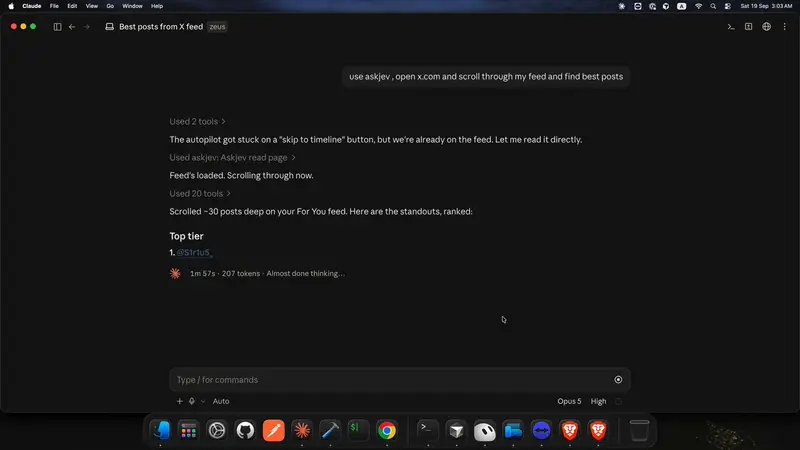
An MCP server and Chrome/Brave extension that lets Claude drive a real browser in plain English, with Jev deciding each click, tab switch, or form fill and a guard freezing irreversible actions.
Laya inference ported to Jolt, running Clojure on Chez Scheme, with a confidence gate that escalates uncertain answers from the Laya encoder to a GGUF chat model scored by token log probabilities.
Recursive Choice over a taxonomy. Jev can only list 255 options in one choice question, so jev-tree walks a JSON shape and calls it once per level or partition, letting you select among thousands of leaves.
Community .NET SDK for the System One API with typed noul, choice and score questions returning confidence-scored answers. States it is not affiliated with TypeSafe AI.
A GitHub Action that asks Jev a set of yes/no questions about a pull request, answered in parallel in one call, and approves it only when every answer clears a confidence threshold you set.
A local browser-agent decider running Laya's open weights, speaking the same /v1/systemone wire format as Jev so existing jev-ultrafast tooling works by changing one base URL. Ships a head-to-head benchmark against hosted Jev.
An experiment that turns Jev's classifier into an autoregressive next-token predictor by having it repeatedly pick the next character from an alphabet of options.
Pure-Rust inference for Laya built on candle, with CPU, Metal and CUDA backends, no Python, torch or ONNX export step, and weights pulled straight from the Apache-2.0 checkpoint.

A CLI that turns AGENTS.md preferences into Jev-checked semantic rules, reviewing code hunks or pull requests with typed choice and noul questions and feeding findings back to a coding agent.
Checks whether each cited paper actually supports the sentence citing it: Claude locates the quote, Jev scores the support, a human makes the final call. Live at verify.papertrellis.com.

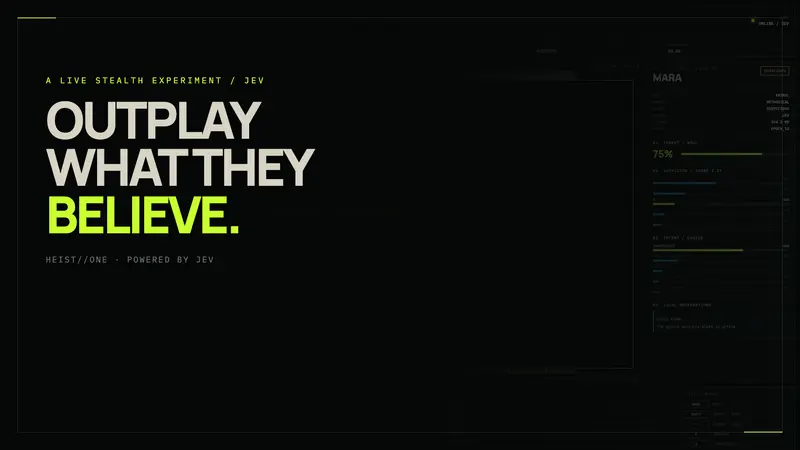
Browser stealth game where Jev makes typed guard judgments while deterministic game code owns all world state.
Paste a public GitHub pull request URL and one Jev call returns risk bars and a verdict. The single request covers merge risk, review depth, whether design or security review is needed, missing tests, docs debt and how wide a bug could spread.
MCP server exposing Jev as typed judgment tools (classify, score, check, batched ask) and shipping as a Claude Code plugin. Runs via npx jev-mcp.
Command line search that asks a yes/no question of every function in a codebase and ranks the answers by the probability that the answer is yes. It is grep whose pattern is a question, not embedding search, and the author measured 1,302 functions of gin-gonic/gin in 3.7 seconds for $0.018.

Benchmark comparing Jev against Cohere Rerank 4, ZeroEntropy zerank-2 and a chat-model baseline across 14 datasets, publishing every raw API response and bootstrap ranges on each gap.
Ruby client for typesafe.ai, MIT licensed, requiring Ruby 3.1+. Defaults to jev-latest.
A TypeScript library for controlling websites with plain-English instructions on top of the full Playwright API, similar to Stagehand but with Jev making the browser decisions instead of a generative LLM.
Reproducible calibration and selective-risk benchmarks for Jev decisions inside DSPy workflows. Runs offline for confidence gating, latency and cost modelling without live API calls.

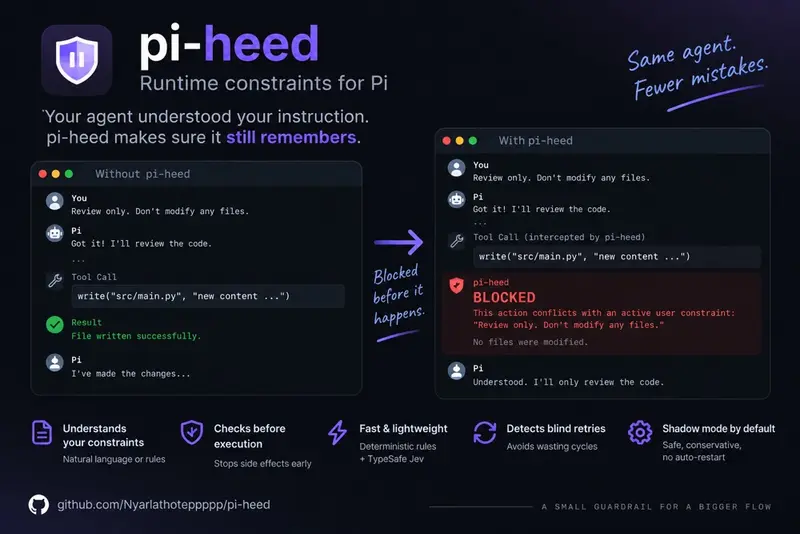
Runtime constraints for the Pi coding agent that check every side-effecting tool call against what you actually said before it runs, using your own words as the reason when it blocks a call.
Combines native Playwright browser operations with Jev decisions over actual page elements, exposed as a typed SDK, a CLI and an MCP server, with native actions running without any AI key.

Runs Laya and Kev decision models inside the browser: a zero-dependency Rust engine compiled to WebAssembly with WebGPU kernels, downloading a pinned int8 model pack and answering choice, score and noul questions with no server or API key.
A pure-Java 17+ SDK that ports the Python Laya decision framework into a deployable inference library, running on Apache 2.0 multilingual checkpoints via ONNX Runtime and the Hugging Face Hub.
Graded relevance eval of a Jev score rerank against BM25, bge-m3 and other rankers over the Agent Skills Hub catalog, with 164 queries, 9,831 labelled pairs and the judge-circularity bias measured. Jev alone does not beat a good embedding ranker, but fusing the two wins even with Jev removed from the judging.
Composable Python toolkit for the Jev decision API bundling question builders, confidence gates, an evaluator, calibration tooling, a CLI, an MCP server over stdio and an agent skill.
Local CV screening workbench that asks Jev a small fixed set of typed questions about each CV in a folder, scores the answers with arithmetic you can read, and shows a sortable shortlist. Judgments are stored apart from the arithmetic, so editing the role policy re-scores every candidate in about 20 ms at no cost.
Hybrid coding harness for the Pi agent: any LLM writes the code while Jev returns typed probabilities, and deterministic policy code turns those into allow, confirm, block, warn or steer. Isolation stays with containers, so it is not a sandbox.
Nothing matches those filters
Clear a filter to widen the search, or send us the thing you were looking for.