Introducing System One Models & Jev
Launch post defining System One models and announcing Jev in early access, with claimed 70-500ms latency versus 3-329s for frontier LLMs and $0.042/MTok input pricing.
Article
Entries 673 to 720 of 743, in the hub's default order. The introduction is on page 1.
Showing 673 to 720 of 743
Launch post defining System One models and announcing Jev in early access, with claimed 70-500ms latency versus 3-329s for frontier LLMs and $0.042/MTok input pricing.

Every's head of evals runs Jev across his own writing. Argues the model turns fuzzy questions into probabilities fast and cheaply enough to check an AI agent's work as it goes.
Official press release announcing a $40M seed round led by DCVC alongside the Jev launch. Fetch returned HTTP 403, so details were taken from search snippets and secondary coverage.
PyPI listing for the official Python SDK, version 0.6.0, MIT licensed. Requires Python 3.10+.
TypeSafe AI blog post from June 2026, three months before the Jev launch. The body did not render when fetched; community lists describe it as the company's argument against using preference-optimized chat models for automation.
MIT-licensed PPO model over BAAI/bge-m3 sequence embeddings that emits turn-by-turn conversion probabilities without generating text (arXiv 2503.23303). Its author claims on Hacker News it is the same non-autoregressive, schema-constrained architecture Jev later shipped, a year earlier.
Official AI SDK provider exposing Jev through the experimental evaluate API in AI SDK 7. Supports Choice (1-255 options), Score (2-10 ordered levels) and Boolean/Noul, batching all questions in one request against the same state.
A 3D robot companion driven by Jev: one call per turn answers nine typed questions, and code decides whether to act, ask or shrug. The panel shows the tracked mood and what the robot decided.
Picks which agent skill to load for a given task by scoring candidate skills against the current state.
Generates and tests candidate features over a dataset by scoring each one with Jev.
Shows how to send many questions about the same state in a single request instead of issuing one call per question.
Uses the confidence value returned with Choice and Score answers to decide when to act automatically and when to escalate.
Filters retrieved passages for relevance before they reach the generation step of a RAG pipeline.
Extracts dates from text using pre-parsing plus Choice questions, working around the documented weakness of jev-1.13 at date arithmetic.
Verifies that each citation in generated text is actually supported by the cited source.
Maps a natural-language request onto a function and its arguments using Choice questions, as a cheaper substitute for LLM tool calling.
Screens LLM inputs and outputs with typed checks so unsafe or off-policy content is caught before it is used.
Classifies into a deep taxonomy by walking the tree one Choice question at a time instead of flattening every leaf into one list.
Decides whether two records refer to the same entity when merging knowledge graphs or databases.
Runs a semantic grep over a file by asking a noul question per line, turning meaning-based lookup into a batch of typed decisions.
Uses code to enumerate candidate values first, then asks Jev to choose among them, avoiding the numeric weaknesses of the model.
Uses Jev scores to re-rank candidate results returned by a first-stage retriever.
Chains cheap Jev decisions in front of expensive steps so only the uncertain cases escalate.
Applies the same repeated-sampling self-consistency check to Choice questions so disagreement between samples becomes a signal to escalate.
Samples a noul question repeatedly and routes uncertain probabilities to human review while keeping the underlying values visible. Worked example uses insurance claim evaluation.
Recovers structured fields from unstructured plain text by asking typed questions rather than prompting an LLM for JSON.
Live demo that tests a post against a crowd of 10,000 AI readers with their own jobs, tastes and memories. Jev answers whether each one likes, dislikes, reposts, follows or blocks, and every reaction comes from an AI reader, not a real person.
Interactive demo that evaluates smart home requests with speculative questions and falls back to an LLM when Jev is uncertain.

Auto mode preset for the DeepSeek Harness coding agent, hosted on a self-run GitLab. At every end prompt, Jev decides whether the agent's open questions can be answered without the human, so full-access runs stay guided by a typed decision.
Browser village where nobody follows a script. Each villager watches what you do, remembers it and decides how to treat you, answering with expressions and actions rather than talk, and a side panel shows the state sent to Jev, the questions asked and the answers returned.
Official page listing what jev-1.13 does badly: literal interpretation, unreliable counting, weak numerics and date ordering, multi-hop indirection, distraction from irrelevant state, and no built-in prompt-injection defence.

Cloudflare Workers AI model catalog page for TypeSafe Jev, documenting the state plus questions request shape and the Noul, Choice and Score answer types. Examples cover ticket routing, refund review and risk assessment.
OpenRouter lists two TypeSafe models, typesafe/jev-latest and typesafe/jev-1.13, both with a 32K context window, at $0.042/M input and $0/M output.
Pac-Man recreation steered by Jev from structured game state. Before each junction the game sends the maze, the actors and the legal directions, and Jev answers with one direction and a probability for each option, with no screenshots, no scripted bot and no hidden pathfinding.
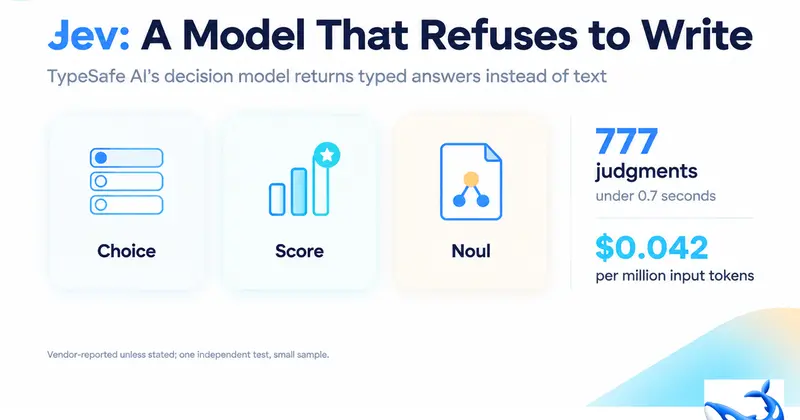
Separates vendor-published numbers from independently observed ones, noting the architecture is unpublished, weights are not released, and the headline benchmark is internal workflow evals rather than a public leaderboard.
Community directory site listing systems built on Jev and the primitives each one sends. Users sign in with GitHub to submit projects from a repo or an X post, and can copy examples into a playground.

Showcase of 342 community projects built with Jev, each page linking to the maker's X post with the demo video. Grouped into eleven categories including Games, Developer tools, Agents, Browser extensions and Robotics.
Benchmark Heaven's own leaderboard for Jev-class decision models, unrelated to the dhruvmehra/jevbench repo, ranking 106 of 112 systems on 1,624 choice, score and noul decisions each in release v1.5.4. Jev 1.13.0 leads on capability at 80.0, while on the four-axis composite that adds speed and cost, Cygnet and Winnow-12B Q8 tie first and Jev is third.
LangChain integration package (0.0.1a2 pre-release, MIT) providing TypeSafeClassifier as a Runnable plus experimental agent middleware: ModelRouterMiddleware, SkillsMiddleware and AutoModeMiddleware for tool-risk gating.
meraGPT's official cookbook for its Decider 1 model: seven recipes, each with a runnable curl, Python and TypeScript request and the unedited output. They cover support triage, confidence gating, phishing and output guardrails, RAG passage filtering, picking an agent's first tool and asking many questions in one call.
Moderation playground that screens text in one System One request: parallel Noul probabilities for profanity, hate, sexual content, violence, illegal help, self-harm and spam or jailbreak, plus a severity Score. The verdict comes from policy thresholds in your code, review at 0.35 and action at 0.70.
Combines several independent score dimensions into a single ranking or decision number.
Uses the returned confidence value as a routing input: act on high confidence, confirm on medium, escalate to a human or an LLM on low.
Classifies an incoming request into an intent with a Choice question and dispatches it to the matching handler.
Sends many questions in one call, including speculative ones, and lets application code decide afterwards which answers matter.
Work-in-progress demo of Jev driving a Minecraft agent, including fleeing zombies at night, as a test of fast structured decisions in a game loop. URL taken from a fetched awesome-jev README; thread not opened.
Thread where builders describe using Jev as an agent tool-use safety layer and plan a prompt-complexity model router on top of it. URL taken from a fetched awesome-jev README; thread not opened.
Launch thread framing Jev as a low-hallucination, low-cost decision model for software rather than a chat model. URL taken verbatim from a fetched awesome-jev README; the thread itself could not be opened, so score, author and date are unconfirmed.
Nothing matches those filters
Clear a filter to widen the search, or send us the thing you were looking for.