Post on X
- Views
- 166,689
- Likes
- 2,020
- Reposts
- 170
Read from X on . Counts change daily.
Reported by the author
- Synthetic accuracy
- ~98%
the one-pass scorer reached about 98% accuracy on synthetic menus
github.com - Speed at 8 options
- ~100x faster
one pass was about 100 times faster than a small decoder forced to write 400 tokens
github.com
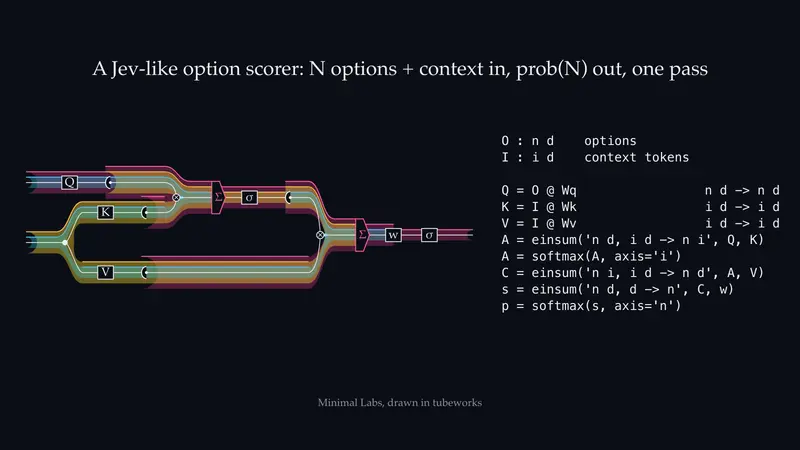
Vincent Wang-Mascianica open-sourced jevlike, a starter model that reproduces Jev’s input and output shape without copying its design, which TypeSafe has not published. A jevlike model takes a piece of text and a changing list of text options, then returns one probability per option in a single pass instead of writing an answer word by word.
The architecture turns each option into a query vector, has it attend over the context to build a matching context vector, then scores the pair with a shared dot product before a softmax turns all the scores into probabilities that sum to one. The default encoder learns byte-level embeddings from scratch, or you can swap in a frozen pretrained Hugging Face encoder behind a small trainable head. The repo includes a demo where the same option-attention head scores controller buttons from image patches to play Doom and chess. The README says those clips were selected for activity and are not competence claims.
On its own benchmarks, the one-pass scorer reached about 98% accuracy on synthetic option menus, and was roughly 100 times faster than a small decoder model writing out 400 tokens at 8 options. On a harder next-click prediction task built from Wikipedia navigation data, a frozen Qwen2.5-0.5B encoder plus the scorer reached 26%, against about 8% for shuffled and random-encoder controls. The README is explicit that these are local experiment numbers, not a reproduction of Jev’s private training method or a claim of matching its quality.