
What Celeris-1 Decision is
Celeris-1 Decision is a System One model from Celeris, a lab that builds diffusion language models for low latency. Tom Hamer announced it on 8 October 2026, and Celeris-1.1 Decision, the current version, on 5 November 2026. You send text, structured data or images and a set of typed questions, and it returns a probability for each outcome. It is a hosted API with no open weights and no fine-tuning.
What it returns
The main endpoint is POST https://inference.celeris.ai/celeris-1-decision/v1/systemone. It implements TypeSafe’s System One API, so code written for Jev with the Jev SDK runs against it once you change the base URL, key and model name. The model name is celeris-1.1-decision, while the URL path keeps celeris-1-decision; moving from the first version needs only the new model name. A second endpoint, POST /v1/decisions, follows the OpenAI Decisions API format. Both serve the same model at the same price.
A Noul returns the probability of yes. A Choice returns a probability per option, and a Score returns a probability per level plus the probability-weighted level. Setting x_celeris.explain adds one sentence per question saying why the model chose its answer. That makes the request slower and cuts the cap from 512 questions to 64.
What it is good at
Celeris’s docs use ticket routing as their example, which maps to support inbox triage and intent and model routing. Its launch post also checks an expense claim against a photo of a receipt, with up to 8 images per request.
The 1.1 launch post reports a median of 36 ms for one question and 44 ms for five, from a GCP us-central1 client, against 99 ms and 98 ms for Jev 1.14.0. The first launch post reported 67 ms for one question and 81 ms for fifty, from an AWS us-east-1 client. Celeris ran those measurements itself, so treat them as vendor-run.
The same post reports results from Celeris’s own decision-benching harness (commit 0cfd276), which called each provider’s endpoint and scored every answer with one scorer. On the 22 datasets and 3,210 items of jev-bench, Celeris-1 Decision scores 0.800 accuracy and 0.272 Brier, against 0.731 and 0.380 for Jev 1.13.0 and 0.790 and 0.288 for pplx-decider-v1.1-27b. A Brier score is the squared distance between the predicted probabilities and the right answer, so lower is better. These figures are vendor-run. The 1.1 post reruns the test on 3,300 items: 0.802 accuracy and 0.274 Brier for Celeris-1.1 Decision, against 0.726 and 0.377 for Jev 1.14.0 and 0.798 and 0.271 for pplx-decider-v1.2. The calibration claim rests only on Brier scores that Celeris computed itself.
Both posts also report typed-decisions results. That benchmark is the one the Decider 1 page describes as built by meraGPT, so this page leaves those figures out.
BenchLM shows the jev-bench numbers and labels them provider-reported, with no overall rank. Benchmark Heaven’s JevBench measured it on its hosted API board on 16 October 2026: a Capability Score of 73.6, from Intelligence 58.9 and Calibration 88.4, against 75.0 for Jev 1.14.
The Artificial Analysis Decision Index is the first independent board to score it. On version 2.1, checked on 12 November 2026, AA names the row Celeris-1.1 Decision, the current version. It scores 62.0, 13th of 19 decision models, against 66.2 for Jev 1.14. It is the fastest and the cheapest of the 19, at 61 ms and $14 per million tasks, against 92 ms and $156 for Jev 1.14. Its When2Call tool-calling accuracy is 87.1%, ninth of the 19. Its calibration error, which this site computed from AA’s published bins, is 0.104, 14th lowest of the 19. On version 1.0, published on 13 October 2026, Celeris-1 Decision scored 52.3 against 57.5 for Jev 1.13, 11th of 17 as of 23 October 2026. Version 2.1 runs six different tests, so the two sets of figures do not compare. It has no row on the Jev Decision Index.
What it is not for
It writes no free text. The only prose is the optional one-sentence explanation. There are no weights to self-host. Images must be base64 data URLs, with no external links.
Access
It is available now through a Celeris API key, with prepaid credit bought by card in the Console. TypeSafe’s typesafe-sdk for Python works with base_url set to https://inference.celeris.ai/celeris-1-decision. Free and promotional credit expires 30 days after it is granted, purchased credit does not expire, and an empty balance returns 402.
Specifications
| System One Score | 85.9 from 2 of 3 boardsArtificial Analysis Decision Index 85.4, JevBench 86.4. How the score works |
| Question types | ChoiceScoreNoul |
| Max Choice options | 512 |
| Score levels | Up to 64 |
| Questions per call | 512 |
| Total context | 131,072 tokens |
| State budget | Not documented |
| Rate limit | Default limits for celeris-1.1-decision are 1,500 requests, 10,000,000 input tokens and 600,000 output tokens per minute, per workspace, shared by all API keys in it, checked 2026-11-12. Celeris calls the numbers a guide that may change. Going over returns HTTP 429 with a Retry-After header, as rate_limit_exceeded or service_busy. Celeris tells customers to contact it for a committed or higher rate. |
| Endpoint | POST https://inference.celeris.ai/celeris-1-decision/v1/systemone |
| Licence | Not published as of 12 Nov 2026 |
| SDKs | Python: typesafe-sdk |
The docs give celeris-1.1-decision a 131,072-token context window, with a fixed part reserved for the answers, so the input limit is slightly lower; the 1.1 launch post calls it 128k tokens. The window was not published as of 9 October 2026. The docs limit a request to 512 questions, or 64 when x_celeris.explain is true, 512 options per Choice, 64 levels per Score, 8 images of up to 25 megapixels each, 100,000 JSON values and an 8 MiB body. Images are base64 data URLs, count as input tokens and are read at the resolution set by x_celeris.max_soft_tokens. External image URLs are not supported. Each response is one JSON body with no streaming.
Versions
- celeris-1.1-decision, 5 Nov 2026, The current version, from the launch post of 5 November 2026. Same endpoint, request format and response format as celeris-1-decision; only the model field changes to celeris-1.1-decision. The URL path keeps the celeris-1-decision segment. $0.004 per million input tokens, output free. Celeris's docs list only this decision model on 12 November 2026. Release notes
- celeris-1-decision, 8 Oct 2026, The first version. The launch post is dated 8 October 2026. At launch the model id in the request body had to match the model segment of the URL path. It cost $0.04 per million input tokens. Celeris's models and pricing docs no longer list it as of 2026-11-12, and do not say whether the id is still served. The docs also serve it at POST /v1/decisions in the OpenAI Decisions API format, with the OpenAI Python SDK 3.26.0 or later. Release notes
Use cases
What people use Celeris-1 Decision for, one page per pattern.
Support inbox triage with System One models
Send a support ticket to Jev once with every question attached. Category comes back as a selected label, severity and frustration as numbers on scales you wrote, refund intent as a probability. Your code reads those values and decides what happens to the ticket.
Intent and model routing with System One models
One Jev call reads an incoming request and returns its intent as a label plus a difficulty rating on a scale you wrote. Your router reads both numbers and picks the handler: deterministic code, a cheap model, an expensive one, or a human queue.
Examples built with Celeris-1 Decision
The most-starred and most-viewed entries in the directory. All Celeris-1 Decision examples.
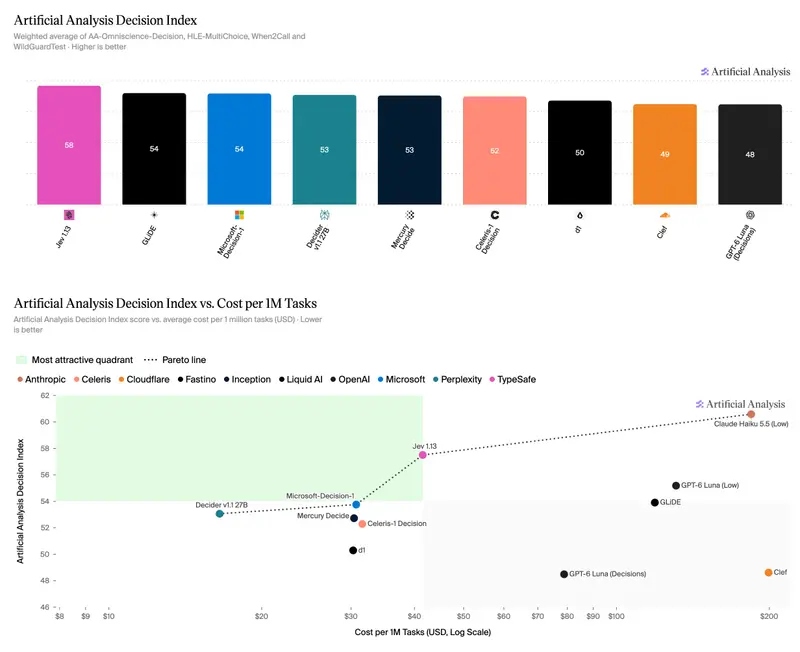
Artificial Analysis Decision Index: 11 hosted decision models against language models
Artificial Analysis scores 11 hosted decision models on knowledge, reasoning, tool-calling and safety tests, with cost and time per task, and runs language models on the same tests. Jev 1.13 led the decision models at launch at 58, and on version 2.1, checked 12 November, Nace.AI's Drex Max v1.1 leads at 72.6; at launch Claude Haiku 5.5 (Low) scores 61 but takes 1.4 seconds per task against 0.13.
 Artificial Analysis (@ArtificialAnlys)45k viewsOpenArtificial Analysis Decision Index: 11 hosted decision models against language models on artificialanalysis.ai
Benchmarks
Published scores, each linked to its source. A row marked vendor-run was measured by the vendor itself, so read it as one side's result. The compare hub sets these beside the other models.
| Benchmark | Metric | Score | Run by | Date |
|---|---|---|---|---|
| Artificial Analysis Decision Index 2.1 | Index score | 62 score | Independent | 12 Nov 2026 |
| Artificial Analysis Decision Index 2.1 | Expected calibration error | 0.1044 ECE | Independent | 12 Nov 2026 |
| Artificial Analysis Decision Index 2.1 | Cost per 1M tasks | 14 USD | Independent | 12 Nov 2026 |
| Artificial Analysis Decision Index 2.1 | Time per task | 61 ms | Independent | 12 Nov 2026 |
| jev-bench (Celeris harness) | Accuracy | 0.802 | vendor-run | 5 Nov 2026 |
| jev-bench (Celeris harness) | Brier score | 0.274 Brier | vendor-run | 5 Nov 2026 |
| JevBench 1.7.47 | Capability Score | 73.6 score | Independent | 16 Oct 2026 |
| Artificial Analysis Decision Index 1.0 | Index score | 52.3 score | Independent | 13 Oct 2026 |
| Artificial Analysis Decision Index 1.0 | Expected calibration error | 0.0842 ECE | Independent | 13 Oct 2026 |
| Artificial Analysis Decision Index 1.0 | Cost per 1M tasks | 32 USD | Independent | 13 Oct 2026 |
| Artificial Analysis Decision Index 1.0 | Time per task | 63 ms | Independent | 13 Oct 2026 |
| jev-bench (Celeris harness) | Accuracy | 0.8 | vendor-run | 8 Oct 2026 |
| jev-bench (Celeris harness) | Brier score | 0.272 Brier | vendor-run | 8 Oct 2026 |
- Artificial Analysis Decision Index, Index score: Row: Celeris-1.1 Decision, host Celeris. Raw value 61.984. 13th of 19 decision models on version 2.1. AA names the row Celeris-1.1 Decision, the current version. Sub-scores: When2Call accuracy 87.1, Omniscience accuracy 33.4, HLE-MultiChoice accuracy 10.6. Version 2.1 figures do not compare with version 1.0 figures.
- Artificial Analysis Decision Index, Expected calibration error: Row: Celeris-1.1 Decision. Computed by this site from AA's published calibration bins (all answers pooled); AA does not publish an ECE. Lower is better.
- Artificial Analysis Decision Index, Cost per 1M tasks: Row: Celeris-1.1 Decision. AA's measured cost per million tasks on its version 2.1 evals.
- Artificial Analysis Decision Index, Time per task: Row: Celeris-1.1 Decision. Time per task.
- jev-bench (Celeris harness), Accuracy: Celeris-1.1 Decision. 3,300 items, 150 from each of 22 datasets, run by Celeris from GCP us-central1-a; Jev 1.14.0 scored 0.726 and pplx-decider-v1.2 0.798.
- jev-bench (Celeris harness), Brier score: Celeris-1.1 Decision, same run; lower is better, Jev 1.14.0 scored 0.377 and pplx-decider-v1.2 0.271.
- JevBench, Capability Score: Row: Celeris-1 Decision, measured 2026-10-16. Intelligence 58.9, Calibration 88.4. Ranked on the hosted API board.
- Artificial Analysis Decision Index, Index score: Row: Celeris-1 Decision. Sub-scores: Omniscience accuracy 37.8, non-hallucination 0.0, HLE-MultiChoice 13.3, When2Call 83.7, WildGuardTest F1 93.3.
- Artificial Analysis Decision Index, Expected calibration error: Row: Celeris-1 Decision. Computed by this site from AA's published calibration bins (all answers pooled); AA does not publish an ECE. Lower is better.
- Artificial Analysis Decision Index, Cost per 1M tasks: Row: Celeris-1 Decision. AA's measured cost at list prices on its four evals.
- Artificial Analysis Decision Index, Time per task: Row: Celeris-1 Decision. Median time per task.
- jev-bench (Celeris harness), Accuracy: Celeris-1 Decision. 22 datasets, 3,210 items, run by Celeris; Jev 1.13.0 scored 0.731.
- jev-bench (Celeris harness), Brier score: Celeris-1 Decision, same run; lower is better, Jev 1.13.0 scored 0.380.